
Homework Answers
21 (a)
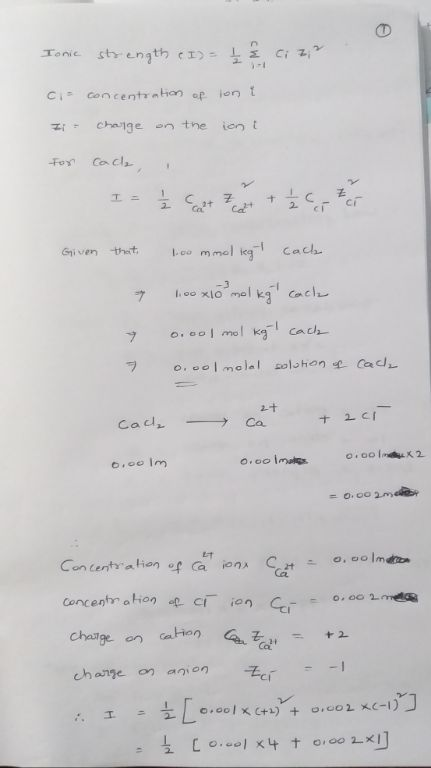
![=> LE - 12.004 + 0.002] 1 [0.006) 2 1 0.003 Tonic strenth of a Innal kat of cach, sol? is 0.003 Accordig to Debye tuckel Limi](http://img.homeworklib.com/questions/91c74da0-8082-11eb-89fe-83dd631f613d.png?x-oss-process=image/resize,w_560)
(b)
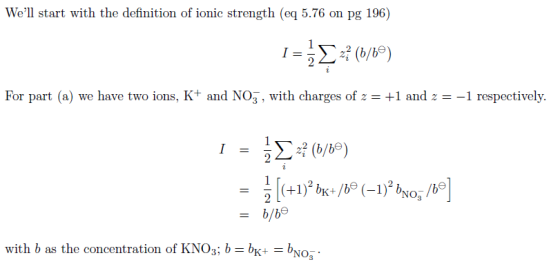
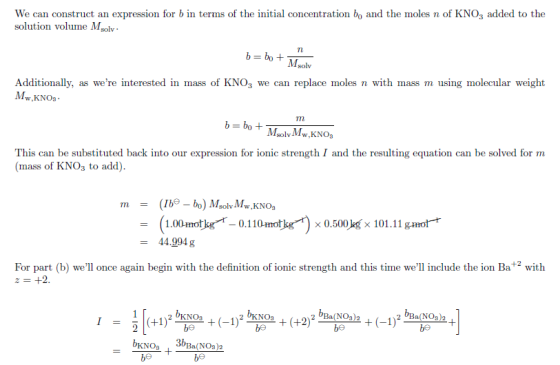
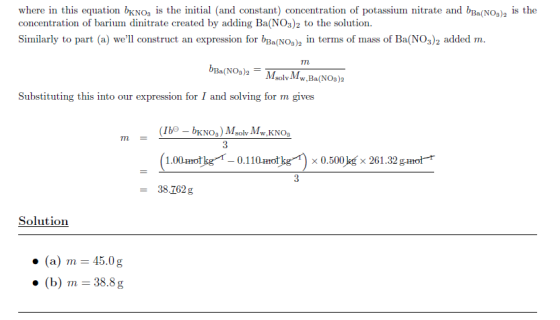
Your one thumbs up will help me lot. Thanks!
Add Answer to:
21 Calculate the ionic strength and the mean activity coefficient of 1.00 mmol kg CaCl, (aq)...
Calculate the masses of (a) Ca(NO3)2 and, separately, (b) NaCl to add to a 0.150 mol/kg...
Calculate the masses of (a) Ca(NO3)2 and, separately, (b) NaCl to add to a 0.150 mol/kg solution of KNO3 (aq) containing 500.0 g of solvent to raise its ionic strength to 0.20.
Estimate the mean ionic activity coefficient and activity of a solution at 25 °C that is...
Estimate the mean ionic activity coefficient and activity of a solution at 25 °C that is 0.020 mol kg−1 NaCl(aq) and 0.035 mol kg−1 Ca(NO3)2(aq).
Estimate the mean ionic activity coefficient for CaCl2 in a solution that is 0.010 mol kg-1...
Estimate the mean ionic activity coefficient for CaCl2 in a solution that is 0.010 mol kg-1 CaCl2(aq) and 0.030 mol kg-1 NaF(aq).
True or fault The mean Ionic activity coefficient of a solution containing 0.05 mol Ca_3(PO_4)_2/kg H_2O...
 True or fault
The mean Ionic activity coefficient of a solution containing 0.05 mol Ca_3(PO_4)_2/kg H_2O and 0.05 mol FeCl_2/kg H_2O does not exceed 1.0.
True or fault
The mean Ionic activity coefficient of a solution containing 0.05 mol Ca_3(PO_4)_2/kg H_2O and 0.05 mol FeCl_2/kg H_2O does not exceed 1.0.
Calculate the activity coefficient, y, of Snt when the ionic strength of the solution, , is...
 Calculate the activity coefficient, y, of Snt when the ionic strength of the solution, , is 0.062 M by linear interpolation of the data in the table. Ionic strength (H, M) 0.001 Activity coefficient (75m?) 0.870 0.005 0.43 0.749 YSa+= 0.01 0.05 10.1 0.675 0.485 0.405 Calculate the activity coefficient, y of Snt when the ionic strength of the solution, , is 0.062 M by using the extended Debye-Hückel equation at 25 °C, where the ion size is 600 pm....
Calculate the activity coefficient, γ, of Sn2+ when the ionic strength of the solution, μ, is...
Calculate the activity coefficient, γ, of Sn2+ when the ionic strength of the solution, μ, is 0.059 M by linear interpolation of the data in the table. Ionic strength (μ, M) Activity coefficient (γSn2+) 0.001 0.870 0.005 0.749 0.01 0.675 0.05 0.485 0.1 0.405 γSn2+= Calculate the activity coefficient, γ, of Sn2+ when the ionic strength of the solution, μ, is 0.059 M by using the extended Debye-Hückel equation at 25 °C, where the ion size is 600 pm. γSn2+=
Question 6 of 11 Calculate the activity coefficient, y, of Ca2 when the ionic Y. Ionic Activity strength of the sol...
 Question 6 of 11 Calculate the activity coefficient, y, of Ca2 when the ionic Y. Ionic Activity strength of the solution, , is 0.083 M by linear interpolation of the data in the table. strength (и, М) coefficient (YCa) 0.001 0.870 0.005 0.749 YCa+ 0.01 0.675 0.05 0.485 Calculate the activity coefficient, y, of Ca2+ when the ionic strength of the solution, u, is 0.083 M by using the extended Debye-Hückel equation at 25 °C, where the ion size is...
Calculate the ionic strength of a solution that is 0.040 mol kg-1 in K3[Fe(CN)6] (aq), 0.030...
Calculate the ionic strength of a solution that is 0.040 mol kg-1 in K3[Fe(CN)6] (aq), 0.030 mol kg-1 in KCl (aq), and 0.050 mol kg-1 in NaBr (aq)
Calculate the activity coefficient, ?, of Cu2 when the ionic strength of the solution, ? ,...
 Calculate the activity coefficient, ?, of Cu2 when the ionic
strength of the solution, ? , is 0.078 M:
(a) by linear interpolation of the data in the table to the
right;
yCu2+ = 0.440
(b) by using the extended Debye-Huckel equation at 25°C, where
the ion size is 600 pm.
yCu2+ =
answer to part a is correct.
ionic strength (,M)
activity coeffient
Cu2+
0.001
0.870
0.005
0.749
0.01
0.675
0.05
0.485
0.1
0.405
Calculate the activity coefficient, ?, of Cu2 when the ionic
strength of the solution, ? , is 0.078 M:
(a) by linear interpolation of the data in the table to the
right;
yCu2+ = 0.440
(b) by using the extended Debye-Huckel equation at 25°C, where
the ion size is 600 pm.
yCu2+ =
answer to part a is correct.
ionic strength (,M)
activity coeffient
Cu2+
0.001
0.870
0.005
0.749
0.01
0.675
0.05
0.485
0.1
0.405
Q2. Using the limiting law, Calculate the mean ionic activity coefficient at 25°C in water of...
 Q2. Using the limiting law, Calculate the mean ionic activity coefficient at 25°C in water of 0.001 m of CaCl,.
 True or fault
The mean Ionic activity coefficient of a solution containing 0.05 mol Ca_3(PO_4)_2/kg H_2O and 0.05 mol FeCl_2/kg H_2O does not exceed 1.0.
True or fault
The mean Ionic activity coefficient of a solution containing 0.05 mol Ca_3(PO_4)_2/kg H_2O and 0.05 mol FeCl_2/kg H_2O does not exceed 1.0.
 Calculate the activity coefficient, y, of Snt when the ionic strength of the solution, , is 0.062 M by linear interpolation of the data in the table. Ionic strength (H, M) 0.001 Activity coefficient (75m?) 0.870 0.005 0.43 0.749 YSa+= 0.01 0.05 10.1 0.675 0.485 0.405 Calculate the activity coefficient, y of Snt when the ionic strength of the solution, , is 0.062 M by using the extended Debye-Hückel equation at 25 °C, where the ion size is 600 pm....
 Question 6 of 11 Calculate the activity coefficient, y, of Ca2 when the ionic Y. Ionic Activity strength of the solution, , is 0.083 M by linear interpolation of the data in the table. strength (и, М) coefficient (YCa) 0.001 0.870 0.005 0.749 YCa+ 0.01 0.675 0.05 0.485 Calculate the activity coefficient, y, of Ca2+ when the ionic strength of the solution, u, is 0.083 M by using the extended Debye-Hückel equation at 25 °C, where the ion size is...
 Calculate the activity coefficient, ?, of Cu2 when the ionic
strength of the solution, ? , is 0.078 M:
(a) by linear interpolation of the data in the table to the
right;
yCu2+ = 0.440
(b) by using the extended Debye-Huckel equation at 25°C, where
the ion size is 600 pm.
yCu2+ =
answer to part a is correct.
ionic strength (,M)
activity coeffient
Cu2+
0.001
0.870
0.005
0.749
0.01
0.675
0.05
0.485
0.1
0.405
Calculate the activity coefficient, ?, of Cu2 when the ionic
strength of the solution, ? , is 0.078 M:
(a) by linear interpolation of the data in the table to the
right;
yCu2+ = 0.440
(b) by using the extended Debye-Huckel equation at 25°C, where
the ion size is 600 pm.
yCu2+ =
answer to part a is correct.
ionic strength (,M)
activity coeffient
Cu2+
0.001
0.870
0.005
0.749
0.01
0.675
0.05
0.485
0.1
0.405
 Q2. Using the limiting law, Calculate the mean ionic activity coefficient at 25°C in water of 0.001 m of CaCl,.
Most questions answered within 3 hours.
-
Where is the error in this code sequence?
String s1 = "Hello";
String s2 = "ello";...
asked 10 months ago -
Financial data for Joel de Paris, Inc., for last year
follow:
Joel de Paris, Inc.
Balance...
asked 10 months ago -
Consider this reaction:
Al2(SO4)3 (aq)+ BaCl3
(aq) Al2Cl6 (aq)- +
3BaSO4(s) . What is the...
asked 10 months ago -
Suppose that Savneet is considering increasing her
recent random sample from 20 car rentals to 40...
asked 10 months ago -
Trucks arrive at an unloading terminal at an average rate of 120
per hour.
Trucks arrive...
asked 10 months ago -
Why are methanol and ethanol completely soluble in water while
octanol is not very little soluble....
asked 10 months ago -
A facilities manager at a university reads in a research report
that the mean amount of...
asked 10 months ago -
When the CuSO4 is rehydrated by adding water to the anhydrous
compound, is this an endothermic...
asked 10 months ago -
A ray of sunlight is passing from diamond into crown glass; the
angle of incidence is...
asked 10 months ago -
A block of mass 0.249 kg is placed on top of a light, vertical
spring of...
asked 10 months ago -
how do the kidneys compensate in the presences of acidosis
a) trigger hyperventilate
b) reserve acid...
asked 10 months ago -
Question 501 pts
The rental rate of capital to the firm increases. Which of the
following...
asked 10 months ago