
Homework Answers
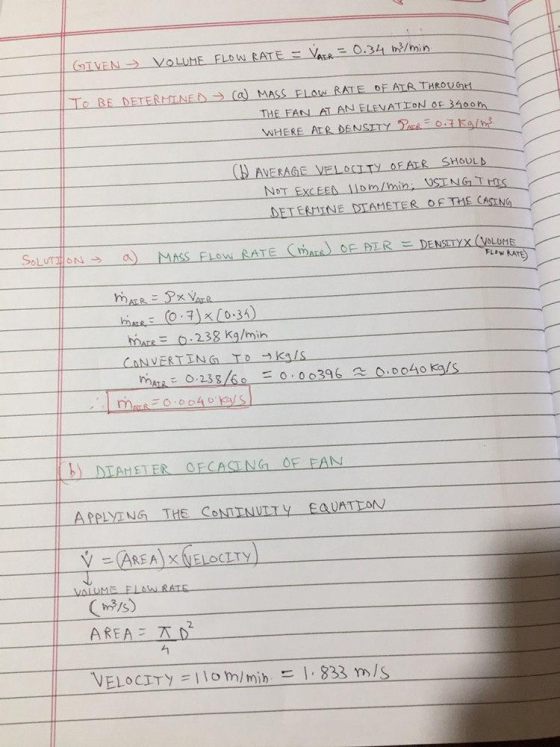
Part a of the question can easily be solved by applying the relation between MASS FLOW RATE, DENSITY & VOLUME FLOW RATE.
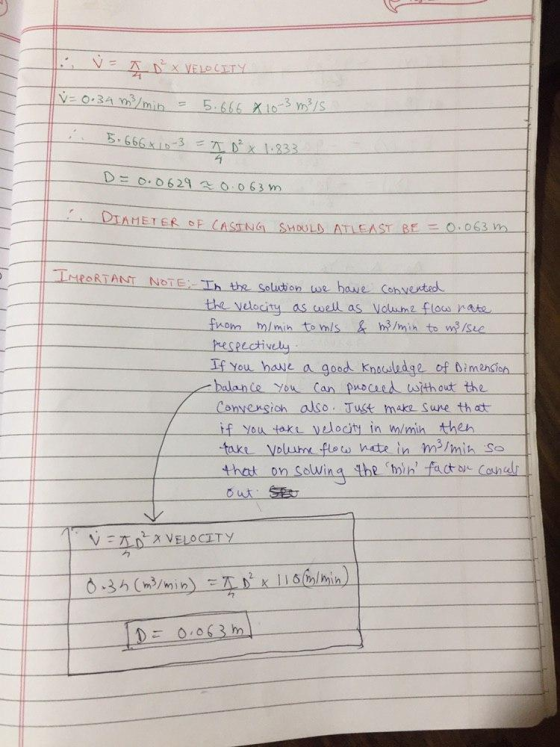
Part b of the question can easily be solved by applying the CONTINUITY EQUATION.
REFER TO THE IMAGES ATTACHED BELOW FOR THE FULL SOLUTION
Add Answer to:
Question 2 A desktop computer is to be cooled by a fan whose volume flow rate...
11: The state of liquid water is changed from 500 psia and 50°F to 3000 psia...
 11: The state of liquid water is changed from 500 psia and 50°F to 3000 psia and 300°F. Determine the change in the internal energy and enthalpy of water on the basis of the (a) compressed liquid tables, (b) incompressible substance approximation and property tables, and (c) specific-heat model. 12: A 2-m3 rigid tank initially contains air whose density is 2.18 kg/m2. The tank is connected to a high- pressure supply line through a valve. The valve is opened, and...
hair dryer may be idealized as a circular duct through which a small fan draws ambient...
 hair dryer may be idealized as a circular duct through which a
small fan draws ambient air and within which the air is heated as
it flows over a coiled electric resistance wire.
(1) If a dryer is designed to operate with an electric power
consumption of Pelec= 1500 W and to heat air from an ambient
temperature of Ti= 20°C to a discharge temperature of To= 45°C, at
what volumetric flow rate ∀˙ should the fan operate? Heat loss...
hair dryer may be idealized as a circular duct through which a
small fan draws ambient air and within which the air is heated as
it flows over a coiled electric resistance wire.
(1) If a dryer is designed to operate with an electric power
consumption of Pelec= 1500 W and to heat air from an ambient
temperature of Ti= 20°C to a discharge temperature of To= 45°C, at
what volumetric flow rate ∀˙ should the fan operate? Heat loss...
A fan draws air from the atmosphere through a 0.3 m diameter round duct that has a smoothly round...
 A fan draws air from the atmosphere through a 0.3 m diameter
round duct that has a smoothly rounded entrance. A differential
manometer connected to an opening in the wall of the duct shows a
vacuum pressure of 2.5 cm of water. The density of air is 1.22
kg/m3.
(a) Determine the volume rate of air flow in the duct in cubic
feet per second.
(b) What is the power of the fan?
Fan 0.30 m 2.5 cm
Fan 0.30...
A fan draws air from the atmosphere through a 0.3 m diameter
round duct that has a smoothly rounded entrance. A differential
manometer connected to an opening in the wall of the duct shows a
vacuum pressure of 2.5 cm of water. The density of air is 1.22
kg/m3.
(a) Determine the volume rate of air flow in the duct in cubic
feet per second.
(b) What is the power of the fan?
Fan 0.30 m 2.5 cm
Fan 0.30...
The mass flow rate of water through a 2.50 cm inner diameter iron pipe is 7.73...
The mass flow rate of water through a 2.50 cm inner diameter iron pipe is 7.73 kg/min. Given that the density of water is 1000 kg/m3 , what is the LINEAR velocity, v, of water moving through the pipe in meters/minute? A. 7.64 m/min B. 10.3 m/min C. 15.7 m/min D. 24.2 m/min E. 30.6 m/min
1) inside D = OD - 2 (thickness t) A (Area) =pi/4 (D^2) Volumetric flow (V)=...
 1) inside D = OD - 2 (thickness t)
A (Area) =pi/4 (D^2)
Volumetric flow (V)= (C m/s) (A m^2)
C=velocity
I can't figure out the density kg/m^3
rho= 1/v (m^3/kg) - specific volume
A fluid that has a relative density of 0.013 is passed through a pipe that has an outer diameter of 98 mm and a wall thickness of 10 mm. The mass flow rate of the fluid measured to be 660 kg/min, determine the average velocity of...
1) inside D = OD - 2 (thickness t)
A (Area) =pi/4 (D^2)
Volumetric flow (V)= (C m/s) (A m^2)
C=velocity
I can't figure out the density kg/m^3
rho= 1/v (m^3/kg) - specific volume
A fluid that has a relative density of 0.013 is passed through a pipe that has an outer diameter of 98 mm and a wall thickness of 10 mm. The mass flow rate of the fluid measured to be 660 kg/min, determine the average velocity of...
A house built on a riverside is to be cooled in summer by utilizing the cool...
A house built on a riverside is to be cooled in summer by utilizing the cool water of the river, which flows at an average temperature of 15°C. A 17.8-m-long section of a circular duct of 20-cm diameter passes through the water. Air enters the underwater section of the duct at 39°C at a velocity of 3 m/s. Assuming the surface of the duct to be at the temperature of the water, determine the outlet temperature of air as it...
Water at 20°C flows in a steel pipe whose diameter is 26.65 mm. The volume flow...
 Water at 20°C flows in a steel pipe whose diameter is 26.65 mm. The volume flow rate of the water in the pipe is measured to be 3.155 x 10⁻⁴ 3/s. The density at this temperature is given as 998.2 kg/m3. The mass flow rate is: m 0.315 kg/s | 1.22 kg/s O 0.522 kg/s O 0.575 kg/s 0.419 kg/s Previous Page Next Page Page 8 of 25
A refrigerant enters a control volume in a steady state through a pipe of 1.6 cm...
A refrigerant enters a control volume in a steady state through a pipe of 1.6 cm internal diameter with a velocity of 4.43 m/s. It’s specific volume is 23.06 cm3 /g. Determine it’s mass flow rate in kg/min
5. Refrigerant-134a at 700kPa, 70°C, and 8 kg/min is cooled by air in a condenser until...
 5. Refrigerant-134a at 700kPa, 70°C, and 8 kg/min is cooled by air in a condenser until it exits as a saturated liquid at the same pressure. The cooling air enters the condenser at 1MPa and 10°C and leaves at 17°C at the same pressure. Determine: a) Considering only the Refrigerant as a system, the heat transfer rate of a refrigerant from the condenser in (kl/min). R-134a Tables are attached! b) The mass flow rate of the air required for cooling...
CHE 3315 FLUID MECHANICS PROBLEM SHEET 5: MASS CONSERVATION AND FLOW RATE 1. Determine the mass...
 CHE 3315 FLUID MECHANICS PROBLEM SHEET 5: MASS CONSERVATION AND FLOW RATE 1. Determine the mass flow rate of air having a temperature of 20C and gauge pressure 80 kPa as it flows through a circular duct 400 mm in diameter with an average velocity of 3 m/s. The gas specific constant R 286.9 JK /kg 2. Determine the average velocity of the steady flow at one outlet of a T- junction if the inlet flow speed is 6 m/s...
 11: The state of liquid water is changed from 500 psia and 50°F to 3000 psia and 300°F. Determine the change in the internal energy and enthalpy of water on the basis of the (a) compressed liquid tables, (b) incompressible substance approximation and property tables, and (c) specific-heat model. 12: A 2-m3 rigid tank initially contains air whose density is 2.18 kg/m2. The tank is connected to a high- pressure supply line through a valve. The valve is opened, and...
 hair dryer may be idealized as a circular duct through which a
small fan draws ambient air and within which the air is heated as
it flows over a coiled electric resistance wire.
(1) If a dryer is designed to operate with an electric power
consumption of Pelec= 1500 W and to heat air from an ambient
temperature of Ti= 20°C to a discharge temperature of To= 45°C, at
what volumetric flow rate ∀˙ should the fan operate? Heat loss...
hair dryer may be idealized as a circular duct through which a
small fan draws ambient air and within which the air is heated as
it flows over a coiled electric resistance wire.
(1) If a dryer is designed to operate with an electric power
consumption of Pelec= 1500 W and to heat air from an ambient
temperature of Ti= 20°C to a discharge temperature of To= 45°C, at
what volumetric flow rate ∀˙ should the fan operate? Heat loss...
 A fan draws air from the atmosphere through a 0.3 m diameter
round duct that has a smoothly rounded entrance. A differential
manometer connected to an opening in the wall of the duct shows a
vacuum pressure of 2.5 cm of water. The density of air is 1.22
kg/m3.
(a) Determine the volume rate of air flow in the duct in cubic
feet per second.
(b) What is the power of the fan?
Fan 0.30 m 2.5 cm
Fan 0.30...
A fan draws air from the atmosphere through a 0.3 m diameter
round duct that has a smoothly rounded entrance. A differential
manometer connected to an opening in the wall of the duct shows a
vacuum pressure of 2.5 cm of water. The density of air is 1.22
kg/m3.
(a) Determine the volume rate of air flow in the duct in cubic
feet per second.
(b) What is the power of the fan?
Fan 0.30 m 2.5 cm
Fan 0.30...
 1) inside D = OD - 2 (thickness t)
A (Area) =pi/4 (D^2)
Volumetric flow (V)= (C m/s) (A m^2)
C=velocity
I can't figure out the density kg/m^3
rho= 1/v (m^3/kg) - specific volume
A fluid that has a relative density of 0.013 is passed through a pipe that has an outer diameter of 98 mm and a wall thickness of 10 mm. The mass flow rate of the fluid measured to be 660 kg/min, determine the average velocity of...
1) inside D = OD - 2 (thickness t)
A (Area) =pi/4 (D^2)
Volumetric flow (V)= (C m/s) (A m^2)
C=velocity
I can't figure out the density kg/m^3
rho= 1/v (m^3/kg) - specific volume
A fluid that has a relative density of 0.013 is passed through a pipe that has an outer diameter of 98 mm and a wall thickness of 10 mm. The mass flow rate of the fluid measured to be 660 kg/min, determine the average velocity of...
 Water at 20°C flows in a steel pipe whose diameter is 26.65 mm. The volume flow rate of the water in the pipe is measured to be 3.155 x 10⁻⁴ 3/s. The density at this temperature is given as 998.2 kg/m3. The mass flow rate is: m 0.315 kg/s | 1.22 kg/s O 0.522 kg/s O 0.575 kg/s 0.419 kg/s Previous Page Next Page Page 8 of 25
 5. Refrigerant-134a at 700kPa, 70°C, and 8 kg/min is cooled by air in a condenser until it exits as a saturated liquid at the same pressure. The cooling air enters the condenser at 1MPa and 10°C and leaves at 17°C at the same pressure. Determine: a) Considering only the Refrigerant as a system, the heat transfer rate of a refrigerant from the condenser in (kl/min). R-134a Tables are attached! b) The mass flow rate of the air required for cooling...
 CHE 3315 FLUID MECHANICS PROBLEM SHEET 5: MASS CONSERVATION AND FLOW RATE 1. Determine the mass flow rate of air having a temperature of 20C and gauge pressure 80 kPa as it flows through a circular duct 400 mm in diameter with an average velocity of 3 m/s. The gas specific constant R 286.9 JK /kg 2. Determine the average velocity of the steady flow at one outlet of a T- junction if the inlet flow speed is 6 m/s...
Most questions answered within 3 hours.
-
Where is the error in this code sequence?
String s1 = "Hello";
String s2 = "ello";...
asked 10 months ago -
Financial data for Joel de Paris, Inc., for last year
follow:
Joel de Paris, Inc.
Balance...
asked 10 months ago -
Consider this reaction:
Al2(SO4)3 (aq)+ BaCl3
(aq) Al2Cl6 (aq)- +
3BaSO4(s) . What is the...
asked 10 months ago -
Suppose that Savneet is considering increasing her
recent random sample from 20 car rentals to 40...
asked 10 months ago -
Trucks arrive at an unloading terminal at an average rate of 120
per hour.
Trucks arrive...
asked 10 months ago -
Why are methanol and ethanol completely soluble in water while
octanol is not very little soluble....
asked 10 months ago -
A facilities manager at a university reads in a research report
that the mean amount of...
asked 10 months ago -
When the CuSO4 is rehydrated by adding water to the anhydrous
compound, is this an endothermic...
asked 10 months ago -
A ray of sunlight is passing from diamond into crown glass; the
angle of incidence is...
asked 10 months ago -
A block of mass 0.249 kg is placed on top of a light, vertical
spring of...
asked 10 months ago -
how do the kidneys compensate in the presences of acidosis
a) trigger hyperventilate
b) reserve acid...
asked 10 months ago -
Question 501 pts
The rental rate of capital to the firm increases. Which of the
following...
asked 10 months ago