A. Based on this question: The reaction between nitrogen and oxygen is given below: N2(g) +...
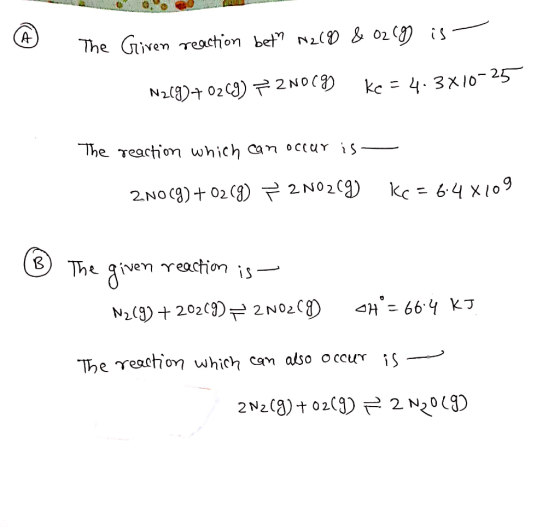
A. Based on this question: The reaction between nitrogen and oxygen is given below: N2(g) + O2(g) +2 NO(g)
We therefore know that which of the following reactions can also occur?
Check which reaction below can occur based on the reaction between nitrogen and oxygen given at N2(g) + O2(g) +2 NO(g)
2 NO(g) + O2(g) 2 NO2(g)
2 NO(g) N2(g) + O2(g)
2 NO2(g) 2 NO(g) + O2(g)
or none of the above
B. Based on this question: The reaction between nitrogen and oxygen is given below: N2(g) + 2 O2(g) +2 NO2(g)
We therefore know that which of the following reactions can also occur?
Check which reaction below can occur based on the reaction between nitrogen and oxygen given at N2(g) + 2 O2(g) +2 NO2(g)
2 N2O(g) 2 N2(g) + O2(g)
PbCl2(s) Pb2+(aq) + 2 Cl-(aq)
2 N2(g) + O2(g) 2 N2O(g)
or none of the above
Homework Answers
Add Answer to:
A. Based on this question: The reaction between nitrogen and
oxygen is given below: N2(g) +...
The nitrogen-monoxide-catalyzed decomposition of dinitrogen monoxide is thought to proceed by a two-step mechanism: NO(g) +...
The nitrogen-monoxide-catalyzed decomposition of dinitrogen monoxide is thought to proceed by a two-step mechanism: NO(g) + N2O(g) --> N2(g) + NO2(g) (slow) 2 NO2(g) --> 2 NO(g) + O2(g) (a) If the first step of this mechanism is rate-determining (slow), choose the correct rate law for the overall process. Rate = k [N2O]2 Rate = k [NO] [NO2] Rate = k [N2O]2 [N2O] Rate = k [NO2] [N2O] Rate = k [N2O] [N2O] Rate = k [NO] [N2O] (b) Choose...
the reaction between oxygen and nitrogen gases at high temperatures contribute to air pollution: N2(g) +...
the reaction between oxygen and nitrogen gases at high temperatures contribute to air pollution: N2(g) + O2 = 2 NO ; Kc 1.0*10^-5 at 1500 K ; suppose air has [N2] = 0.080 M and [O2] =0.020 M what is the concentration of NO at equilibrium (do it using small x approximation and don't use quadratic formula)
The concentrations of nitrogen and oxygen are determined to be 0.0837 M N2 and 0.536 M...
The concentrations of nitrogen and oxygen are determined to be 0.0837 M N2 and 0.536 M O2 at 25°C. What is the concentration of N2O at equilibrium if the equilibrium constant at 25°C is 5.39 x 10 - 8. 2 N2(g) + O2(g) ↔ 2 N2O(g)
All of the following equations for the reaction between nitrogen, N2 and oxygen, O2 to produce...
All of the following equations for the reaction between nitrogen, N2 and oxygen, O2 to produce dinitrogen pentoxide, N2O5 are balanced. However, which of them is normally chosen by convention to represent the balanced equation for this reaction? Select one: a. 12 N2 + 60 O2 --> 12 N2O5 b. 4 N2 + 10 O2 --> 4 N2O5 c. 10 N2 + 25 O2 --> 10 N2O5 d. 2 N2 + 5 O2 --> 2 N2O5
3. Consider the reaction between nitrogen and oxygen to form dinitrogen monoxide: 2 N2(g) + O2(g)...
 3. Consider the reaction between nitrogen and oxygen to form dinitrogen monoxide: 2 N2(g) + O2(g) → 2N2O(g) AH = 163.2 kJ more a. Calculate the entropy change in the surroundings associated with this process at 25°C. (1 mark) b. Determine the sign for the entropy change for the system, as well as the sign of the entropy change for the universe. Will this be a spontaneous reaction at 25°C? (2 marks)
Nitrogen oxide, NO, is a common pollutant produced by the reaction of nitrogen and oxygen gas....
Nitrogen oxide, NO, is a common pollutant produced by the reaction of nitrogen and oxygen gas. Since these gases are several major components of air, nitrogen oxide forms when air is heated in furnaces, engines and other high temperature combustion reactions. Given the standard enthalpy of formation for NO (g) = 90.25 kJ / mole and using the absolute entropies shown in the table below, the free energy change for the reaction at 25.00 ºC can be calculated, and equals...
3. Nitrogen and oxygen react to produce nitric oxide according to the following equation: N2 (g)...
3. Nitrogen and oxygen react to produce nitric oxide according to the following equation: N2 (g) + O2 (g) → 2 NO (g) The equilibrium constant for this reaction is 1.70 x 10⁻³. Suppose that 0.280 mol N2 and 0.120 mol O2 are mixed in a 3.00-L reaction vessel. What will be the concentrations of N2, O2, and NO when equilibrium is established? (Hint: assume that the amounts of N2 and O2 that react are small—less than 10% of the...
Hydrazine, N2H4N2H4, reacts with oxygen to form nitrogen gas and water. N2H4(aq)+O2(g)⟶N2(g)+2H2O(l)N2H4(aq)+O2(g)⟶N2(g)+2H2O(l) If 2.55 g2.55 g...
Hydrazine, N2H4N2H4, reacts with oxygen to form nitrogen gas and water. N2H4(aq)+O2(g)⟶N2(g)+2H2O(l)N2H4(aq)+O2(g)⟶N2(g)+2H2O(l) If 2.55 g2.55 g of N2H4N2H4 reacts with excess oxygen and produces 0.550 L0.550 L of N2N2, at 295 K295 K and 1.00 atm,1.00 atm, what is the percent yield of the reaction?
Hydrazine, N2H4N2H4, reacts with oxygen to form nitrogen gas and water. N2H4(aq)+O2(g)⟶N2(g)+2H2O(l)N2H4(aq)+O2(g)⟶N2(g)+2H2O(l) If 2.05 g2.05 g...
Hydrazine, N2H4N2H4, reacts with oxygen to form nitrogen gas and water. N2H4(aq)+O2(g)⟶N2(g)+2H2O(l)N2H4(aq)+O2(g)⟶N2(g)+2H2O(l) If 2.05 g2.05 g of N2H4N2H4 reacts with excess oxygen and produces 0.650 L0.650 L of N2N2, at 295 K295 K and 1.00 atm,1.00 atm, what is the percent yield of the reaction?
3. Nitrogen and oxygen react to produce nitric oxide according to the following equation: N2 (g)...
 3. Nitrogen and oxygen react to produce nitric oxide according to the following equation: N2 (g) + O2(g) → 2 NO (g) The equilibrium constant for this reaction is 1.70 x 10⁻³. Suppose that 0.180 mol N2 and 0.650 mol O2 are mixed in a 4.00-L reaction vessel. What will be the concentrations of N2, 02, and NO when equilibrium is established? (Hint: assume that the amounts of N2 and O2 that react are small-less than 10% of the starting...
 3. Consider the reaction between nitrogen and oxygen to form dinitrogen monoxide: 2 N2(g) + O2(g) → 2N2O(g) AH = 163.2 kJ more a. Calculate the entropy change in the surroundings associated with this process at 25°C. (1 mark) b. Determine the sign for the entropy change for the system, as well as the sign of the entropy change for the universe. Will this be a spontaneous reaction at 25°C? (2 marks)
 3. Nitrogen and oxygen react to produce nitric oxide according to the following equation: N2 (g) + O2(g) → 2 NO (g) The equilibrium constant for this reaction is 1.70 x 10⁻³. Suppose that 0.180 mol N2 and 0.650 mol O2 are mixed in a 4.00-L reaction vessel. What will be the concentrations of N2, 02, and NO when equilibrium is established? (Hint: assume that the amounts of N2 and O2 that react are small-less than 10% of the starting...
Most questions answered within 3 hours.
-
Where is the error in this code sequence?
String s1 = "Hello";
String s2 = "ello";...
asked 10 months ago -
Financial data for Joel de Paris, Inc., for last year
follow:
Joel de Paris, Inc.
Balance...
asked 10 months ago -
Consider this reaction:
Al2(SO4)3 (aq)+ BaCl3
(aq) Al2Cl6 (aq)- +
3BaSO4(s) . What is the...
asked 10 months ago -
Suppose that Savneet is considering increasing her
recent random sample from 20 car rentals to 40...
asked 10 months ago -
Trucks arrive at an unloading terminal at an average rate of 120
per hour.
Trucks arrive...
asked 10 months ago -
Why are methanol and ethanol completely soluble in water while
octanol is not very little soluble....
asked 10 months ago -
A facilities manager at a university reads in a research report
that the mean amount of...
asked 10 months ago -
When the CuSO4 is rehydrated by adding water to the anhydrous
compound, is this an endothermic...
asked 10 months ago -
A ray of sunlight is passing from diamond into crown glass; the
angle of incidence is...
asked 10 months ago -
A block of mass 0.249 kg is placed on top of a light, vertical
spring of...
asked 10 months ago -
how do the kidneys compensate in the presences of acidosis
a) trigger hyperventilate
b) reserve acid...
asked 10 months ago -
Question 501 pts
The rental rate of capital to the firm increases. Which of the
following...
asked 10 months ago