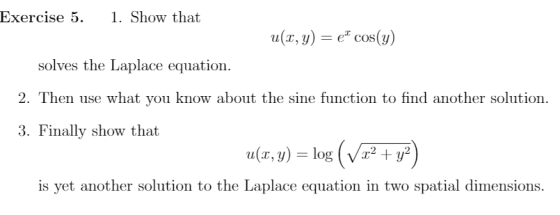
Show that u(x,y) =excos(y) solves the Laplace equation.
Homework Answers
Request Answer!
We need at least 10 more requests to produce the answer.
0 / 10 have requested this problem solution
The more requests, the faster the answer.
Problem 3. Show that the solution of the partial differential equation (Laplace equation), Wxx(x, y) +...
 Problem 3. Show that the solution of the partial differential equation (Laplace equation), Wxx(x, y) + Wyy(x, y) = 0, with the four boundary conditions: w(x,0) = 0, w(x, 1) = 0, w(0, y) = 0 and w(1, y) = 24 sin ny, can be obtained as w(x, y) = 2 sinh nx · sin ny. [Suggested Solution Steps for Problem 3] (1) Apply the method of separation of variables as w(x,y) = X(x) · Y(y); (2) substitute into the...
Problem 3. Show that the solution of the partial differential equation (Laplace equation), Wxx(x,y) + Wyy(x,...
 Problem 3. Show that the solution of the partial differential equation (Laplace equation), Wxx(x,y) + Wyy(x, y) = 0, with the four boundary conditions: w(x,0) = 0, w(x, 1) = 0, w(0,y) = 0 and w(1, y) = 24 sin ny, can be obtained as w(x, y) = 2 sinh nx · sin ny.
6.8. Verify that u(x, y)= A sin(27Tx) sin(27ty) solves Poisson's equation V2u-Ron W (0, 1) x...
 6.8. Verify that u(x, y)= A sin(27Tx) sin(27ty) solves Poisson's equation V2u-Ron W (0, 1) x (0,1) for some A-value, where R(x, y) sin(2x) sin(2Ty) (a) Find the correct A value (b) Compute the total source S w RdA (c) Compute the flux out through the top part of W (y 1) and verify by symmetry that it is one-quarter that of the full source S.
6.8. Verify that u(x, y)= A sin(27Tx) sin(27ty) solves Poisson's equation V2u-Ron W (0,...
6.8. Verify that u(x, y)= A sin(27Tx) sin(27ty) solves Poisson's equation V2u-Ron W (0, 1) x (0,1) for some A-value, where R(x, y) sin(2x) sin(2Ty) (a) Find the correct A value (b) Compute the total source S w RdA (c) Compute the flux out through the top part of W (y 1) and verify by symmetry that it is one-quarter that of the full source S.
6.8. Verify that u(x, y)= A sin(27Tx) sin(27ty) solves Poisson's equation V2u-Ron W (0,...
Consider the Laplace equation v²u(x, y, z) = 0 in 3D and find its most general...
 Consider the Laplace equation v²u(x, y, z) = 0 in 3D and find its most general solution for a parallelepiped defend by planar as (see the figure below) (x = 0,X = 2, y = 0, y = 2, (z=0,2 = 5, with the Dirichlet boundary conditions as u(0, y, z) = u(2, y, z) = 0 u(x, 0, 2) = u(x, 2, z) = 0 (u(x, y,0) = 0, u(x,y,5) = 17
7. Consider the boundary value problem for the Laplace equation on the strip u(0, y) u(n,y)=0,...
 7. Consider the boundary value problem for the Laplace equation on the strip u(0, y) u(n,y)=0, = a. Explain why it makes sense to look for a solution of the form b. Find all solutions of the form u(x,y) = Σ Yn (y) sin nx satisfying c. Among the solutions you found in part (b) find the unique solution u (x, y) = Σ Y, (y) sin na. the Laplace equation and the boundary conditions. (i.e. find Yn (y).) that...
7. Consider the boundary value problem for the Laplace equation on the strip u (0, y)...
 7. Consider the boundary value problem for the Laplace equation on the strip u (0, y) u (т, y) = 0, = a. Explain why it makes sense to look for a solution of the form b. Find all solutions of the form u(x, y) -ZYn (v)sinnx satisfying c. Among the solutions you found in part (b) find the unique solution u (x, y)-Yn (y) sin n. the Laplace equation and the boundary conditions. (i.e. find Yn. (3).) that satisfies...
2. Show that the function u(x, 1) = C, exp(-n?n?) sin nax = solves the heat...
 2. Show that the function u(x, 1) = C, exp(-n?n?) sin nax = solves the heat conduction problem uxx = u, with boundary conditions u(x,0) = Cn sinnix u(0, 1) = u(1, 1) = 0
Find an integer x ∈ {0, . . . , 196} which solves the equation x^...
Find an integer x ∈ {0, . . . , 196} which solves the equation x^ 157 ≡ 8 (mod 197)
Repeat the flat-plate momentum analysis by replacing the equation u(x, y) ~U ( ) 0<y>$(x) using...
 Repeat the flat-plate momentum analysis by replacing the equation u(x, y) ~U ( ) 0<y>$(x) using a trigonometric profile approximation: 5 = sin()
7.4 Solve the Laplace equation Δ11-0 in the square 0 < x, y < π, subject to the bound- ary condition 11(0, y) u(T, y) = 0. 11(x, 0) = 11(x, π) = 1, = 1/(π, y) = 7.4 Solve the Laplace equat...
 7.4 Solve the Laplace equation Δ11-0 in the square 0 < x, y < π, subject to the bound- ary condition 11(0, y) u(T, y) = 0. 11(x, 0) = 11(x, π) = 1, = 1/(π, y) =
7.4 Solve the Laplace equation Δ11-0 in the square 0
7.4 Solve the Laplace equation Δ11-0 in the square 0 < x, y < π, subject to the bound- ary condition 11(0, y) u(T, y) = 0. 11(x, 0) = 11(x, π) = 1, = 1/(π, y) =
7.4 Solve the Laplace equation Δ11-0 in the square 0
 Problem 3. Show that the solution of the partial differential equation (Laplace equation), Wxx(x, y) + Wyy(x, y) = 0, with the four boundary conditions: w(x,0) = 0, w(x, 1) = 0, w(0, y) = 0 and w(1, y) = 24 sin ny, can be obtained as w(x, y) = 2 sinh nx · sin ny. [Suggested Solution Steps for Problem 3] (1) Apply the method of separation of variables as w(x,y) = X(x) · Y(y); (2) substitute into the...
 Problem 3. Show that the solution of the partial differential equation (Laplace equation), Wxx(x,y) + Wyy(x, y) = 0, with the four boundary conditions: w(x,0) = 0, w(x, 1) = 0, w(0,y) = 0 and w(1, y) = 24 sin ny, can be obtained as w(x, y) = 2 sinh nx · sin ny.
 6.8. Verify that u(x, y)= A sin(27Tx) sin(27ty) solves Poisson's equation V2u-Ron W (0, 1) x (0,1) for some A-value, where R(x, y) sin(2x) sin(2Ty) (a) Find the correct A value (b) Compute the total source S w RdA (c) Compute the flux out through the top part of W (y 1) and verify by symmetry that it is one-quarter that of the full source S.
6.8. Verify that u(x, y)= A sin(27Tx) sin(27ty) solves Poisson's equation V2u-Ron W (0,...
6.8. Verify that u(x, y)= A sin(27Tx) sin(27ty) solves Poisson's equation V2u-Ron W (0, 1) x (0,1) for some A-value, where R(x, y) sin(2x) sin(2Ty) (a) Find the correct A value (b) Compute the total source S w RdA (c) Compute the flux out through the top part of W (y 1) and verify by symmetry that it is one-quarter that of the full source S.
6.8. Verify that u(x, y)= A sin(27Tx) sin(27ty) solves Poisson's equation V2u-Ron W (0,...
 Consider the Laplace equation v²u(x, y, z) = 0 in 3D and find its most general solution for a parallelepiped defend by planar as (see the figure below) (x = 0,X = 2, y = 0, y = 2, (z=0,2 = 5, with the Dirichlet boundary conditions as u(0, y, z) = u(2, y, z) = 0 u(x, 0, 2) = u(x, 2, z) = 0 (u(x, y,0) = 0, u(x,y,5) = 17
 7. Consider the boundary value problem for the Laplace equation on the strip u(0, y) u(n,y)=0, = a. Explain why it makes sense to look for a solution of the form b. Find all solutions of the form u(x,y) = Σ Yn (y) sin nx satisfying c. Among the solutions you found in part (b) find the unique solution u (x, y) = Σ Y, (y) sin na. the Laplace equation and the boundary conditions. (i.e. find Yn (y).) that...
 7. Consider the boundary value problem for the Laplace equation on the strip u (0, y) u (т, y) = 0, = a. Explain why it makes sense to look for a solution of the form b. Find all solutions of the form u(x, y) -ZYn (v)sinnx satisfying c. Among the solutions you found in part (b) find the unique solution u (x, y)-Yn (y) sin n. the Laplace equation and the boundary conditions. (i.e. find Yn. (3).) that satisfies...
 2. Show that the function u(x, 1) = C, exp(-n?n?) sin nax = solves the heat conduction problem uxx = u, with boundary conditions u(x,0) = Cn sinnix u(0, 1) = u(1, 1) = 0
 Repeat the flat-plate momentum analysis by replacing the equation u(x, y) ~U ( ) 0<y>$(x) using a trigonometric profile approximation: 5 = sin()
 7.4 Solve the Laplace equation Δ11-0 in the square 0 < x, y < π, subject to the bound- ary condition 11(0, y) u(T, y) = 0. 11(x, 0) = 11(x, π) = 1, = 1/(π, y) =
7.4 Solve the Laplace equation Δ11-0 in the square 0
7.4 Solve the Laplace equation Δ11-0 in the square 0 < x, y < π, subject to the bound- ary condition 11(0, y) u(T, y) = 0. 11(x, 0) = 11(x, π) = 1, = 1/(π, y) =
7.4 Solve the Laplace equation Δ11-0 in the square 0
Most questions answered within 3 hours.
-
Where is the error in this code sequence?
String s1 = "Hello";
String s2 = "ello";...
asked 10 months ago -
Financial data for Joel de Paris, Inc., for last year
follow:
Joel de Paris, Inc.
Balance...
asked 10 months ago -
Consider this reaction:
Al2(SO4)3 (aq)+ BaCl3
(aq) Al2Cl6 (aq)- +
3BaSO4(s) . What is the...
asked 10 months ago -
Suppose that Savneet is considering increasing her
recent random sample from 20 car rentals to 40...
asked 10 months ago -
Trucks arrive at an unloading terminal at an average rate of 120
per hour.
Trucks arrive...
asked 10 months ago -
Why are methanol and ethanol completely soluble in water while
octanol is not very little soluble....
asked 10 months ago -
A facilities manager at a university reads in a research report
that the mean amount of...
asked 10 months ago -
When the CuSO4 is rehydrated by adding water to the anhydrous
compound, is this an endothermic...
asked 10 months ago -
A ray of sunlight is passing from diamond into crown glass; the
angle of incidence is...
asked 10 months ago -
A block of mass 0.249 kg is placed on top of a light, vertical
spring of...
asked 10 months ago -
how do the kidneys compensate in the presences of acidosis
a) trigger hyperventilate
b) reserve acid...
asked 10 months ago -
Question 501 pts
The rental rate of capital to the firm increases. Which of the
following...
asked 10 months ago