
Homework Answers
5. The plot is given by,
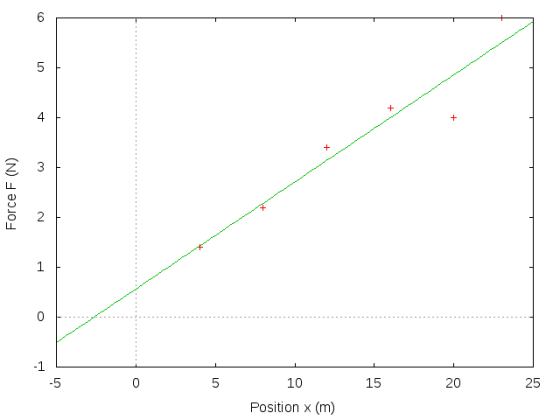
If the straight line is denoted by,

The slope of the straight line is given by, m = 0.214 N/m and the interception is b = 0.567 N.
-----------------------------------------------------------------------------------------------------------------------------------
6. If we compare the equation with the given one,
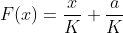
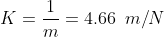
we get the values of K and a.

---------------------------------------------------------------------------------------------------------------------------------
7. No data found
------------------------------------------------------------------------------------------------------------------------------------
8. If we just plot the data it will look like,
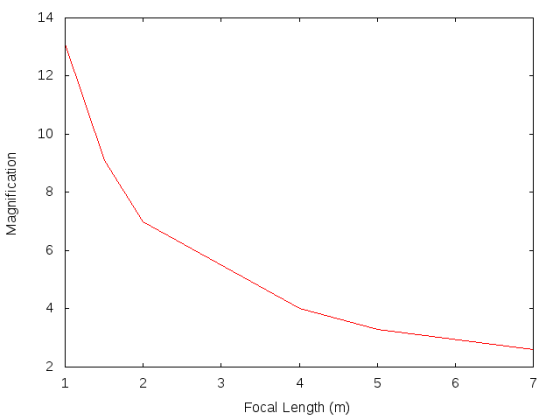
It is clear that the plot is not linear. Look at the equation,

if we take a new variable as x = 1/f, then the equation would be linear, as,

The new data set will be,
x = 1/f ----------------- M
1 13.1
0.67
9.1
0.5 7.0
0.25 4.0
0.2
3.3
0.143 2.6
We plot this set of data and get,
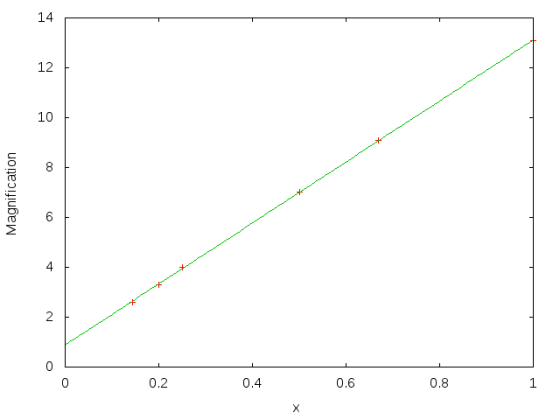
The slope of the curve is m = 12.26 m and the intercept is b = 0.88
Clearly the plot is linear now. From the equation,
we can easily say that the slope is k = m = 12.26 m.
Add Answer to:
Plot the following data, then find the slope and intercept. F = 1/K(x + a) F...
Plot the following data. Then make a change of variable substitution that will transform the data...
 Plot the following data. Then make a change of variable substitution that will transform the data to a linear form. Plot the "new" data set and find the value of k from the slope and/or intercept of the graph. 8) focal length Magnification (m) k M=-+1 & 13.1 1.0 M=magnification f= focal length 1.5 9.1 2.0 7.0 m = 4.0 4.0 b = 5.0 3.3 k = 7.0 2.6
Plot the following data. Then make a change of variable substitution...
Plot the following data. Then make a change of variable substitution that will transform the data to a linear form. Plot the "new" data set and find the value of k from the slope and/or intercept of the graph. 8) focal length Magnification (m) k M=-+1 & 13.1 1.0 M=magnification f= focal length 1.5 9.1 2.0 7.0 m = 4.0 4.0 b = 5.0 3.3 k = 7.0 2.6
Plot the following data. Then make a change of variable substitution...
Note: The lens/mirror formula is : 1/f= 1/s + 1/s’ Analysis Questions: Plot a graph of...
Note: The lens/mirror formula is : 1/f= 1/s + 1/s’ Analysis Questions: Plot a graph of 1/s (x-axis) vs. 1/s’ (y-axis). 2. Rearrange the lens equation as 1/s’= -1/s + 1/f and compare with y=mx+c. Record the slope and intercept. From the intercept, find f. 3.. How did the focal length obtained from the intercept compare with that obtained from the distant object? Slope of graph …………………… Focal length from intercept ……………… Intercept of graph ………………. Focal length from distant...
x²+2x+2 4. Let y=f(x)= x² – 3x-5 (a) Find f(3) (b) Find and simplify f(x) -...
 x²+2x+2 4. Let y=f(x)= x² – 3x-5 (a) Find f(3) (b) Find and simplify f(x) - $(3) X-3 f(x)- $(3) (c) Find lim X-3 (d) Find and simplify $(3+h)-f(3) h 13 (e) Find lim f(3+h) – S (3) h 0 h (t) Find the slope-intercept form of the tangent line to y = f(x) at x = 3. (g) Plot the curve and the tangent line on the same graph, using the form on the window (-3,7]*[-10,10). 5. A car...
Perform a linear regression to determine the slope of the plot of Ln(A/A0) vs time that...
Perform a linear regression to determine the slope of the plot of Ln(A/A0) vs time that is discussed on page 16. Recall from page 12 that the slope for this plot is -k (where k is the radioactive decay constant). Input below the value for k obtained from this data set. Answer=0.0715 Note that your k value should be positive, since it is the negative of the slope. All reaction rate constants are positive values. The units for this k...
Procedure Use the following sets of data and work with each one. The equation for a...
 Procedure Use the following sets of data and work with each one. The equation for a linear graph is y mx+b, where m is the slope and b is the y-intercept. DATA SET 1: Fahrenheit-vs- Celsius Fahrenheit Celsius 32 68 104 140 176 0 20 40 60 80 1. Using Data Set 1 above, graph Fahrenheit (y) -vs- Celsius (x), using the scatterplot function in excel, or another graphing software. Make sure you label the axes. Fahrenheit should be on...
#2 between two quantities can be established. Procedure: Use the following sets of data and work...
 #2
between two quantities can be established. Procedure: Use the following sets of data and work with each one. The equation for a linear graph is y mx+b, where m is the slope and b is the y-intercept DATA SET 1: Fahrenheit-vs-Celsius Fahrenheit Celsius 32 68 104 140 176 0 20 40 60 80 1. Using Data Set 1 above, graph Fahrenheit (y)-vs- Celsius (x), using the scatterplot function in excel, or another graphing software. Make sure you label the...
#2
between two quantities can be established. Procedure: Use the following sets of data and work with each one. The equation for a linear graph is y mx+b, where m is the slope and b is the y-intercept DATA SET 1: Fahrenheit-vs-Celsius Fahrenheit Celsius 32 68 104 140 176 0 20 40 60 80 1. Using Data Set 1 above, graph Fahrenheit (y)-vs- Celsius (x), using the scatterplot function in excel, or another graphing software. Make sure you label the...
k c M mm] F M = 70kg C = 1 Ns/m k = 26N/m FO...
 k c M mm] F M = 70kg C = 1 Ns/m k = 26N/m FO = 5N/S a = 9s (duration of the couple in seconds) b = 45N (magnitude of the step in N) z = 2.4 (zero of the controller) p = 4.3 (pole of the controller) 1. Determine the transfer function of the system where force F is the input and displacement is the output variable. 2. Draw the block diagram of the system indicating clearly...
Consider the following function. f(x) = -½x2 – 3x + 1
Consider the following function. f(x) = -½x2 – 3x + 1 Find the slope and an equation of the tangent line to the graph of the function at the point (-2,5). Slope: m= Equation: y = (Enter equation in slope-intercept form, i.e.y = mx + b)
4. In this experiment students measure the force (F) holding a 2.0 kg mass on rotating...
 4. In this experiment students measure the force (F) holding a 2.0 kg mass on rotating platfornm of radius r when the mass is traveling at different velocities (v). The centripetal force acting on an object of mass m can be expressed as mv E N 2.0 v (m/s) 0.46 0.55 0.61 0.70 0.78 4.0 5.0 6.0 Plot a graph for this data and find the radius from your linear fit equation assuming that m 2.0 kg. Note: 1 N...
2 pts. when regression line has no slope, we can still predict Y from X because...
 2 pts. when regression line has no slope, we can still predict Y from X because the line still has a y intercept. A. True B. False 34. 2 pts. Can we infer causality between two variables solely on the basis of their correlation? A. Yes, we can infer causality. B. No, we cannot infer causality. 35. 2 pts. Which of the following is the fundamental task of regression? A. Correctly plotting all of the points on a scatter plot....
 Plot the following data. Then make a change of variable substitution that will transform the data to a linear form. Plot the "new" data set and find the value of k from the slope and/or intercept of the graph. 8) focal length Magnification (m) k M=-+1 & 13.1 1.0 M=magnification f= focal length 1.5 9.1 2.0 7.0 m = 4.0 4.0 b = 5.0 3.3 k = 7.0 2.6
Plot the following data. Then make a change of variable substitution...
Plot the following data. Then make a change of variable substitution that will transform the data to a linear form. Plot the "new" data set and find the value of k from the slope and/or intercept of the graph. 8) focal length Magnification (m) k M=-+1 & 13.1 1.0 M=magnification f= focal length 1.5 9.1 2.0 7.0 m = 4.0 4.0 b = 5.0 3.3 k = 7.0 2.6
Plot the following data. Then make a change of variable substitution...
 x²+2x+2 4. Let y=f(x)= x² – 3x-5 (a) Find f(3) (b) Find and simplify f(x) - $(3) X-3 f(x)- $(3) (c) Find lim X-3 (d) Find and simplify $(3+h)-f(3) h 13 (e) Find lim f(3+h) – S (3) h 0 h (t) Find the slope-intercept form of the tangent line to y = f(x) at x = 3. (g) Plot the curve and the tangent line on the same graph, using the form on the window (-3,7]*[-10,10). 5. A car...
 Procedure Use the following sets of data and work with each one. The equation for a linear graph is y mx+b, where m is the slope and b is the y-intercept. DATA SET 1: Fahrenheit-vs- Celsius Fahrenheit Celsius 32 68 104 140 176 0 20 40 60 80 1. Using Data Set 1 above, graph Fahrenheit (y) -vs- Celsius (x), using the scatterplot function in excel, or another graphing software. Make sure you label the axes. Fahrenheit should be on...
 #2
between two quantities can be established. Procedure: Use the following sets of data and work with each one. The equation for a linear graph is y mx+b, where m is the slope and b is the y-intercept DATA SET 1: Fahrenheit-vs-Celsius Fahrenheit Celsius 32 68 104 140 176 0 20 40 60 80 1. Using Data Set 1 above, graph Fahrenheit (y)-vs- Celsius (x), using the scatterplot function in excel, or another graphing software. Make sure you label the...
#2
between two quantities can be established. Procedure: Use the following sets of data and work with each one. The equation for a linear graph is y mx+b, where m is the slope and b is the y-intercept DATA SET 1: Fahrenheit-vs-Celsius Fahrenheit Celsius 32 68 104 140 176 0 20 40 60 80 1. Using Data Set 1 above, graph Fahrenheit (y)-vs- Celsius (x), using the scatterplot function in excel, or another graphing software. Make sure you label the...
 k c M mm] F M = 70kg C = 1 Ns/m k = 26N/m FO = 5N/S a = 9s (duration of the couple in seconds) b = 45N (magnitude of the step in N) z = 2.4 (zero of the controller) p = 4.3 (pole of the controller) 1. Determine the transfer function of the system where force F is the input and displacement is the output variable. 2. Draw the block diagram of the system indicating clearly...
 4. In this experiment students measure the force (F) holding a 2.0 kg mass on rotating platfornm of radius r when the mass is traveling at different velocities (v). The centripetal force acting on an object of mass m can be expressed as mv E N 2.0 v (m/s) 0.46 0.55 0.61 0.70 0.78 4.0 5.0 6.0 Plot a graph for this data and find the radius from your linear fit equation assuming that m 2.0 kg. Note: 1 N...
 2 pts. when regression line has no slope, we can still predict Y from X because the line still has a y intercept. A. True B. False 34. 2 pts. Can we infer causality between two variables solely on the basis of their correlation? A. Yes, we can infer causality. B. No, we cannot infer causality. 35. 2 pts. Which of the following is the fundamental task of regression? A. Correctly plotting all of the points on a scatter plot....
Most questions answered within 3 hours.
-
Where is the error in this code sequence?
String s1 = "Hello";
String s2 = "ello";...
asked 10 months ago -
Financial data for Joel de Paris, Inc., for last year
follow:
Joel de Paris, Inc.
Balance...
asked 10 months ago -
Consider this reaction:
Al2(SO4)3 (aq)+ BaCl3
(aq) Al2Cl6 (aq)- +
3BaSO4(s) . What is the...
asked 10 months ago -
Suppose that Savneet is considering increasing her
recent random sample from 20 car rentals to 40...
asked 10 months ago -
Trucks arrive at an unloading terminal at an average rate of 120
per hour.
Trucks arrive...
asked 10 months ago -
Why are methanol and ethanol completely soluble in water while
octanol is not very little soluble....
asked 10 months ago -
A facilities manager at a university reads in a research report
that the mean amount of...
asked 10 months ago -
When the CuSO4 is rehydrated by adding water to the anhydrous
compound, is this an endothermic...
asked 10 months ago -
A ray of sunlight is passing from diamond into crown glass; the
angle of incidence is...
asked 10 months ago -
A block of mass 0.249 kg is placed on top of a light, vertical
spring of...
asked 10 months ago -
how do the kidneys compensate in the presences of acidosis
a) trigger hyperventilate
b) reserve acid...
asked 10 months ago -
Question 501 pts
The rental rate of capital to the firm increases. Which of the
following...
asked 10 months ago