Equilibrium analysis
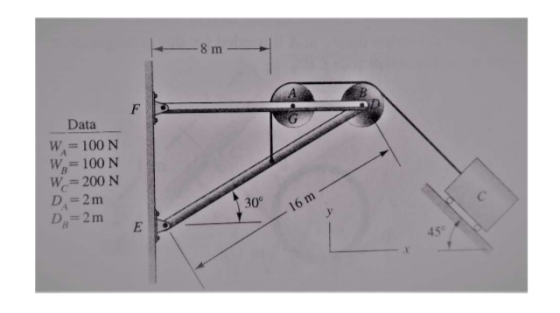
Draw the free body diagram for each of the members of the system. Write the equilibrium equations and find the supporting forces at E and F. Pulleys A and B offer no rotational resistance from friction at the bearings.
Homework Answers


Determine the force in members DE, EJ, and JK by the method of sections. Draw all...
 Determine the force in members DE, EJ, and JK by the method of sections. Draw all free body diagrams. Below each free body diagram write the equilibrium equations associated with that free body diagram. Failure to format your answers in this fashion will result in a zero. All forces shown are vertical and horizontal 14000 lb 3200 lb E 6700 lb 12-0" 6 bays at 9-0" 54'-0" 5200 lb
draw free body diagram, draw coordinate system, isolate object from its supports , add applied forces...
 draw free body diagram, draw coordinate system,
isolate object from its supports , add applied forces and body
force to object , determine known and unknown variables , resolve
force vectors into components , write the equilibrium equations ,
choose points about which moments rotate and show + direction ,
substitute values for the variables and solve for unknowns
rthe trusses shown below, neglect self-weight, and do the following: (a) Draw a free body diagram and solve for the reactions....
draw free body diagram, draw coordinate system,
isolate object from its supports , add applied forces and body
force to object , determine known and unknown variables , resolve
force vectors into components , write the equilibrium equations ,
choose points about which moments rotate and show + direction ,
substitute values for the variables and solve for unknowns
rthe trusses shown below, neglect self-weight, and do the following: (a) Draw a free body diagram and solve for the reactions....
More details and instructions in picture below 1) draw the forces acting on each mass *pulleys...
 More details and instructions in picture below
1) draw the forces acting on each mass *pulleys are "ideal".
(use appropriate coordinate systems)
2) sum the forces in x,y and find acceleration
Free Body Diagram. Three masses mi, m2, and m3 are attached by a light rope that does not stretch. The rope goes over two massless and frictionless pulleys. Draw the complete free body diagram on each of the three masses. The coefficient of kinetic friction between mi and the...
More details and instructions in picture below
1) draw the forces acting on each mass *pulleys are "ideal".
(use appropriate coordinate systems)
2) sum the forces in x,y and find acceleration
Free Body Diagram. Three masses mi, m2, and m3 are attached by a light rope that does not stretch. The rope goes over two massless and frictionless pulleys. Draw the complete free body diagram on each of the three masses. The coefficient of kinetic friction between mi and the...
Question 4. A) Describe the conditions required for any three forces to be in equilibrium. [2...
 Question 4. A) Describe the conditions required for any three forces to be in equilibrium. [2 marks] B) A force P = 5000N is applied at the centre C of the beam AB of length 5m as shown in the fig 4B. Draw free body diagram for the beam and find the reactions at the hinge and the roller support. [8 marks] P= 5000 N А C 30° B 2.5 m 2.5 m Fig. 4B. The loaded beam and the...
3. A sledge of mass 5.0 kg is on a slope. There is just enough friction...
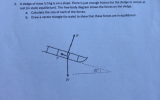 3. A sledge of mass 5.0 kg is on a slope. There is just enough friction for the sledge to remain at rest (in static equilibrium). The free-body diagram shows the forces on the sledge. a. Calculate the size of each of the forces. b. Draw a vector triangle (to scale) to show that these forces are in equilibrium. AR F 2001 - w
3. The following figure shows the block diagram of a mechanical translational system k1 U3 m1...
 3. The following figure shows the block diagram of a mechanical translational system k1 U3 m1 (a) Draw free body diagrams for each of the masses. Bearing in mind that the force due to spring is proportional to its length and the force due to friction is proportional to velocity, label each of the forces acting upon each body. (b) Develop the dynamical equations for the system.
So we are learning about the Free Body diagram and method but I don't fully understand...
 So we are learning about the Free Body diagram and method but I
don't fully understand how to apply the steps to the problem. 1st I
have to identify all the forces acting such as gravity by drawing
it out. 2nd I have to use that drawing and draw it in a free body
diagram form in the x-axis and y-axis where the object is at the
origin and that the forces are arrows and then rotate it the degree...
So we are learning about the Free Body diagram and method but I
don't fully understand how to apply the steps to the problem. 1st I
have to identify all the forces acting such as gravity by drawing
it out. 2nd I have to use that drawing and draw it in a free body
diagram form in the x-axis and y-axis where the object is at the
origin and that the forces are arrows and then rotate it the degree...
Q8. (6 pts.) Physics 211 Review: Static Equilibrium, Vector Addition & Trigonometry The figure below shows...
 Q8. (6 pts.) Physics 211 Review: Static Equilibrium, Vector Addition & Trigonometry The figure below shows a mass M suspended from a vertical string. A horizontal force F is applied to the mass as shown, so that it is deflected by an angle 6 from the vertical. The entire system is in static equilibrium. Draw the free body diagram for the forces acting on the mass and determine an expression that relates F to the mass Mand the angle e....
Problem 1: Two blocks of mass: m, =25 kg and m2=45 kg are connected by that...
 Problem 1: Two blocks of mass: m, =25 kg and m2=45 kg are connected by that passes over a pulley as show in the figure. The coefficients of kinetic and static friction between m, and the table are 0.25 and = 0.45, respectively a massless string 1 (a) Identify and label all forces and draw the free- body diagram for each block (b) Will the system be in static equilibrium? Assume the pulley is frictionless. m2 (e) Find the tension...
Q1. Given the situation as shown in the figure. M1-5Kg and M2-10kg. Assume there is no...
 Q1. Given the situation as shown in the figure. M1-5Kg and M2-10kg. Assume there is no friction M1 M2 300 a. Draw one Free Body Diagram for each object. Draw them on above diagram. 10points b. For each object and each direction, write down F-ma for each object 10 points c. Solve the set of equations and find the acceleration of the boxes. 10 points
 Determine the force in members DE, EJ, and JK by the method of sections. Draw all free body diagrams. Below each free body diagram write the equilibrium equations associated with that free body diagram. Failure to format your answers in this fashion will result in a zero. All forces shown are vertical and horizontal 14000 lb 3200 lb E 6700 lb 12-0" 6 bays at 9-0" 54'-0" 5200 lb
 draw free body diagram, draw coordinate system,
isolate object from its supports , add applied forces and body
force to object , determine known and unknown variables , resolve
force vectors into components , write the equilibrium equations ,
choose points about which moments rotate and show + direction ,
substitute values for the variables and solve for unknowns
rthe trusses shown below, neglect self-weight, and do the following: (a) Draw a free body diagram and solve for the reactions....
draw free body diagram, draw coordinate system,
isolate object from its supports , add applied forces and body
force to object , determine known and unknown variables , resolve
force vectors into components , write the equilibrium equations ,
choose points about which moments rotate and show + direction ,
substitute values for the variables and solve for unknowns
rthe trusses shown below, neglect self-weight, and do the following: (a) Draw a free body diagram and solve for the reactions....
 More details and instructions in picture below
1) draw the forces acting on each mass *pulleys are "ideal".
(use appropriate coordinate systems)
2) sum the forces in x,y and find acceleration
Free Body Diagram. Three masses mi, m2, and m3 are attached by a light rope that does not stretch. The rope goes over two massless and frictionless pulleys. Draw the complete free body diagram on each of the three masses. The coefficient of kinetic friction between mi and the...
More details and instructions in picture below
1) draw the forces acting on each mass *pulleys are "ideal".
(use appropriate coordinate systems)
2) sum the forces in x,y and find acceleration
Free Body Diagram. Three masses mi, m2, and m3 are attached by a light rope that does not stretch. The rope goes over two massless and frictionless pulleys. Draw the complete free body diagram on each of the three masses. The coefficient of kinetic friction between mi and the...
 Question 4. A) Describe the conditions required for any three forces to be in equilibrium. [2 marks] B) A force P = 5000N is applied at the centre C of the beam AB of length 5m as shown in the fig 4B. Draw free body diagram for the beam and find the reactions at the hinge and the roller support. [8 marks] P= 5000 N А C 30° B 2.5 m 2.5 m Fig. 4B. The loaded beam and the...
 3. A sledge of mass 5.0 kg is on a slope. There is just enough friction for the sledge to remain at rest (in static equilibrium). The free-body diagram shows the forces on the sledge. a. Calculate the size of each of the forces. b. Draw a vector triangle (to scale) to show that these forces are in equilibrium. AR F 2001 - w
 3. The following figure shows the block diagram of a mechanical translational system k1 U3 m1 (a) Draw free body diagrams for each of the masses. Bearing in mind that the force due to spring is proportional to its length and the force due to friction is proportional to velocity, label each of the forces acting upon each body. (b) Develop the dynamical equations for the system.
 So we are learning about the Free Body diagram and method but I
don't fully understand how to apply the steps to the problem. 1st I
have to identify all the forces acting such as gravity by drawing
it out. 2nd I have to use that drawing and draw it in a free body
diagram form in the x-axis and y-axis where the object is at the
origin and that the forces are arrows and then rotate it the degree...
So we are learning about the Free Body diagram and method but I
don't fully understand how to apply the steps to the problem. 1st I
have to identify all the forces acting such as gravity by drawing
it out. 2nd I have to use that drawing and draw it in a free body
diagram form in the x-axis and y-axis where the object is at the
origin and that the forces are arrows and then rotate it the degree...
 Q8. (6 pts.) Physics 211 Review: Static Equilibrium, Vector Addition & Trigonometry The figure below shows a mass M suspended from a vertical string. A horizontal force F is applied to the mass as shown, so that it is deflected by an angle 6 from the vertical. The entire system is in static equilibrium. Draw the free body diagram for the forces acting on the mass and determine an expression that relates F to the mass Mand the angle e....
 Problem 1: Two blocks of mass: m, =25 kg and m2=45 kg are connected by that passes over a pulley as show in the figure. The coefficients of kinetic and static friction between m, and the table are 0.25 and = 0.45, respectively a massless string 1 (a) Identify and label all forces and draw the free- body diagram for each block (b) Will the system be in static equilibrium? Assume the pulley is frictionless. m2 (e) Find the tension...
 Q1. Given the situation as shown in the figure. M1-5Kg and M2-10kg. Assume there is no friction M1 M2 300 a. Draw one Free Body Diagram for each object. Draw them on above diagram. 10points b. For each object and each direction, write down F-ma for each object 10 points c. Solve the set of equations and find the acceleration of the boxes. 10 points
Most questions answered within 3 hours.
-
Where is the error in this code sequence?
String s1 = "Hello";
String s2 = "ello";...
asked 11 months ago -
Financial data for Joel de Paris, Inc., for last year
follow:
Joel de Paris, Inc.
Balance...
asked 11 months ago -
Consider this reaction:
Al2(SO4)3 (aq)+ BaCl3
(aq) Al2Cl6 (aq)- +
3BaSO4(s) . What is the...
asked 11 months ago -
Suppose that Savneet is considering increasing her
recent random sample from 20 car rentals to 40...
asked 11 months ago -
Trucks arrive at an unloading terminal at an average rate of 120
per hour.
Trucks arrive...
asked 11 months ago -
Why are methanol and ethanol completely soluble in water while
octanol is not very little soluble....
asked 11 months ago -
A facilities manager at a university reads in a research report
that the mean amount of...
asked 11 months ago -
When the CuSO4 is rehydrated by adding water to the anhydrous
compound, is this an endothermic...
asked 11 months ago -
A ray of sunlight is passing from diamond into crown glass; the
angle of incidence is...
asked 11 months ago -
A block of mass 0.249 kg is placed on top of a light, vertical
spring of...
asked 11 months ago -
how do the kidneys compensate in the presences of acidosis
a) trigger hyperventilate
b) reserve acid...
asked 11 months ago -
Question 501 pts
The rental rate of capital to the firm increases. Which of the
following...
asked 11 months ago