myDictionary= {1:"Apple", 2:"Mango", 3:"Banana"} 2POINTS write a PYTHON code that removes Apple from the myDictionary, is...
myDictionary= {1:"Apple", 2:"Mango", 3:"Banana"} 2POINTS
-
write a PYTHON code that removes Apple from the myDictionary, is this possible? explain
-
write a PYTHON code that inserts Grape into the myDictionary, is this possible? explain
-
write a PYTHON code that removes 3 from myDictionary, is this possible? Explain
Homework Answers
# part a
![1 myDictionary= {1:Apple, 2: Mango, 3: Banana} 2 3 4- 5 6 7 8 for one in myDictionary: if myDictionary[one] Apple: my](http://img.homeworklib.com/questions/83d117f0-8292-11eb-8999-75bad5c61874.png?x-oss-process=image/resize,w_560)
myDictionary= {1:"Apple", 2:"Mango", 3:"Banana"}
for one in myDictionary:
if myDictionary[one] == 'Apple':
myDictionary.pop(one)
break
print(myDictionary)
# part b
myDictionary[4] = "Grape"
# By this {1: 'Apple', 2: 'Mango', 3: 'Banana', 4: 'Grape'}
# part c
myDictionary.pop(3)
# By this {1: 'Apple', 2: 'Mango'}
# Please up vote
Add Answer to:
myDictionary=
{1:"Apple", 2:"Mango", 3:"Banana"} 2POINTS
write a PYTHON
code that removes Apple from the myDictionary, is...
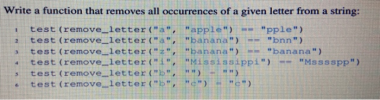
In Python 1 2 Write a function that removes all occurrences of a given letter from...
 In Python
1 2 Write a function that removes all occurrences of a given letter from a string: test (remove_letter ("a", "apple") "pple") test (remove_letter ("a", "banana") "bnn") test (remove_letter (2", "banana") "banana") test (remove_letter ("i", "Mississippi") "Msssspp") test (remove letter (",) "") test (remove_letter("b","0"> MO) 4 5 ### Run the following lines. # If you get "Correct" you # did it right. if remove_letter("a", "banana") == "nn": print("Correct!") else: print("Incorrect :(")
In Python
1 2 Write a function that removes all occurrences of a given letter from a string: test (remove_letter ("a", "apple") "pple") test (remove_letter ("a", "banana") "bnn") test (remove_letter (2", "banana") "banana") test (remove_letter ("i", "Mississippi") "Msssspp") test (remove letter (",) "") test (remove_letter("b","0"> MO) 4 5 ### Run the following lines. # If you get "Correct" you # did it right. if remove_letter("a", "banana") == "nn": print("Correct!") else: print("Incorrect :(")
In python and without using Libraries (comment the code and please don't use lambda code): Write...
In python and without using Libraries (comment the code and please don't use lambda code): Write a function called mostfrequent that takes one string argument containing a list of words separated by commas (e.g., “apple,banana,apple,pear”, note there are no spaces). The function must return the word that occurs most frequently in the input string. You can assume there will be no ties in frequency. Examples: mostfrequent(“apple,apple,banana,apple,peach,banana”) “apple” mostfrequent(“apple,banana,banana,apple,peach,banana”) “banana” mostfrequent(“apple”) “apple”
Question about spark with python. I have a dataset named example.csv, here is data in CSV...
 Question about spark with python.
I have a dataset named example.csv, here is data in CSV file
below: [0] name [1] name of fruits [2] number of fruits
1. use Pyspark code to plot the number of each fruit. sort the
result based on the number of fruits
the x-axis is the name of fruits, the y-axis is num of total
fruits
the output should be apple 10 banana 5 orange 3 mango 2
2. use Pyspark code to plot...
Question about spark with python.
I have a dataset named example.csv, here is data in CSV file
below: [0] name [1] name of fruits [2] number of fruits
1. use Pyspark code to plot the number of each fruit. sort the
result based on the number of fruits
the x-axis is the name of fruits, the y-axis is num of total
fruits
the output should be apple 10 banana 5 orange 3 mango 2
2. use Pyspark code to plot...
Write a Python program (remove_first_char.py) that removes the first character from each item in a list...
Write a Python program (remove_first_char.py) that removes the first character from each item in a list of words. Sometimes, we come across an issue in which we require to delete the first character from each string, that we might have added by mistake and we need to extend this to the whole list. Having shorthands (like this program) to perform this particular job is always a plus. Your program should contain two functions: (1) remove_first(list): This function takes in a...
Provide Python code that does the following: Create the following list in your program: lst1 =...
Provide Python code that does the following: Create the following list in your program: lst1 = ["apple", "banana", "pear", "grapefruit", "pineapple", "grape", "guava", "plum", "peach"] Write code that then does the following: Print the last item in the list. Print the first item in the list. Print all but the last three items in the list. Print the first, third, fifth etc. items of the list. Print the second, fourth, sixth etc. items of the list. Parts A- E should...
please explain why Suppose the Xavier values each apple at $1 and each banana at $2;...
 please explain why
Suppose the Xavier values each apple at $1 and each banana at $2; Yolanda values each apple at $2 and each banana at $4; and Zoe value each apple at $2 and each banana at $1. Consider the following three allocations: Allocation 1: Xavier has 4 apples and 3 bananas, Yolanda has 2 apples and 2 bananas, and Zoe has 3 bananas and 4 apples. Allocation 2: Xavier has 3 apples and 4 bananas, Yolanda has 2...
please explain why
Suppose the Xavier values each apple at $1 and each banana at $2; Yolanda values each apple at $2 and each banana at $4; and Zoe value each apple at $2 and each banana at $1. Consider the following three allocations: Allocation 1: Xavier has 4 apples and 3 bananas, Yolanda has 2 apples and 2 bananas, and Zoe has 3 bananas and 4 apples. Allocation 2: Xavier has 3 apples and 4 bananas, Yolanda has 2...
please explain why Suppose the Xavier values each apple at $1 and each banana at $2;...
 please explain why
Suppose the Xavier values each apple at $1 and each banana at $2; Yolanda values each apple at $2 and each banana at $4; and Zoe value each apple at $2 and each banana at $1. Consider the following three allocations Allocation 1: Xavier has 4 apples and 3 bananas, Yolanda has 2 apples and 2 bananas, and Zoe has 3 bananas and 4 apples. Allocation 2: Xavier has 3 apples and 4 bananas, Yolanda has 2...
please explain why
Suppose the Xavier values each apple at $1 and each banana at $2; Yolanda values each apple at $2 and each banana at $4; and Zoe value each apple at $2 and each banana at $1. Consider the following three allocations Allocation 1: Xavier has 4 apples and 3 bananas, Yolanda has 2 apples and 2 bananas, and Zoe has 3 bananas and 4 apples. Allocation 2: Xavier has 3 apples and 4 bananas, Yolanda has 2...
The following table shows the Total utility or Marginal utility for three goods apple and mango...
 The following table shows the Total utility or Marginal utility for three goods apple and mango and orange the price of apple=10 Ryals the price of mango=2 Ryals and price of orange-8 Ryals Complete the following table by calculating the missing data (1 Find the optimum quantity that must be consumed from each goods in (2 order to achieve the maximum utility. Calculate the maximum total utility that you can achieve by consuming (3 . optimum of the three goods...
python Write a program that reads the name of fruits and the colors from an input...
 python
Write a program that reads the name of fruits and the colors from an input file fruit. txt. Each fruit name and the color is given on a line as shown below separated by space Apple Red Orange Orange Grape Green Now write output to an output file (fruit2.txt) as shown below Color of Apple is Red Color of Orange is Orange Color of Grape is Green The program has to be general to read in as many lines...
python
Write a program that reads the name of fruits and the colors from an input file fruit. txt. Each fruit name and the color is given on a line as shown below separated by space Apple Red Orange Orange Grape Green Now write output to an output file (fruit2.txt) as shown below Color of Apple is Red Color of Orange is Orange Color of Grape is Green The program has to be general to read in as many lines...
please explain why Suppose the Xavier values each apple at $1 and each banana at $2;...
 please explain why
Suppose the Xavier values each apple at $1 and each banana at $2; Yolanda values each apple at $2 and each banana at $4; and Zoe value each apple at $2 and each banana at $1. Consider the following three allocations: Allocation 1: Xavier has 4 apples and 3 bananas, Yolanda has 2 apples and 2 bananas, and Zoe has 3 bananas and 4 apples. Allocation 2: Xavier has 3 apples and 4 bananas, Yolanda has 2...
please explain why
Suppose the Xavier values each apple at $1 and each banana at $2; Yolanda values each apple at $2 and each banana at $4; and Zoe value each apple at $2 and each banana at $1. Consider the following three allocations: Allocation 1: Xavier has 4 apples and 3 bananas, Yolanda has 2 apples and 2 bananas, and Zoe has 3 bananas and 4 apples. Allocation 2: Xavier has 3 apples and 4 bananas, Yolanda has 2...
 In Python
1 2 Write a function that removes all occurrences of a given letter from a string: test (remove_letter ("a", "apple") "pple") test (remove_letter ("a", "banana") "bnn") test (remove_letter (2", "banana") "banana") test (remove_letter ("i", "Mississippi") "Msssspp") test (remove letter (",) "") test (remove_letter("b","0"> MO) 4 5 ### Run the following lines. # If you get "Correct" you # did it right. if remove_letter("a", "banana") == "nn": print("Correct!") else: print("Incorrect :(")
In Python
1 2 Write a function that removes all occurrences of a given letter from a string: test (remove_letter ("a", "apple") "pple") test (remove_letter ("a", "banana") "bnn") test (remove_letter (2", "banana") "banana") test (remove_letter ("i", "Mississippi") "Msssspp") test (remove letter (",) "") test (remove_letter("b","0"> MO) 4 5 ### Run the following lines. # If you get "Correct" you # did it right. if remove_letter("a", "banana") == "nn": print("Correct!") else: print("Incorrect :(")
 Question about spark with python.
I have a dataset named example.csv, here is data in CSV file
below: [0] name [1] name of fruits [2] number of fruits
1. use Pyspark code to plot the number of each fruit. sort the
result based on the number of fruits
the x-axis is the name of fruits, the y-axis is num of total
fruits
the output should be apple 10 banana 5 orange 3 mango 2
2. use Pyspark code to plot...
Question about spark with python.
I have a dataset named example.csv, here is data in CSV file
below: [0] name [1] name of fruits [2] number of fruits
1. use Pyspark code to plot the number of each fruit. sort the
result based on the number of fruits
the x-axis is the name of fruits, the y-axis is num of total
fruits
the output should be apple 10 banana 5 orange 3 mango 2
2. use Pyspark code to plot...
 please explain why
Suppose the Xavier values each apple at $1 and each banana at $2; Yolanda values each apple at $2 and each banana at $4; and Zoe value each apple at $2 and each banana at $1. Consider the following three allocations: Allocation 1: Xavier has 4 apples and 3 bananas, Yolanda has 2 apples and 2 bananas, and Zoe has 3 bananas and 4 apples. Allocation 2: Xavier has 3 apples and 4 bananas, Yolanda has 2...
please explain why
Suppose the Xavier values each apple at $1 and each banana at $2; Yolanda values each apple at $2 and each banana at $4; and Zoe value each apple at $2 and each banana at $1. Consider the following three allocations: Allocation 1: Xavier has 4 apples and 3 bananas, Yolanda has 2 apples and 2 bananas, and Zoe has 3 bananas and 4 apples. Allocation 2: Xavier has 3 apples and 4 bananas, Yolanda has 2...
 please explain why
Suppose the Xavier values each apple at $1 and each banana at $2; Yolanda values each apple at $2 and each banana at $4; and Zoe value each apple at $2 and each banana at $1. Consider the following three allocations Allocation 1: Xavier has 4 apples and 3 bananas, Yolanda has 2 apples and 2 bananas, and Zoe has 3 bananas and 4 apples. Allocation 2: Xavier has 3 apples and 4 bananas, Yolanda has 2...
please explain why
Suppose the Xavier values each apple at $1 and each banana at $2; Yolanda values each apple at $2 and each banana at $4; and Zoe value each apple at $2 and each banana at $1. Consider the following three allocations Allocation 1: Xavier has 4 apples and 3 bananas, Yolanda has 2 apples and 2 bananas, and Zoe has 3 bananas and 4 apples. Allocation 2: Xavier has 3 apples and 4 bananas, Yolanda has 2...
 The following table shows the Total utility or Marginal utility for three goods apple and mango and orange the price of apple=10 Ryals the price of mango=2 Ryals and price of orange-8 Ryals Complete the following table by calculating the missing data (1 Find the optimum quantity that must be consumed from each goods in (2 order to achieve the maximum utility. Calculate the maximum total utility that you can achieve by consuming (3 . optimum of the three goods...
 python
Write a program that reads the name of fruits and the colors from an input file fruit. txt. Each fruit name and the color is given on a line as shown below separated by space Apple Red Orange Orange Grape Green Now write output to an output file (fruit2.txt) as shown below Color of Apple is Red Color of Orange is Orange Color of Grape is Green The program has to be general to read in as many lines...
python
Write a program that reads the name of fruits and the colors from an input file fruit. txt. Each fruit name and the color is given on a line as shown below separated by space Apple Red Orange Orange Grape Green Now write output to an output file (fruit2.txt) as shown below Color of Apple is Red Color of Orange is Orange Color of Grape is Green The program has to be general to read in as many lines...
 please explain why
Suppose the Xavier values each apple at $1 and each banana at $2; Yolanda values each apple at $2 and each banana at $4; and Zoe value each apple at $2 and each banana at $1. Consider the following three allocations: Allocation 1: Xavier has 4 apples and 3 bananas, Yolanda has 2 apples and 2 bananas, and Zoe has 3 bananas and 4 apples. Allocation 2: Xavier has 3 apples and 4 bananas, Yolanda has 2...
please explain why
Suppose the Xavier values each apple at $1 and each banana at $2; Yolanda values each apple at $2 and each banana at $4; and Zoe value each apple at $2 and each banana at $1. Consider the following three allocations: Allocation 1: Xavier has 4 apples and 3 bananas, Yolanda has 2 apples and 2 bananas, and Zoe has 3 bananas and 4 apples. Allocation 2: Xavier has 3 apples and 4 bananas, Yolanda has 2...
Most questions answered within 3 hours.
-
Where is the error in this code sequence?
String s1 = "Hello";
String s2 = "ello";...
asked 10 months ago -
Financial data for Joel de Paris, Inc., for last year
follow:
Joel de Paris, Inc.
Balance...
asked 10 months ago -
Consider this reaction:
Al2(SO4)3 (aq)+ BaCl3
(aq) Al2Cl6 (aq)- +
3BaSO4(s) . What is the...
asked 10 months ago -
Suppose that Savneet is considering increasing her
recent random sample from 20 car rentals to 40...
asked 10 months ago -
Trucks arrive at an unloading terminal at an average rate of 120
per hour.
Trucks arrive...
asked 10 months ago -
Why are methanol and ethanol completely soluble in water while
octanol is not very little soluble....
asked 10 months ago -
A facilities manager at a university reads in a research report
that the mean amount of...
asked 10 months ago -
When the CuSO4 is rehydrated by adding water to the anhydrous
compound, is this an endothermic...
asked 10 months ago -
A ray of sunlight is passing from diamond into crown glass; the
angle of incidence is...
asked 10 months ago -
A block of mass 0.249 kg is placed on top of a light, vertical
spring of...
asked 10 months ago -
how do the kidneys compensate in the presences of acidosis
a) trigger hyperventilate
b) reserve acid...
asked 10 months ago -
Question 501 pts
The rental rate of capital to the firm increases. Which of the
following...
asked 10 months ago