
Homework Answers
Add Answer to:
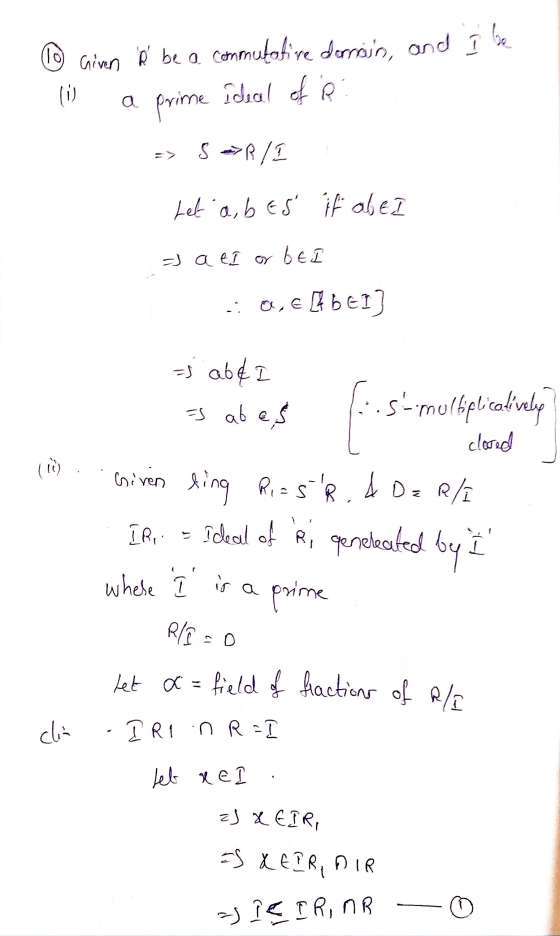
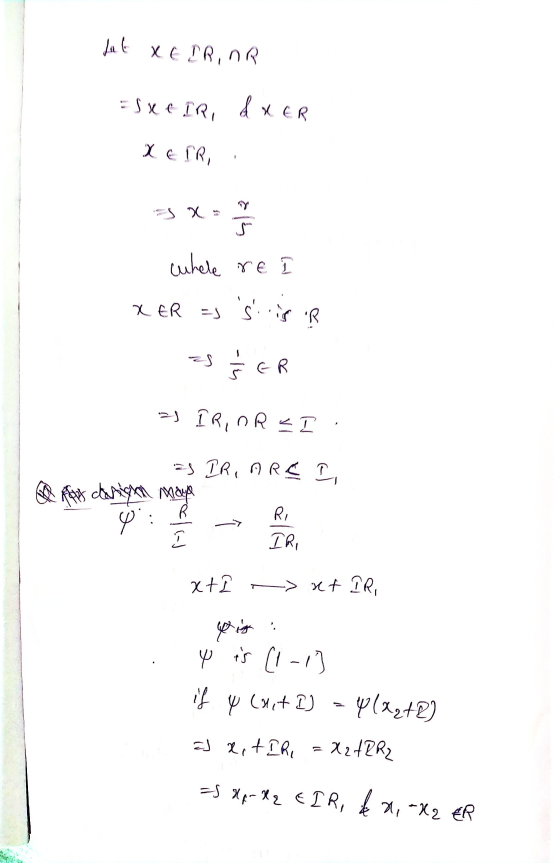
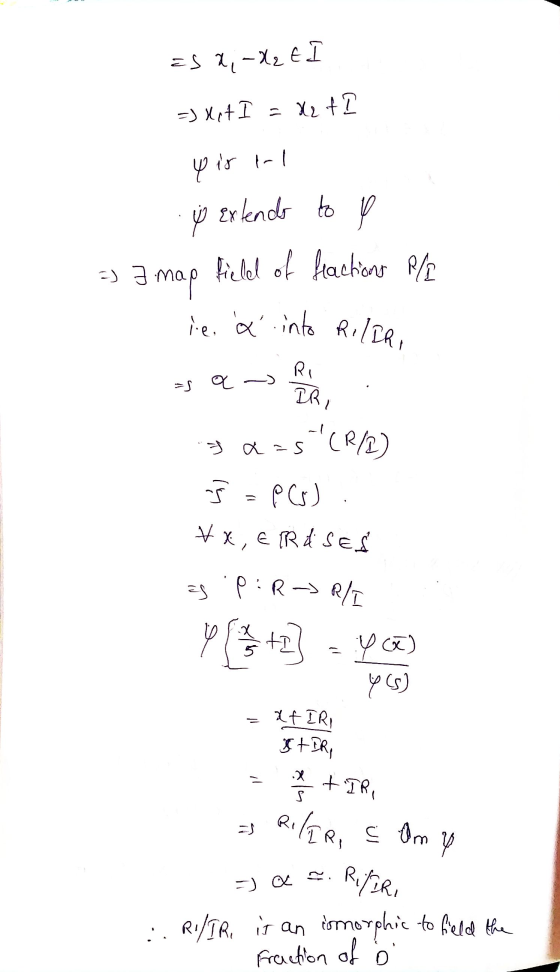
10 Let R be a commutative domain, and let I be a prime ideal of R....
Let R be a commutative ring with unity. If I is a prime ideal of R,...
Let R be a commutative ring with unity. If I is a prime ideal of R, prove that I[x] is a prime ideal of R[x].
Please solve all questions 1. Let 0 : Z/9Z+Z/12Z be the map 6(x + 9Z) =...
 Please solve all questions
1. Let 0 : Z/9Z+Z/12Z be the map 6(x + 9Z) = 4.+ 12Z (a) Prove that o is a ring homomorphism. Note: You must first show that o is well-defined (b) Is o injective? explain (c) Is o surjective? explain 2. In Z, let I = (3) and J = (18). Show that the group I/J is isomorphic to the group Z6 but that the ring I/J is not ring-isomorphic to the ring Z6. 3....
Please solve all questions
1. Let 0 : Z/9Z+Z/12Z be the map 6(x + 9Z) = 4.+ 12Z (a) Prove that o is a ring homomorphism. Note: You must first show that o is well-defined (b) Is o injective? explain (c) Is o surjective? explain 2. In Z, let I = (3) and J = (18). Show that the group I/J is isomorphic to the group Z6 but that the ring I/J is not ring-isomorphic to the ring Z6. 3....
66. Let R be a commutative ring with identity. An ideal I of R is irreducible if it cannot be expressed as the i...
 66. Let R be a commutative ring with identity. An ideal I of R is irreducible if it cannot be expressed as the intersection of two ideals of R neither of which is contained in the other. the following. (a) If P is a prime ideal then P is irreducible. (b) If z is a non-zero element of R, then there is an ideal I, maximal with respect to the property that r gI, and I is irreducible. (c) If...
Please answer all parts. Thank you! 20. Let R be a commutative ring with identity. We define a multiplicative subset of R to be a subset S such that 1 S and ab S if a, b E S. Define a relation ~ on R...
 Please answer all parts. Thank you!
20. Let R be a commutative ring with identity. We define a multiplicative subset of R to be a subset S such that 1 S and ab S if a, b E S. Define a relation ~ on R × S by (a, s) ~ (a, s') if there exists an s"e S such that s* (s,a-sa,) a. 0. Show that ~ is an equivalence relation on b. Let a/s denote the equivalence class...
Please answer all parts. Thank you!
20. Let R be a commutative ring with identity. We define a multiplicative subset of R to be a subset S such that 1 S and ab S if a, b E S. Define a relation ~ on R × S by (a, s) ~ (a, s') if there exists an s"e S such that s* (s,a-sa,) a. 0. Show that ~ is an equivalence relation on b. Let a/s denote the equivalence class...
thanks Let I be a proper ideal of a commutative ring R with 1. Prove that...
 thanks
Let I be a proper ideal of a commutative ring R with 1. Prove that I is a maximal 3. (10 ideal of R if and only if for every a e R\I, I+(a) : {i+ ar i e I,rE R} = R.
Let I be a proper ideal of a commutative ring R with 1. Prove that I is a maximal 3. (10 ideal of R if and only if for every a e R\I, I+(a) : {i+...
thanks
Let I be a proper ideal of a commutative ring R with 1. Prove that I is a maximal 3. (10 ideal of R if and only if for every a e R\I, I+(a) : {i+ ar i e I,rE R} = R.
Let I be a proper ideal of a commutative ring R with 1. Prove that I is a maximal 3. (10 ideal of R if and only if for every a e R\I, I+(a) : {i+...
2. Let R be a commutative ring with unity 1, and let a be a unit...
 2. Let R be a commutative ring with unity 1, and let a be a unit in R Let / be an ideal in R that contains the element a. Prove that / cannot be a proper ideal of R. 3. Let R be a commutative ring with unity 1 of order 30, and let be a prime ideal of R. Prove that is a maximal ideal of R
= Let R be a ring (not necessarily commutative) and let I be a two-sided ideal...
 = Let R be a ring (not necessarily commutative) and let I be a two-sided ideal in R. Let 0 : R + R/I denote the natural projection homomorphism, and write ř = º(r) = r +I. (a) Show that the function Ø : Mn(R) + Mn(R/I) M = (mij) Ø(M)= M is a surjective ring homomorphism with ker ý = Mn(I). (b) Use Homework 11, Problem 2, to argue that M2(2Z) is a maximal ideal in M2(Z). (c) Show...
74. Let R be a commutative ring with identity such that not every ideal is a principal ideal principal ideal. (b)...
 74. Let R be a commutative ring with identity such that not every ideal is a principal ideal principal ideal. (b) If I is the ideal of part (a), show that R/I is a principal ideal ring
74. Let R be a commutative ring with identity such that not every ideal is a principal ideal principal ideal. (b) If I is the ideal of part (a), show that R/I is a principal ideal ring
74. Let R be a commutative ring with identity such that not every ideal is a principal ideal principal ideal. (b) If I is the ideal of part (a), show that R/I is a principal ideal ring
Suppose R is a principal ideal domain, and let S be a multiplicatively closed subset of...
 Suppose R is a principal ideal domain, and let S be a multiplicatively closed subset of R not containing 0. Show that S-R is a principal ideal domain. Let I be an ideal of a principal ideal domain R. Show that R/I is a principal ideal domain if and only if I is prime.
Let R be a commutative ring with unity 1 and let I be a minimal ideal...
Let R be a commutative ring with unity 1 and let I be a minimal ideal in R i.e. a nonzero ideal which does not properly contain another non-zero ideal. Show that either the product of two elements in I is always zero or there is an element in I that serves as unity in the ring I. Show also that in the latter case I is a field.
 Please solve all questions
1. Let 0 : Z/9Z+Z/12Z be the map 6(x + 9Z) = 4.+ 12Z (a) Prove that o is a ring homomorphism. Note: You must first show that o is well-defined (b) Is o injective? explain (c) Is o surjective? explain 2. In Z, let I = (3) and J = (18). Show that the group I/J is isomorphic to the group Z6 but that the ring I/J is not ring-isomorphic to the ring Z6. 3....
Please solve all questions
1. Let 0 : Z/9Z+Z/12Z be the map 6(x + 9Z) = 4.+ 12Z (a) Prove that o is a ring homomorphism. Note: You must first show that o is well-defined (b) Is o injective? explain (c) Is o surjective? explain 2. In Z, let I = (3) and J = (18). Show that the group I/J is isomorphic to the group Z6 but that the ring I/J is not ring-isomorphic to the ring Z6. 3....
 66. Let R be a commutative ring with identity. An ideal I of R is irreducible if it cannot be expressed as the intersection of two ideals of R neither of which is contained in the other. the following. (a) If P is a prime ideal then P is irreducible. (b) If z is a non-zero element of R, then there is an ideal I, maximal with respect to the property that r gI, and I is irreducible. (c) If...
 Please answer all parts. Thank you!
20. Let R be a commutative ring with identity. We define a multiplicative subset of R to be a subset S such that 1 S and ab S if a, b E S. Define a relation ~ on R × S by (a, s) ~ (a, s') if there exists an s"e S such that s* (s,a-sa,) a. 0. Show that ~ is an equivalence relation on b. Let a/s denote the equivalence class...
Please answer all parts. Thank you!
20. Let R be a commutative ring with identity. We define a multiplicative subset of R to be a subset S such that 1 S and ab S if a, b E S. Define a relation ~ on R × S by (a, s) ~ (a, s') if there exists an s"e S such that s* (s,a-sa,) a. 0. Show that ~ is an equivalence relation on b. Let a/s denote the equivalence class...
 thanks
Let I be a proper ideal of a commutative ring R with 1. Prove that I is a maximal 3. (10 ideal of R if and only if for every a e R\I, I+(a) : {i+ ar i e I,rE R} = R.
Let I be a proper ideal of a commutative ring R with 1. Prove that I is a maximal 3. (10 ideal of R if and only if for every a e R\I, I+(a) : {i+...
thanks
Let I be a proper ideal of a commutative ring R with 1. Prove that I is a maximal 3. (10 ideal of R if and only if for every a e R\I, I+(a) : {i+ ar i e I,rE R} = R.
Let I be a proper ideal of a commutative ring R with 1. Prove that I is a maximal 3. (10 ideal of R if and only if for every a e R\I, I+(a) : {i+...
 2. Let R be a commutative ring with unity 1, and let a be a unit in R Let / be an ideal in R that contains the element a. Prove that / cannot be a proper ideal of R. 3. Let R be a commutative ring with unity 1 of order 30, and let be a prime ideal of R. Prove that is a maximal ideal of R
 = Let R be a ring (not necessarily commutative) and let I be a two-sided ideal in R. Let 0 : R + R/I denote the natural projection homomorphism, and write ř = º(r) = r +I. (a) Show that the function Ø : Mn(R) + Mn(R/I) M = (mij) Ø(M)= M is a surjective ring homomorphism with ker ý = Mn(I). (b) Use Homework 11, Problem 2, to argue that M2(2Z) is a maximal ideal in M2(Z). (c) Show...
 74. Let R be a commutative ring with identity such that not every ideal is a principal ideal principal ideal. (b) If I is the ideal of part (a), show that R/I is a principal ideal ring
74. Let R be a commutative ring with identity such that not every ideal is a principal ideal principal ideal. (b) If I is the ideal of part (a), show that R/I is a principal ideal ring
74. Let R be a commutative ring with identity such that not every ideal is a principal ideal principal ideal. (b) If I is the ideal of part (a), show that R/I is a principal ideal ring
 Suppose R is a principal ideal domain, and let S be a multiplicatively closed subset of R not containing 0. Show that S-R is a principal ideal domain. Let I be an ideal of a principal ideal domain R. Show that R/I is a principal ideal domain if and only if I is prime.
Most questions answered within 3 hours.
-
Where is the error in this code sequence?
String s1 = "Hello";
String s2 = "ello";...
asked 10 months ago -
Financial data for Joel de Paris, Inc., for last year
follow:
Joel de Paris, Inc.
Balance...
asked 10 months ago -
Consider this reaction:
Al2(SO4)3 (aq)+ BaCl3
(aq) Al2Cl6 (aq)- +
3BaSO4(s) . What is the...
asked 10 months ago -
Suppose that Savneet is considering increasing her
recent random sample from 20 car rentals to 40...
asked 10 months ago -
Trucks arrive at an unloading terminal at an average rate of 120
per hour.
Trucks arrive...
asked 10 months ago -
Why are methanol and ethanol completely soluble in water while
octanol is not very little soluble....
asked 10 months ago -
A facilities manager at a university reads in a research report
that the mean amount of...
asked 10 months ago -
When the CuSO4 is rehydrated by adding water to the anhydrous
compound, is this an endothermic...
asked 10 months ago -
A ray of sunlight is passing from diamond into crown glass; the
angle of incidence is...
asked 10 months ago -
A block of mass 0.249 kg is placed on top of a light, vertical
spring of...
asked 10 months ago -
how do the kidneys compensate in the presences of acidosis
a) trigger hyperventilate
b) reserve acid...
asked 10 months ago -
Question 501 pts
The rental rate of capital to the firm increases. Which of the
following...
asked 10 months ago