
Homework Answers

Add Answer to:
Use the following information to answer the next two questions The reaction between sodium phosphate and...
Numerical Response 16. The pH of a 0.070 mol/L benzoic acid solution is (Record your three-digit...
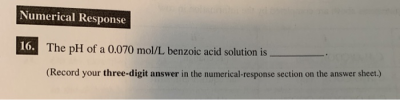 Numerical Response 16. The pH of a 0.070 mol/L benzoic acid solution is (Record your three-digit answer in the numerical-response section on the answer sheet.)
Solve stoichiometry problems with reactants in sol ution Question Refer to the precipitation reaction below. CaCl2...
 Solve stoichiometry problems with reactants in sol ution Question Refer to the precipitation reaction below. CaCl2 (aq)2AgNO3 (aq) - Ca(NO3)2 (aq) +2AgCI (s) How much 1.5 M CaCl2, in liters, will completely precipitate the Agt in 1.0 L of 0.20 mol A^NO2 solution? Round to two significant figures. Do not include units in your answer. Provide your answer below:
Use the following information to answer questions 20 to 22. The following evidence was obtained from...
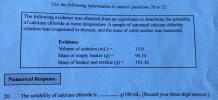 Use the following information to answer questions 20 to 22. The following evidence was obtained from an experiment to determine the solubility of calcium chloride at room temperature. A sample of saturated calcium chloride solution was evaporated to dryness, and the mass of solid residue was measured. Evidence Volume of solution (mL) = Mass of empty beaker (g) = Mass of beaker and residue (g) = 15.0 90.54 101.36 Numerical Response 20. The solubility of calcium chloride is g/100 mL....
Watch the ChemTour animation below on acid-base titrations. Then, answer the questions about the following reaction:...
 Watch the ChemTour animation below on acid-base titrations.
Then, answer the questions about the following reaction:
$$Ca(OH)2(aq)+2HCl(aq)CaCl2(aq)+H2O(l)
An aqueous solution of Ca(OH)2with a concentration of
0.140 M was used to titrate 25.00 mL of aqueous HCl. 14.43
mL of the Ca(OH)2was required to reach the endpoint of
the titration.
Pt1: How many moles of base were required to react completely with
the acid in this reaction?
Pt2:How many moles of HCl were present in the original 25.00 mL
of acid?...
Watch the ChemTour animation below on acid-base titrations.
Then, answer the questions about the following reaction:
$$Ca(OH)2(aq)+2HCl(aq)CaCl2(aq)+H2O(l)
An aqueous solution of Ca(OH)2with a concentration of
0.140 M was used to titrate 25.00 mL of aqueous HCl. 14.43
mL of the Ca(OH)2was required to reach the endpoint of
the titration.
Pt1: How many moles of base were required to react completely with
the acid in this reaction?
Pt2:How many moles of HCl were present in the original 25.00 mL
of acid?...
Use the following information to answer the next the questions prot the Double Replacement Reaction In...
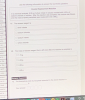 Use the following information to answer the next the questions prot the Double Replacement Reaction In a chemical analysis, 5.00 g of silver nitrate in solution reacted with 20 got sodium chloride in solution Alter the reaction was como the mature was thered and the mass of dried precipitate was measured to be 3.0 div drox 47. The excess roagentis sliver nitrate ventu magn sodium chloride sodium nitrate silver chondo aion soluti 48. The mass of excess reagent that is...
QUESTION 3 1 points Save Answer The enthalpy change for the reaction of perchloric acid (HC104)...
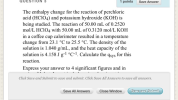 QUESTION 3 1 points Save Answer The enthalpy change for the reaction of perchloric acid (HC104) and potassium hydroxide (KOH) is being studied. The reaction of 50.00 mL of 0.2520 mol/L HCIO4 with 50.00 mL of 0.3120 mol/L KOH in a coffee cup calorimeter resulted in a temperature change from 23.1 °C to 25.5 °C. The density of the solution is 1.040 g/mL, and the heat capacity of the solution is 4.158 J g-1 °C-1. Calculate the qsys for this...
Use the following information to answer the next question. In the Rutherford alpha particle scattering experiment,...
 Use the following information to answer the next question. In the Rutherford alpha particle scattering experiment, some alpha particles were deflected coming straight back from the gold foil. When an alpha particle is emitted by the radium sample, it has a kinetic energy of 1.0 x 10⁻²² J. The electric potential energy of a charged particle in a radial electric field is modelled as kq192 Ер r Numerical Response 2. The maximum acceleration of an alpha particle at its closest...
i need the answer for part 2 and 3! please PART II - Short answer questions...
 i need the answer for part 2 and 3! please
PART II - Short answer questions (50 points) Show all setup and work for all numerical "P and work for all numerical problems. Make sure that your final anwer has the correct sumber of significant figures. No acant figures. NO CREDIT for answers without CLEARLY shown setup and solution w many grams of 12 (253.8 g/mol) will be formed when 45.0 ml. of 0.350 M Cu(NO3)2 is reacted with excess...
i need the answer for part 2 and 3! please
PART II - Short answer questions (50 points) Show all setup and work for all numerical "P and work for all numerical problems. Make sure that your final anwer has the correct sumber of significant figures. No acant figures. NO CREDIT for answers without CLEARLY shown setup and solution w many grams of 12 (253.8 g/mol) will be formed when 45.0 ml. of 0.350 M Cu(NO3)2 is reacted with excess...
The stoichiometric relationship between the reactants and products of an aqueous reaction can be used to...
The stoichiometric relationship between the reactants and products of an aqueous reaction can be used to determine different kinds of information about a reaction, such as the volume of a given molarity reactant required to produce a certain amount of product. Hydrochloric acid (HCl) reacts with sodium carbonate (Na2CO3), forming sodium chloride (NaCl), water (H2O), and carbon dioxide (CO2). This equation is balanced as written: 2HCl(aq)+Na2CO3(aq)→2NaCl(aq)+H2O(l)+CO2(g) a. What volume of 2.50 M HCl in liters is needed to react completely...
15. The mixing of which pair of reactants will result in a precipitation reaction? CsI(aq)...
15. The mixing of which pair of reactants will result in a precipitation reaction? CsI(aq) + NaOH(aq) HCl(aq) + Ca(OH)2(aq) K2SO4(aq) + Hg2(NO3)2(aq) NaNO3(aq) + NH4Cl(aq) 16. Which of the following is a precipitation reaction? Zn(s) + 2 AgNO3(aq) 2 Ag(s) + Zn(NO3)2(aq) NaCl(aq) + LiI(aq) NaI(aq) + LiCl(aq) 2 KI(aq) + Hg2(NO3)2(aq) Hg2I2(s) + 2 KNO3(aq) HI(aq) + NaOH(aq) NaI(aq) + H2O(l) None of these are precipitation reactions. 17. Which...
 Numerical Response 16. The pH of a 0.070 mol/L benzoic acid solution is (Record your three-digit answer in the numerical-response section on the answer sheet.)
 Solve stoichiometry problems with reactants in sol ution Question Refer to the precipitation reaction below. CaCl2 (aq)2AgNO3 (aq) - Ca(NO3)2 (aq) +2AgCI (s) How much 1.5 M CaCl2, in liters, will completely precipitate the Agt in 1.0 L of 0.20 mol A^NO2 solution? Round to two significant figures. Do not include units in your answer. Provide your answer below:
 Use the following information to answer questions 20 to 22. The following evidence was obtained from an experiment to determine the solubility of calcium chloride at room temperature. A sample of saturated calcium chloride solution was evaporated to dryness, and the mass of solid residue was measured. Evidence Volume of solution (mL) = Mass of empty beaker (g) = Mass of beaker and residue (g) = 15.0 90.54 101.36 Numerical Response 20. The solubility of calcium chloride is g/100 mL....
 Watch the ChemTour animation below on acid-base titrations.
Then, answer the questions about the following reaction:
$$Ca(OH)2(aq)+2HCl(aq)CaCl2(aq)+H2O(l)
An aqueous solution of Ca(OH)2with a concentration of
0.140 M was used to titrate 25.00 mL of aqueous HCl. 14.43
mL of the Ca(OH)2was required to reach the endpoint of
the titration.
Pt1: How many moles of base were required to react completely with
the acid in this reaction?
Pt2:How many moles of HCl were present in the original 25.00 mL
of acid?...
Watch the ChemTour animation below on acid-base titrations.
Then, answer the questions about the following reaction:
$$Ca(OH)2(aq)+2HCl(aq)CaCl2(aq)+H2O(l)
An aqueous solution of Ca(OH)2with a concentration of
0.140 M was used to titrate 25.00 mL of aqueous HCl. 14.43
mL of the Ca(OH)2was required to reach the endpoint of
the titration.
Pt1: How many moles of base were required to react completely with
the acid in this reaction?
Pt2:How many moles of HCl were present in the original 25.00 mL
of acid?...
 Use the following information to answer the next the questions prot the Double Replacement Reaction In a chemical analysis, 5.00 g of silver nitrate in solution reacted with 20 got sodium chloride in solution Alter the reaction was como the mature was thered and the mass of dried precipitate was measured to be 3.0 div drox 47. The excess roagentis sliver nitrate ventu magn sodium chloride sodium nitrate silver chondo aion soluti 48. The mass of excess reagent that is...
 QUESTION 3 1 points Save Answer The enthalpy change for the reaction of perchloric acid (HC104) and potassium hydroxide (KOH) is being studied. The reaction of 50.00 mL of 0.2520 mol/L HCIO4 with 50.00 mL of 0.3120 mol/L KOH in a coffee cup calorimeter resulted in a temperature change from 23.1 °C to 25.5 °C. The density of the solution is 1.040 g/mL, and the heat capacity of the solution is 4.158 J g-1 °C-1. Calculate the qsys for this...
 Use the following information to answer the next question. In the Rutherford alpha particle scattering experiment, some alpha particles were deflected coming straight back from the gold foil. When an alpha particle is emitted by the radium sample, it has a kinetic energy of 1.0 x 10⁻²² J. The electric potential energy of a charged particle in a radial electric field is modelled as kq192 Ер r Numerical Response 2. The maximum acceleration of an alpha particle at its closest...
 i need the answer for part 2 and 3! please
PART II - Short answer questions (50 points) Show all setup and work for all numerical "P and work for all numerical problems. Make sure that your final anwer has the correct sumber of significant figures. No acant figures. NO CREDIT for answers without CLEARLY shown setup and solution w many grams of 12 (253.8 g/mol) will be formed when 45.0 ml. of 0.350 M Cu(NO3)2 is reacted with excess...
i need the answer for part 2 and 3! please
PART II - Short answer questions (50 points) Show all setup and work for all numerical "P and work for all numerical problems. Make sure that your final anwer has the correct sumber of significant figures. No acant figures. NO CREDIT for answers without CLEARLY shown setup and solution w many grams of 12 (253.8 g/mol) will be formed when 45.0 ml. of 0.350 M Cu(NO3)2 is reacted with excess...
Most questions answered within 3 hours.
-
Where is the error in this code sequence?
String s1 = "Hello";
String s2 = "ello";...
asked 10 months ago -
Financial data for Joel de Paris, Inc., for last year
follow:
Joel de Paris, Inc.
Balance...
asked 10 months ago -
Consider this reaction:
Al2(SO4)3 (aq)+ BaCl3
(aq) Al2Cl6 (aq)- +
3BaSO4(s) . What is the...
asked 10 months ago -
Suppose that Savneet is considering increasing her
recent random sample from 20 car rentals to 40...
asked 10 months ago -
Trucks arrive at an unloading terminal at an average rate of 120
per hour.
Trucks arrive...
asked 10 months ago -
Why are methanol and ethanol completely soluble in water while
octanol is not very little soluble....
asked 10 months ago -
A facilities manager at a university reads in a research report
that the mean amount of...
asked 10 months ago -
When the CuSO4 is rehydrated by adding water to the anhydrous
compound, is this an endothermic...
asked 10 months ago -
A ray of sunlight is passing from diamond into crown glass; the
angle of incidence is...
asked 10 months ago -
A block of mass 0.249 kg is placed on top of a light, vertical
spring of...
asked 10 months ago -
how do the kidneys compensate in the presences of acidosis
a) trigger hyperventilate
b) reserve acid...
asked 10 months ago -
Question 501 pts
The rental rate of capital to the firm increases. Which of the
following...
asked 10 months ago