
Homework Answers


Add Answer to:
Select all that do not follow the octet rule. PCI_3 SeF_4 AICI_3 SbF_5 Select all choices...
Which of the following atoms cannot exceed the octet rule in a molecule? a. CI b....
 Which of the following atoms cannot exceed the octet rule in a molecule? a. CI b. O c. P d. S e. All of them can exceed octet Thionyl chloride is used as an oxidizing and chlorinating agent in organic chemistry. Select the best Lewis structure for SOCI_2, Which of the following molecules has a net dipole moment (polar)? a. BeCI_2 b. SF_2 c. KrF_2 d. CO_2 e. CCI_4 Write Lewis dot symbol for O^2-? Place the following in order...
Compoumas at mignt result from the combination of these metals and nonmetals. Name these compounds. Name...
 Compoumas at mignt result from the combination of these metals and nonmetals. Name these compounds. Name one ionic compound that contains only nonmetallic elements. Name one ionic compound that contains a polyatomic cation and a polyatomic anion (see Table 2.3). 9.9 9.10 An ionic bond is formed between a cation A and an anion B". How would the 9.15 energy of the ionic bond [see Equation (9.2)] be affected by the following changes? (a) doubling the radius of A*, (b)...
Which response includes all the molecules below that do not follow the octet rule? H_2S BCl_3...
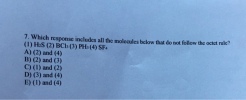 Which response includes all the molecules below that do not follow the octet rule? H_2S BCl_3 PH_3 SF_4 (2) and (4) (2) and (3) (1) and (2) (3) and (4) (1) and (4)
Select all correct answers to fill in the blank and complete the statement below. When atoms...
Select all correct answers to fill in the blank and complete the statement below. When atoms transfer electrons to form charged species that stick together like little magnets, _______. Ionic compounds are formed. The compound is held together by covalent bonds. The compound is made of ions. A molecule is formed. ___________________________________________________________________________ Which of the following ionic compounds should have the shortest ionic bond and strongest lattice energy? NaI NaCl NaF NaBr _________________________________________________________________ The name of...
How many valence electrons does S^2 have? A. 3 B. 8 C. 15 D. 1 E....
 How many valence electrons does S^2 have? A. 3 B. 8 C. 15 D. 1 E. 18 52. Which of the following ground-state ions has the largest number of unpaired electrons? A. Cr^2+ B. Mn^2+ C. Ni^2+ D. Cu^+ E. Co^2+ 53. Arrange the following ions in order of increasing ionic radius: K^+, P^3-, S^2-, CI^-, increasing radius A. K^+ < CI^- < S^2- < P^3- B. CI^- < S^2- < P^3- < K^+ C. K^+ < P^3- < S^2-...
TRUE-FALSE QUESTIONS (2 points each) 22. Current chemical theory strongly suggests that all naturally occurring elements have been The most common (abundant) element in the universe is Common phy...
 TRUE-FALSE QUESTIONS (2 points each) 22. Current chemical theory strongly suggests that all naturally occurring elements have been The most common (abundant) element in the universe is Common physical properties for a substance include color, melting point, boiling po 24. flammability and hardness. lonic bonds result from the sharing of one or more pairs of electrons. 26, The elements gold, silver and antimony all have chemical symbols which start with the 27 letter A Once a coordinate covalent bond is...
1. Which one of the following is most likely to be an ionic compound? A) CaCl2...
1. Which one of the following is most likely to be an ionic compound? A) CaCl2 B) CO2 C) CS2 D) SO2 E) OF2 2. Which one of the following ionic solids would have the largest lattice energy? A) NaCl B) NaF C) CaBr2 D) CsI E) CaCl2 3. Calculate the energy change for the reaction K(g) + I(g) → K+(g) + I – (g) given the following ionization energy (IE) and electron affinity (EA) values. IE K: 419 kJ/mol...
1. Select the two compounds that are more likely to be a gas at room temperature...
1. Select the two compounds that are more likely to be a gas at room temperature (as opposed to a liquid). CH4 CH3OH C2H6 H2O 2. The separation of charges within a polar molecule is called a(n) ________. polar bond strong attraction dipole ionic bond dipole-dipole 3. Which of the following intermolecular forces best describes why nonpolar molecules like gasoline (C8H18) have only limited solubility in water? dipole-dipole ion-dipole Both dipole-dipole and induced dipole-induced dipole induced dipole-induced dipole dipole-induced dipole...
1. How are the properties of molecules related to the 3D distribution of electrons and Coulomb’s...
1. How are the properties of molecules related to the 3D distribution of electrons and Coulomb’s law? Provide evidence and reasoning to support your answer in 5-6 sentences. 2. Match each compound to the description of electron distribution between the atoms. Cl2, AgCl, PCl3, C2H6O, CH4 - Electrons transferred - Unequal distribution of electrons - Electrons equal distributed 3. Which bond is the most polar? H-O, H-F, H-N, H-C. Which (ones) of these substances have a smell? Si, P, CaCl2,...
all 1. Which of the following Lewis structures represent resonance forms of ozone, O,? -0 A...
 all
1. Which of the following Lewis structures represent resonance forms of ozone, O,? -0 A В C A) A and B B) B and C C) C and D D) A and C E) A and D 2. What is the molar mass of carbon monoxide? [Atomic masses: C, 12.01 g/mol; O, 16.00 g/mol] A) 28.01 g/mol B) 56.02 g/mol C) 44.01 g/mol D) 4.01 g/mol E) 40.01 g/mol 3. Select the ionic compound which is insoluble in water....
all
1. Which of the following Lewis structures represent resonance forms of ozone, O,? -0 A В C A) A and B B) B and C C) C and D D) A and C E) A and D 2. What is the molar mass of carbon monoxide? [Atomic masses: C, 12.01 g/mol; O, 16.00 g/mol] A) 28.01 g/mol B) 56.02 g/mol C) 44.01 g/mol D) 4.01 g/mol E) 40.01 g/mol 3. Select the ionic compound which is insoluble in water....
 Which of the following atoms cannot exceed the octet rule in a molecule? a. CI b. O c. P d. S e. All of them can exceed octet Thionyl chloride is used as an oxidizing and chlorinating agent in organic chemistry. Select the best Lewis structure for SOCI_2, Which of the following molecules has a net dipole moment (polar)? a. BeCI_2 b. SF_2 c. KrF_2 d. CO_2 e. CCI_4 Write Lewis dot symbol for O^2-? Place the following in order...
 Compoumas at mignt result from the combination of these metals and nonmetals. Name these compounds. Name one ionic compound that contains only nonmetallic elements. Name one ionic compound that contains a polyatomic cation and a polyatomic anion (see Table 2.3). 9.9 9.10 An ionic bond is formed between a cation A and an anion B". How would the 9.15 energy of the ionic bond [see Equation (9.2)] be affected by the following changes? (a) doubling the radius of A*, (b)...
 Which response includes all the molecules below that do not follow the octet rule? H_2S BCl_3 PH_3 SF_4 (2) and (4) (2) and (3) (1) and (2) (3) and (4) (1) and (4)
 How many valence electrons does S^2 have? A. 3 B. 8 C. 15 D. 1 E. 18 52. Which of the following ground-state ions has the largest number of unpaired electrons? A. Cr^2+ B. Mn^2+ C. Ni^2+ D. Cu^+ E. Co^2+ 53. Arrange the following ions in order of increasing ionic radius: K^+, P^3-, S^2-, CI^-, increasing radius A. K^+ < CI^- < S^2- < P^3- B. CI^- < S^2- < P^3- < K^+ C. K^+ < P^3- < S^2-...
 TRUE-FALSE QUESTIONS (2 points each) 22. Current chemical theory strongly suggests that all naturally occurring elements have been The most common (abundant) element in the universe is Common physical properties for a substance include color, melting point, boiling po 24. flammability and hardness. lonic bonds result from the sharing of one or more pairs of electrons. 26, The elements gold, silver and antimony all have chemical symbols which start with the 27 letter A Once a coordinate covalent bond is...
 all
1. Which of the following Lewis structures represent resonance forms of ozone, O,? -0 A В C A) A and B B) B and C C) C and D D) A and C E) A and D 2. What is the molar mass of carbon monoxide? [Atomic masses: C, 12.01 g/mol; O, 16.00 g/mol] A) 28.01 g/mol B) 56.02 g/mol C) 44.01 g/mol D) 4.01 g/mol E) 40.01 g/mol 3. Select the ionic compound which is insoluble in water....
all
1. Which of the following Lewis structures represent resonance forms of ozone, O,? -0 A В C A) A and B B) B and C C) C and D D) A and C E) A and D 2. What is the molar mass of carbon monoxide? [Atomic masses: C, 12.01 g/mol; O, 16.00 g/mol] A) 28.01 g/mol B) 56.02 g/mol C) 44.01 g/mol D) 4.01 g/mol E) 40.01 g/mol 3. Select the ionic compound which is insoluble in water....
Most questions answered within 3 hours.
-
Where is the error in this code sequence?
String s1 = "Hello";
String s2 = "ello";...
asked 10 months ago -
Financial data for Joel de Paris, Inc., for last year
follow:
Joel de Paris, Inc.
Balance...
asked 10 months ago -
Consider this reaction:
Al2(SO4)3 (aq)+ BaCl3
(aq) Al2Cl6 (aq)- +
3BaSO4(s) . What is the...
asked 10 months ago -
Suppose that Savneet is considering increasing her
recent random sample from 20 car rentals to 40...
asked 10 months ago -
Trucks arrive at an unloading terminal at an average rate of 120
per hour.
Trucks arrive...
asked 10 months ago -
Why are methanol and ethanol completely soluble in water while
octanol is not very little soluble....
asked 10 months ago -
A facilities manager at a university reads in a research report
that the mean amount of...
asked 10 months ago -
When the CuSO4 is rehydrated by adding water to the anhydrous
compound, is this an endothermic...
asked 10 months ago -
A ray of sunlight is passing from diamond into crown glass; the
angle of incidence is...
asked 10 months ago -
A block of mass 0.249 kg is placed on top of a light, vertical
spring of...
asked 10 months ago -
how do the kidneys compensate in the presences of acidosis
a) trigger hyperventilate
b) reserve acid...
asked 10 months ago -
Question 501 pts
The rental rate of capital to the firm increases. Which of the
following...
asked 10 months ago