
Homework Answers
- When we apply the axial force to the specimen, it tends to elongate and deforms.
Stress-strain curve for elastic material :
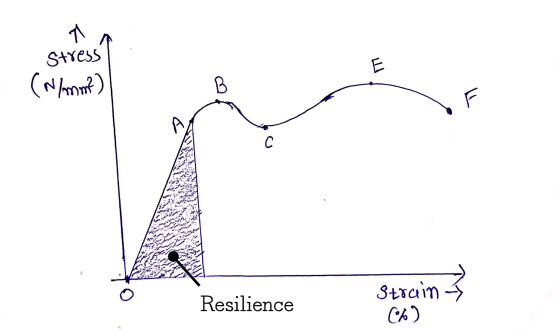
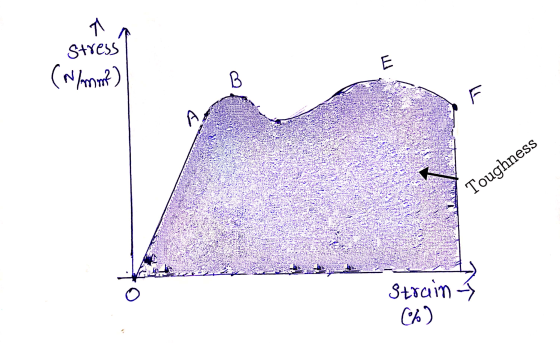
- There are mainly three phases of deformation,
(1) Temporary deformation :- It is also known as Elastic deformation of the body. OA region in the stress- strain diagram shows the Temporary deformation.
(2) Permenent deformation :- It is also known as plastic deformation of the body. BF region in stress-strain diagram shows the permenent deformation.
(3) Fracture :- It is the last point on stress- strain diagram ( Point F ) and it is the point at which body breaks into two parts.
Now, Toughness :- It is the energy absorbed per unit volume of the body, when subjected to axial force till the Fracture point.
Resilience :- It is the energy absorbed per unit volume of the body, when subjected to axial force till the elastic point.
So, Toughness and Resilience both are energy absorbing Phenomena but for different regions.
So, We can say that Resilience is the area under the curve of stress-strain diagram till elastic point ( Point A ) and Toughness is the area under the curve of stress-strain diagram till fracture point.
So, Obviously Thoughness will be greater than the Resilience.
Resilience is considered when large elastic deformation is needed or desired and Toughness is important property of the material for different metal forming processes.
Add Answer to:
material engineering
Q8: What are the main differences between toughness and resilience?
5) Find the resilience and the toughness for a metal that experiences both elastic and plastic...
 5) Find the resilience and the toughness for a metal that experiences both elastic and plastic deformation. Assume a linear elastic relationship for the elastic deformation (Hooke's Law) and that the modulus of elasticity is 172 GPa and that the strain at yield is 0.01. For the plastic deformation, assume that the relationship between stress and strain is described by-ken and that k-6900 MPa and n-0.30. Plastic deformation occurs between the strain at yield, 0.01, and the failure strain, 0.75.
What is the main memory and what are the differences between RAM and ROM
What is the main memory and what are the differences between RAM and ROM
Define machinability. Compare the machinability of acrylic material with the metal materials. Define Toughness. What does...
 Define machinability. Compare the machinability of acrylic material with the metal materials. Define Toughness. What does Toughness of Material Indicate? What is Tolerance and why is it important when making products. List the 3 different of tolerances. What is GD&T? Why it is important
What are the main differences between the wheels of a railway and a highway vehicle
What are the main differences between the wheels of a railway and a highway vehicle
What are the main differences between the wheels of a railway and a highway vehicle?
What are the main differences between the wheels of a railway and a highway vehicle?
What are the wo main focuses used in statistics and what are the differences between them?
What are the wo main focuses used in statistics and what are the differences between them?
What are the main differences between qualitative and quantitative studies? What are the three types of...
What are the main differences between qualitative and quantitative studies? What are the three types of pre-experimental studies? What is the most significant threat to this type of experimentation?
1. What are the main differences between alloys and composite materials? Explain with an example.
 1. What are the main differences between alloys and composite materials? Explain with an example.
What are the main differences between epidemiology and risk assessment in terms of goals and approaches?
What are the main differences between epidemiology and risk assessment in terms of goals and approaches?
What are the main similarities and differences in the approaches to epidemiology between human health, veterinary...
 What are the main similarities and differences in the approaches to epidemiology between human health, veterinary medicine and plant disease epidemiology? What are the reasons behind those differences and the implications of those differences? You can discuss this in broad terms or focus on a specific aspect of epidemiology and compare it between the three realms, but the most important thing is that you think critically and develop your arguments for the comparison. (Write between 200words).
 5) Find the resilience and the toughness for a metal that experiences both elastic and plastic deformation. Assume a linear elastic relationship for the elastic deformation (Hooke's Law) and that the modulus of elasticity is 172 GPa and that the strain at yield is 0.01. For the plastic deformation, assume that the relationship between stress and strain is described by-ken and that k-6900 MPa and n-0.30. Plastic deformation occurs between the strain at yield, 0.01, and the failure strain, 0.75.
 Define machinability. Compare the machinability of acrylic material with the metal materials. Define Toughness. What does Toughness of Material Indicate? What is Tolerance and why is it important when making products. List the 3 different of tolerances. What is GD&T? Why it is important
 1. What are the main differences between alloys and composite materials? Explain with an example.
 What are the main similarities and differences in the approaches to epidemiology between human health, veterinary medicine and plant disease epidemiology? What are the reasons behind those differences and the implications of those differences? You can discuss this in broad terms or focus on a specific aspect of epidemiology and compare it between the three realms, but the most important thing is that you think critically and develop your arguments for the comparison. (Write between 200words).
Most questions answered within 3 hours.
-
Where is the error in this code sequence?
String s1 = "Hello";
String s2 = "ello";...
asked 11 months ago -
Financial data for Joel de Paris, Inc., for last year
follow:
Joel de Paris, Inc.
Balance...
asked 11 months ago -
Consider this reaction:
Al2(SO4)3 (aq)+ BaCl3
(aq) Al2Cl6 (aq)- +
3BaSO4(s) . What is the...
asked 11 months ago -
Suppose that Savneet is considering increasing her
recent random sample from 20 car rentals to 40...
asked 11 months ago -
Trucks arrive at an unloading terminal at an average rate of 120
per hour.
Trucks arrive...
asked 11 months ago -
Why are methanol and ethanol completely soluble in water while
octanol is not very little soluble....
asked 11 months ago -
A facilities manager at a university reads in a research report
that the mean amount of...
asked 11 months ago -
When the CuSO4 is rehydrated by adding water to the anhydrous
compound, is this an endothermic...
asked 11 months ago -
A ray of sunlight is passing from diamond into crown glass; the
angle of incidence is...
asked 11 months ago -
A block of mass 0.249 kg is placed on top of a light, vertical
spring of...
asked 11 months ago -
how do the kidneys compensate in the presences of acidosis
a) trigger hyperventilate
b) reserve acid...
asked 11 months ago -
Question 501 pts
The rental rate of capital to the firm increases. Which of the
following...
asked 11 months ago