
Homework Answers
Add Answer to:
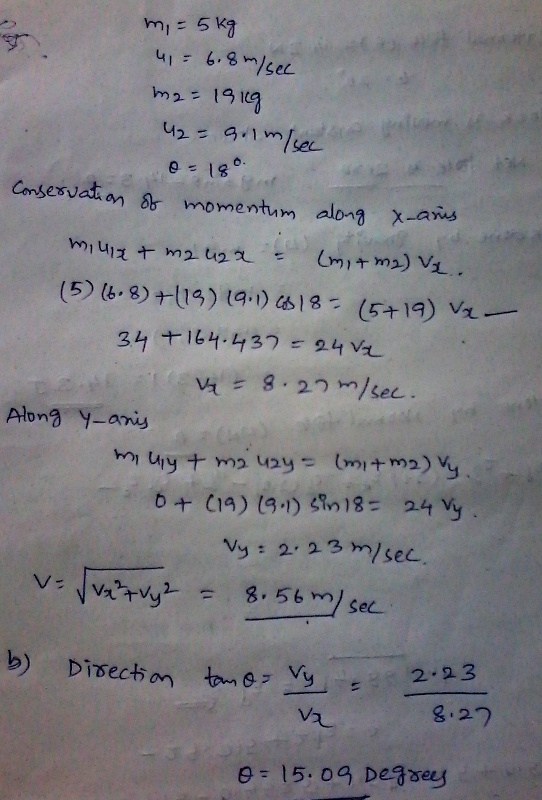
A(n) 5 kg object moving with a speed of 6.8 m/s collides with a(n) 19 kg...
017 (part 1 of 2) 10.0 points A(n) 4 kg object moving with a speed of...
 017 (part 1 of 2) 10.0 points A(n) 4 kg object moving with a speed of 9.4 m/s collides with a(n) 17 kg object moving with a velocity of 8.6 m/s in a direction 22 from the initial direction of motion of the 4 kg object. 4 kg 9.4 m/s 22° 8.6 m/s 17 kg What is the speed of the two objects after the collision if they remain stuck together? Answer in units of m/s 018 (part 2 of...
001 (part 1 of 2) 10.0 points A(n) 6 kg object moving with a speed 8.7...
 001 (part 1 of 2) 10.0 points A(n) 6 kg object moving with a speed 8.7 m/s collides with a(n) 16 kg object movir with a velocity of 8.8 m/s in a direction 24 from the initial direction of motion of the 6 kų object. 6 kg 8.7 m/s 24° 8.8 m/s 16 kg What is the speed of the two objects after the collision if they remain stuck together? Answer in units of m/s. 002 (part 2 of 2)...
A 4.00 kg object traveling at 3.00 m/s collides with a 3.00 kg object moving in...
A 4.00 kg object traveling at 3.00 m/s collides with a 3.00 kg object moving in the opposite direction. After the collision both objects are at rest. How much kinetic energy was lost in the collision?
An 4.7-kg object moving at 12.2 m/s catches up and collides with an 22.3-kg object moving...
An 4.7-kg object moving at 12.2 m/s catches up and collides with an 22.3-kg object moving at 2.1 m/s in the same direction. After the collision the 4.7-kg object is observed to be moving in the opposite direction with the speed of 2.6 m/s. How much kinetic energy was lost in this system?
A 19.5kg object moving in the +x direction at 5.5 m/s collides head on with a...
A 19.5kg object moving in the +x direction at 5.5 m/s collides head on with a 15.9kg object moving in the -x direction at 3.5m/s. Part A Find the final velocity of each mass if the objects stick together. Part B Find the final velocity of each mass if the collision is elastic. Part C Find the final velocity of each mass if the 19.5 kg object is at rest after the collision. Part D Is the result in part...
a 2 kg object is moving east 3 m/s. It collides with a 10 kg object...
a 2 kg object is moving east 3 m/s. It collides with a 10 kg object moving west 5 m/s. after the collision, the 2 kg moves west with velocity of 5 m/s. A.) what is the velocity of the 10 kg after the collision? B.) Show that kinetic energy is not considered.
A 2-kg block moving in the positive x direction with a speed of 5.0 m/s collides...
A 2-kg block moving in the positive x direction with a speed of 5.0 m/s collides with a 3-kg block moving in the same direction with a speed of 2.0 m/s. After the collision the 3-kg block moves at 4.2 m/s. Find the velocity of the 2-kg block after the collision. Is the collision elastic or inelastic? Justify your answer.
A moving object A of mass 8.7 kg and speed 2.2 m/s collides with a stationary...
A moving object A of mass 8.7 kg and speed 2.2 m/s collides with a stationary object B of mass 9.4 kg. The collision is totally inelastic. Calculate the speed of the combined object after collision.
A mass of 2.5 kg moving at 5.5 m/s collides with a stationary object of mass...
A mass of 2.5 kg moving at 5.5 m/s collides with a stationary object of mass 4.6 kg. After collision, they move off together. Calculate the final speed in m/s, to 2 sf.
An object of mass m moves to the right with speed v it collides head on...
An object of mass m moves to the right with speed v it collides head on with an object of mass 2m moving with speed v/3 in the opposite edirection. if the two objects stick together what is the speed and direction of the combined object of mass 3m after collision
 017 (part 1 of 2) 10.0 points A(n) 4 kg object moving with a speed of 9.4 m/s collides with a(n) 17 kg object moving with a velocity of 8.6 m/s in a direction 22 from the initial direction of motion of the 4 kg object. 4 kg 9.4 m/s 22° 8.6 m/s 17 kg What is the speed of the two objects after the collision if they remain stuck together? Answer in units of m/s 018 (part 2 of...
 001 (part 1 of 2) 10.0 points A(n) 6 kg object moving with a speed 8.7 m/s collides with a(n) 16 kg object movir with a velocity of 8.8 m/s in a direction 24 from the initial direction of motion of the 6 kų object. 6 kg 8.7 m/s 24° 8.8 m/s 16 kg What is the speed of the two objects after the collision if they remain stuck together? Answer in units of m/s. 002 (part 2 of 2)...
Most questions answered within 3 hours.
-
Where is the error in this code sequence?
String s1 = "Hello";
String s2 = "ello";...
asked 11 months ago -
Financial data for Joel de Paris, Inc., for last year
follow:
Joel de Paris, Inc.
Balance...
asked 11 months ago -
Consider this reaction:
Al2(SO4)3 (aq)+ BaCl3
(aq) Al2Cl6 (aq)- +
3BaSO4(s) . What is the...
asked 11 months ago -
Suppose that Savneet is considering increasing her
recent random sample from 20 car rentals to 40...
asked 11 months ago -
Trucks arrive at an unloading terminal at an average rate of 120
per hour.
Trucks arrive...
asked 11 months ago -
Why are methanol and ethanol completely soluble in water while
octanol is not very little soluble....
asked 11 months ago -
A facilities manager at a university reads in a research report
that the mean amount of...
asked 11 months ago -
When the CuSO4 is rehydrated by adding water to the anhydrous
compound, is this an endothermic...
asked 11 months ago -
A ray of sunlight is passing from diamond into crown glass; the
angle of incidence is...
asked 11 months ago -
A block of mass 0.249 kg is placed on top of a light, vertical
spring of...
asked 11 months ago -
how do the kidneys compensate in the presences of acidosis
a) trigger hyperventilate
b) reserve acid...
asked 11 months ago -
Question 501 pts
The rental rate of capital to the firm increases. Which of the
following...
asked 11 months ago