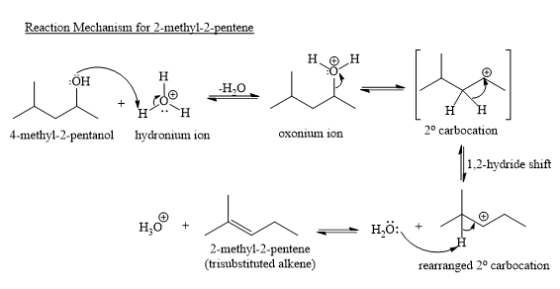
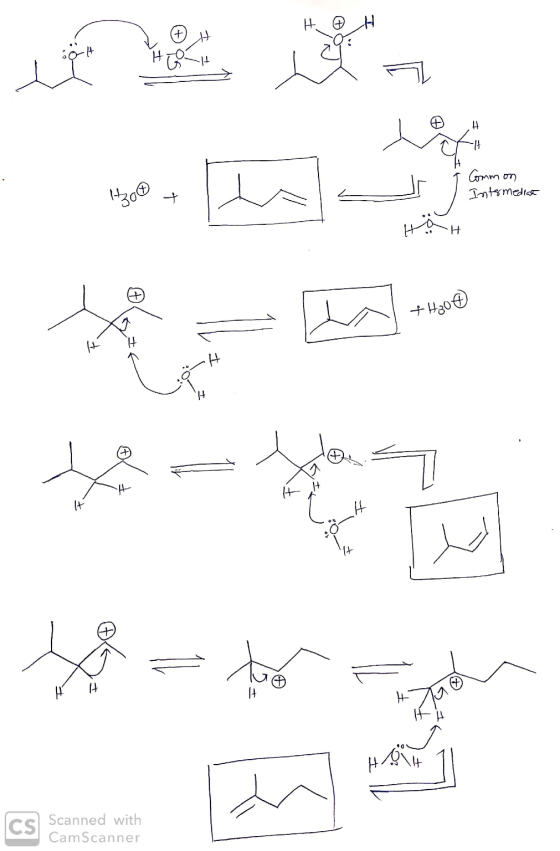
PLEASE DO A STEP BY STEP MECHANISM FOR THE ISOMERS.
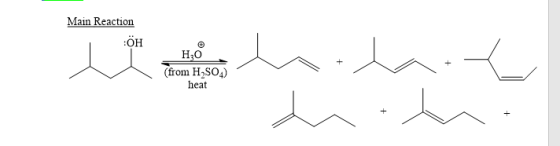
In this experiment, a mixture of methyl pentene isomers will be produced by the dehydration of 4-methyl-2-pentanol. The expected alkene isomers are 4-methyl-1-pentene, 2-methyl-1-pentene, (Z)-4-methyl-2-pentene and (E)-4-methyl-2-pentene, 2-methyl-2-pentene
WRITE OUT THE STEP-BY-STEP MECHANISM FOR THE REMAINING 4 ALKENE ISOMERS.
Homework Answers
Add Answer to:
PLEASE DO A STEP BY STEP MECHANISM FOR THE
ISOMERS.
In this experiment, a mixture of...
Acid-catalyzed dehydration of secondary and tertiary alcohols proceeds through an E1 mechanism. The first step is...
Acid-catalyzed dehydration of secondary and tertiary alcohols proceeds through an E1 mechanism. The first step is the protonation of the alcohol oxygen to form an oxonium ion. Dehydration of 3-methyl-2-butanol forms one major and two minor organic products. Draw the structures, including hydrogen atoms, of the three organic products of this reaction. 3-methyl-2-butanol ------->an oxonium ion
Acid-catalyzed dehydration of secondary and tertiary alcohols proceeds through an E1 mechanism. The first step is...
 Acid-catalyzed dehydration of secondary and tertiary alcohols proceeds through an E1 mechanism. The first step is the protonation of the alcohol oxygen to form an oxonium ion Dehydration of 3-methyl-2-butanol forms one major and two minor organic products. Draw the structures, including hydrogen atoms, of the three organic products of this reaction :он H3 3 CH3 an oxonium ion 3-methyl-2-butanol Major Product Minor Product Minor Product
Write a detailed mechanism for the sulfuric acid-catalyzed dehydration of 4-methyl-2-pentanol that accounts for the formation...
Write a detailed mechanism for the sulfuric acid-catalyzed dehydration of 4-methyl-2-pentanol that accounts for the formation of all 5 of the below alkenes. (Hint: More than one carbocation rearrangement may be necessary to account for the formation of all of the products.) 4-methyl-1-pentene Z and E-4-methyl-2-pentene 2-methyl-1-pentene 2-methyl-2-pentene Unassigned
During the dehydration of 2-methylcyclohexanol what is the rate determining step for the E1 mechanism? a....
During the dehydration of 2-methylcyclohexanol what is the rate determining step for the E1 mechanism? a. the addition of chloride b. dissociation of the oxonium ion to form a carbocation and water c. elimination of the beta hydrogen d. the formation of the pi bond
Chemistry 2401 Experiment 7 Acid Catalyzed Dehydration of 3.3-Dimethyl-2-Butanol with Rearrangement Experiment 7 Pre-lab Assignment Dehydration...
 Chemistry 2401 Experiment 7 Acid Catalyzed Dehydration of 3.3-Dimethyl-2-Butanol with Rearrangement Experiment 7 Pre-lab Assignment Dehydration of 3,3-Dimethyl-2-Butanol 1. Draw the structures of all the expected products from the following reactions: a) 3-methyl-3-pentanol + H = b)2-methylcyclohexanol + H - c) 2-methyl-2-butanol + H - d) 2,2-dimethylcyclohexanol + H = This reaction will give a complex mixture of products, since rearrangements can occur. Show the full mechanism for this reaction and how the possible products can form from the carbocation...
Acid-catalyzed dehydration of secondary and tertiary alcohols proceeds through an E1 mechanism. The first step is...
 Acid-catalyzed dehydration of secondary and tertiary alcohols proceeds through an E1 mechanism. The first step is the protonation of the alcohol oxygen to form an oxonium ion Dehydration of 3-methyl-2-butanol forms one major and two minor organic products. Draw the structures, including hydrogen atoms, of the three organic products of this reaction. Realize, the major product follows Zaitsev's Rule; minor products may not follow this rule. Do NOT forget to add in all HYDROGENS! Н-б-н Н-о-н) H-O-H :он 3-methyl-2-butanol an...
Explain the step by step mechanism for the reaction of 2-methylpentan-2-ol with HCl. For each step...
Explain the step by step mechanism for the reaction of 2-methylpentan-2-ol with HCl. For each step tell your reader if the molecule is gaining or losing potential energy and why. Include the following words in your description: leaving group, nucleophile, carbocation, protonation, intermediate, oxonium ion
Acid-catalyzed dehydration of secondary and tertiary alcohols proceeds through an E1 mechanism. The first step is...
 Acid-catalyzed dehydration of secondary and tertiary alcohols
proceeds through an E1 mechanism. The first step is the protonation
of alcohol and oxygen to form an oxonium ion.
Dehydration of 3-methyl-2-butanol forms one major and two minor
organic products. Draw the structures, including hydrogen atoms, of
the three organic products of this reaction.
The 3.) is correct that is the minor product I came up with but
I cant get the answer correct for 1.) major product? and 2.) minor
product
Acid-catalyzed dehydration of secondary and tertiary alcohols
proceeds through an E1 mechanism. The first step is the protonation
of alcohol and oxygen to form an oxonium ion.
Dehydration of 3-methyl-2-butanol forms one major and two minor
organic products. Draw the structures, including hydrogen atoms, of
the three organic products of this reaction.
The 3.) is correct that is the minor product I came up with but
I cant get the answer correct for 1.) major product? and 2.) minor
product
Explain the step by step mechanism for the reaction of 2-methylpentan-2-ol with HCl. For each step tell your reader if t...
Explain the step by step mechanism for the reaction of 2-methylpentan-2-ol with HCl. For each step tell your reader if the molecule is gaining or losing potential energy and why. Include the following words in your description: leaving group, nucleophile, carbocation, protonation, intermediate, oxonium ion (protonated oxygen)
Acid-catalyzed dehydration of secondary and tertiary alcohols proceeds through an E1 mechanism.
 Acid-catalyzed dehydration of secondary and tertiary alcohols
proceeds through an E1 mechanism. The first step is the protonation
of the alcohol oxygen to form an oxonium ion. Dehydration of
3-methyl-2-butanol forms one major and two minor organic products.
Draw the structures, including hydrogen atoms, of the three organic
products of this reaction.
Acid-catalyzed dehydration of secondary and tertiary alcohols
proceeds through an E1 mechanism. The first step is the protonation
of the alcohol oxygen to form an oxonium ion. Dehydration of
3-methyl-2-butanol forms one major and two minor organic products.
Draw the structures, including hydrogen atoms, of the three organic
products of this reaction.
 Acid-catalyzed dehydration of secondary and tertiary alcohols proceeds through an E1 mechanism. The first step is the protonation of the alcohol oxygen to form an oxonium ion Dehydration of 3-methyl-2-butanol forms one major and two minor organic products. Draw the structures, including hydrogen atoms, of the three organic products of this reaction :он H3 3 CH3 an oxonium ion 3-methyl-2-butanol Major Product Minor Product Minor Product
 Chemistry 2401 Experiment 7 Acid Catalyzed Dehydration of 3.3-Dimethyl-2-Butanol with Rearrangement Experiment 7 Pre-lab Assignment Dehydration of 3,3-Dimethyl-2-Butanol 1. Draw the structures of all the expected products from the following reactions: a) 3-methyl-3-pentanol + H = b)2-methylcyclohexanol + H - c) 2-methyl-2-butanol + H - d) 2,2-dimethylcyclohexanol + H = This reaction will give a complex mixture of products, since rearrangements can occur. Show the full mechanism for this reaction and how the possible products can form from the carbocation...
 Acid-catalyzed dehydration of secondary and tertiary alcohols proceeds through an E1 mechanism. The first step is the protonation of the alcohol oxygen to form an oxonium ion Dehydration of 3-methyl-2-butanol forms one major and two minor organic products. Draw the structures, including hydrogen atoms, of the three organic products of this reaction. Realize, the major product follows Zaitsev's Rule; minor products may not follow this rule. Do NOT forget to add in all HYDROGENS! Н-б-н Н-о-н) H-O-H :он 3-methyl-2-butanol an...
 Acid-catalyzed dehydration of secondary and tertiary alcohols
proceeds through an E1 mechanism. The first step is the protonation
of alcohol and oxygen to form an oxonium ion.
Dehydration of 3-methyl-2-butanol forms one major and two minor
organic products. Draw the structures, including hydrogen atoms, of
the three organic products of this reaction.
The 3.) is correct that is the minor product I came up with but
I cant get the answer correct for 1.) major product? and 2.) minor
product
Acid-catalyzed dehydration of secondary and tertiary alcohols
proceeds through an E1 mechanism. The first step is the protonation
of alcohol and oxygen to form an oxonium ion.
Dehydration of 3-methyl-2-butanol forms one major and two minor
organic products. Draw the structures, including hydrogen atoms, of
the three organic products of this reaction.
The 3.) is correct that is the minor product I came up with but
I cant get the answer correct for 1.) major product? and 2.) minor
product
Most questions answered within 3 hours.
-
Where is the error in this code sequence?
String s1 = "Hello";
String s2 = "ello";...
asked 10 months ago -
Financial data for Joel de Paris, Inc., for last year
follow:
Joel de Paris, Inc.
Balance...
asked 10 months ago -
Consider this reaction:
Al2(SO4)3 (aq)+ BaCl3
(aq) Al2Cl6 (aq)- +
3BaSO4(s) . What is the...
asked 10 months ago -
Suppose that Savneet is considering increasing her
recent random sample from 20 car rentals to 40...
asked 10 months ago -
Trucks arrive at an unloading terminal at an average rate of 120
per hour.
Trucks arrive...
asked 10 months ago -
Why are methanol and ethanol completely soluble in water while
octanol is not very little soluble....
asked 10 months ago -
A facilities manager at a university reads in a research report
that the mean amount of...
asked 10 months ago -
When the CuSO4 is rehydrated by adding water to the anhydrous
compound, is this an endothermic...
asked 10 months ago -
A ray of sunlight is passing from diamond into crown glass; the
angle of incidence is...
asked 10 months ago -
A block of mass 0.249 kg is placed on top of a light, vertical
spring of...
asked 10 months ago -
how do the kidneys compensate in the presences of acidosis
a) trigger hyperventilate
b) reserve acid...
asked 10 months ago -
Question 501 pts
The rental rate of capital to the firm increases. Which of the
following...
asked 10 months ago