

Homework Answers


Add Answer to:
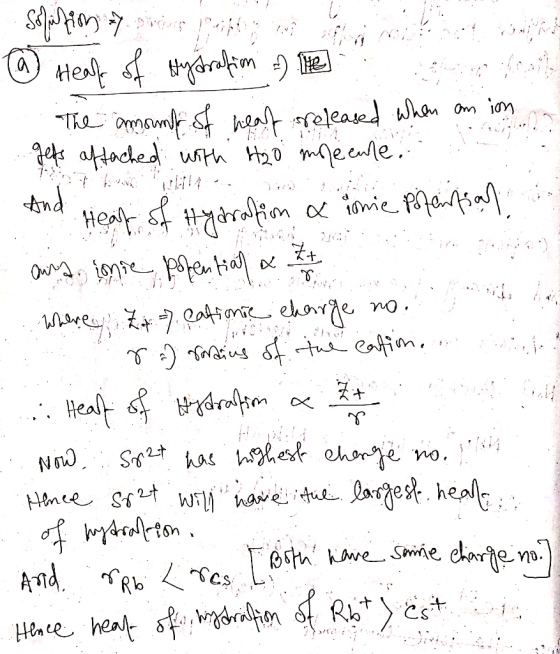
(a) Which of the ions Sr 2+, Rb . Cs will have the largest heat of...
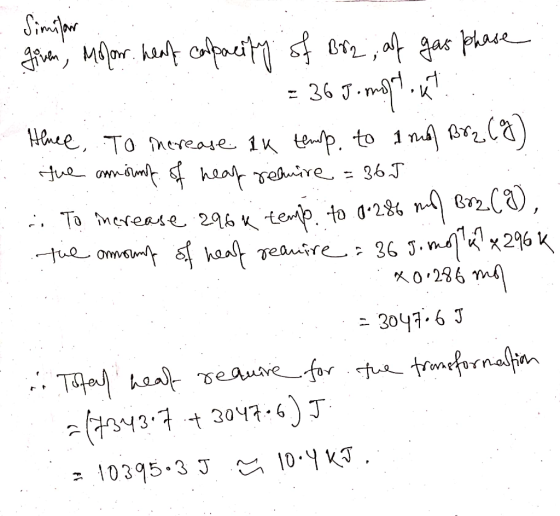
5. Calculate the heat (in kJ) required to transform 70.80 g of bromine from a solid...
5. Calculate the heat (in kJ) required to transform 70.80 g of bromine from a solid at a temperature of -7.2 °C to a gas at 92 °C. Report your answer to one decimal place. Data: Molar mass of bromine, Br 2 = 159.808 g/mol Melting point = -7.2 °C Boiling point = 59°C. Enthalpy of fus ion = 10.57 kJ/mol Enthalpy of vaporization = 29.96 kJ/mol. Molar heat capacity of the liquid phase = 75.7 J/mol • K Molar...
(a) Which of the ions K + , Na + , Be 2+ will have the...
(a) Which of the ions K + , Na + , Be 2+ will have the lar gest heat of hydration? Which the smallest? (b) Of the two compounds K 2 O and CaO, which has the stronger intermolecular forces? (c) Of the two compounds KBr and CH 3 OH, which has the stronger intermolecular forces?
Calculate the heat (in kJ) required to transform 45.30 g of hydrogen peroxide from a solid...
Calculate the heat (in kJ) required to transform 45.30 g of hydrogen peroxide from a solid at a temperature of -0.4 °C to a gas at 186 °C. Report your answer to one decimal place. Data: Molar mass of hydrogen peroxide, H 2 O 2 = 34.015 g/mol Melting point = -0.4 °C Boiling point = 150 °C. Enthalpy of fusion = 12.5 kJ/mol Enthalpy of vaporization = 51.6 kJ/mol. Molar heat capacity of the liquid phase = 89.1 J/mol...
Which of the following statements is FALSE? O When a substance melts, some - but not...
 Which of the following statements is FALSE? O When a substance melts, some - but not all-of the intermolecular forces are disrupted O When a substance evaporates, all of the intermolecular forces are disrupted O A compound with stronger intermolecular forces will have a higher boiling point The enthalpy of sublimation is less than the enthalpy of vaporization but more than the enthalpy of fusion O The enthalpy of vaporization for a compound is greater than the enthalpy of fusion...
q 2 and 4 please! Question 2 Which of the following compounds will hydrogen bond with water (H20)? Select all that apply...
 q 2 and 4 please!
Question 2 Which of the following compounds will hydrogen bond with water (H20)? Select all that apply. Cl2 CC14 CH20 NH3 SCI2 Question 3 Which of the following will have the lowest boiling point? Ne OKr O Ar o Не Question 4 Which of the following statements is FALSE? O A compound with stronger intermolecular forces will have a higher boiling point When a substance melts, some - but not all- of the intermolecular forces...
q 2 and 4 please!
Question 2 Which of the following compounds will hydrogen bond with water (H20)? Select all that apply. Cl2 CC14 CH20 NH3 SCI2 Question 3 Which of the following will have the lowest boiling point? Ne OKr O Ar o Не Question 4 Which of the following statements is FALSE? O A compound with stronger intermolecular forces will have a higher boiling point When a substance melts, some - but not all- of the intermolecular forces...
1. (8 pts) Virtually every pchem textbook has a table of enthalpy values for 25°C. One...
 1. (8 pts) Virtually every pchem textbook has a table of enthalpy values for 25°C. One use for these may be to calculate the enthalpy fora phase change such as boiling. However, not t0o many compounds boil at 25°C. You are going to calculate the percent difference between the heat of vaporization of ethanol using data for 25°C and that at its boiling point of 78°C. a) Write the chemical equation that shows the vaporization of 1 mol of ethanol...
The heat of vaporization of benzene (C6H6) is 30.77 kJ/mol at it's boiling point (80 C)....
The heat of vaporization of benzene (C6H6) is 30.77 kJ/mol at it's boiling point (80 C). As a liquid, it has a heat capacity of 134.8 J/mol*K, and as a gas it has a heat capacity of 82.4 J/mol*K. Calculate the enthalpy change of heating 245g of benzene from 50 C to 100 C.
The vaporization of compound A is described by the following chemical equation. A(1) A(8) A rap(72.39...
 The vaporization of compound A is described by the following chemical equation. A(1) A(8) A rap(72.39 °C) = 38.21 kJ/mol Calculate the entropy of vaporization, Aswap, for A(l) at 25.0 °C given that the boiling point of A is 72.39 °C, and the molar heat capacity of A(l) is 119.09 J/mol K). Assume that the molar heat capacity of A(R) is 56.5% of that of A(1). ASP J. mol-K Calculate the standard enthalpy of vaporization. A Hap, for A(1) at...
11. The following would be required for calculations of heat flow in which of the heating...
 11. The following would be required for calculations of heat flow in which of the heating curve steps ? Molar heat of vaporization of water (AH vap = 40.7 kJ/mol) Specific heat of ice (Cice = 2.09 J/g °C) Molar heat of fusion of water (AH fus = 6.02 kJ/mol) Specific heat of water (C H20 = 4.18 J/g °C) Specific heat of steam(C steam = 2.01 J/g °C) Heating Curve for Water Degrees Celsius -50+ 0 400 800 1200...
1. What types of intermolecular forces would you expect to exist among molecules of ethanol? 2....
1. What types of intermolecular forces would you expect to exist among molecules of ethanol? 2. highest boiling point CCl4, CF4, CBr4 3.lowest freezing point LiF, Cl2 HBr 4. lowest freezing point CH3OCH3, CH3CH2OH , CH3CH2CH3 5. The vapor pressure of substance X is 100. mm Hg at 1070.°C. The vapor pressure of substance X increases to 800. mm Hg at 1210.°C. Determine the molar heat of vaporization of substance X using the derived form of the Clausius-Clapeyron equation given...
 Which of the following statements is FALSE? O When a substance melts, some - but not all-of the intermolecular forces are disrupted O When a substance evaporates, all of the intermolecular forces are disrupted O A compound with stronger intermolecular forces will have a higher boiling point The enthalpy of sublimation is less than the enthalpy of vaporization but more than the enthalpy of fusion O The enthalpy of vaporization for a compound is greater than the enthalpy of fusion...
 q 2 and 4 please!
Question 2 Which of the following compounds will hydrogen bond with water (H20)? Select all that apply. Cl2 CC14 CH20 NH3 SCI2 Question 3 Which of the following will have the lowest boiling point? Ne OKr O Ar o Не Question 4 Which of the following statements is FALSE? O A compound with stronger intermolecular forces will have a higher boiling point When a substance melts, some - but not all- of the intermolecular forces...
q 2 and 4 please!
Question 2 Which of the following compounds will hydrogen bond with water (H20)? Select all that apply. Cl2 CC14 CH20 NH3 SCI2 Question 3 Which of the following will have the lowest boiling point? Ne OKr O Ar o Не Question 4 Which of the following statements is FALSE? O A compound with stronger intermolecular forces will have a higher boiling point When a substance melts, some - but not all- of the intermolecular forces...
 1. (8 pts) Virtually every pchem textbook has a table of enthalpy values for 25°C. One use for these may be to calculate the enthalpy fora phase change such as boiling. However, not t0o many compounds boil at 25°C. You are going to calculate the percent difference between the heat of vaporization of ethanol using data for 25°C and that at its boiling point of 78°C. a) Write the chemical equation that shows the vaporization of 1 mol of ethanol...
 The vaporization of compound A is described by the following chemical equation. A(1) A(8) A rap(72.39 °C) = 38.21 kJ/mol Calculate the entropy of vaporization, Aswap, for A(l) at 25.0 °C given that the boiling point of A is 72.39 °C, and the molar heat capacity of A(l) is 119.09 J/mol K). Assume that the molar heat capacity of A(R) is 56.5% of that of A(1). ASP J. mol-K Calculate the standard enthalpy of vaporization. A Hap, for A(1) at...
 11. The following would be required for calculations of heat flow in which of the heating curve steps ? Molar heat of vaporization of water (AH vap = 40.7 kJ/mol) Specific heat of ice (Cice = 2.09 J/g °C) Molar heat of fusion of water (AH fus = 6.02 kJ/mol) Specific heat of water (C H20 = 4.18 J/g °C) Specific heat of steam(C steam = 2.01 J/g °C) Heating Curve for Water Degrees Celsius -50+ 0 400 800 1200...
Most questions answered within 3 hours.
-
Where is the error in this code sequence?
String s1 = "Hello";
String s2 = "ello";...
asked 11 months ago -
Financial data for Joel de Paris, Inc., for last year
follow:
Joel de Paris, Inc.
Balance...
asked 11 months ago -
Consider this reaction:
Al2(SO4)3 (aq)+ BaCl3
(aq) Al2Cl6 (aq)- +
3BaSO4(s) . What is the...
asked 11 months ago -
Suppose that Savneet is considering increasing her
recent random sample from 20 car rentals to 40...
asked 11 months ago -
Trucks arrive at an unloading terminal at an average rate of 120
per hour.
Trucks arrive...
asked 11 months ago -
Why are methanol and ethanol completely soluble in water while
octanol is not very little soluble....
asked 11 months ago -
A facilities manager at a university reads in a research report
that the mean amount of...
asked 11 months ago -
When the CuSO4 is rehydrated by adding water to the anhydrous
compound, is this an endothermic...
asked 11 months ago -
A ray of sunlight is passing from diamond into crown glass; the
angle of incidence is...
asked 11 months ago -
A block of mass 0.249 kg is placed on top of a light, vertical
spring of...
asked 11 months ago -
how do the kidneys compensate in the presences of acidosis
a) trigger hyperventilate
b) reserve acid...
asked 11 months ago -
Question 501 pts
The rental rate of capital to the firm increases. Which of the
following...
asked 11 months ago