
Homework Answers
Add Answer to:
calculus 2
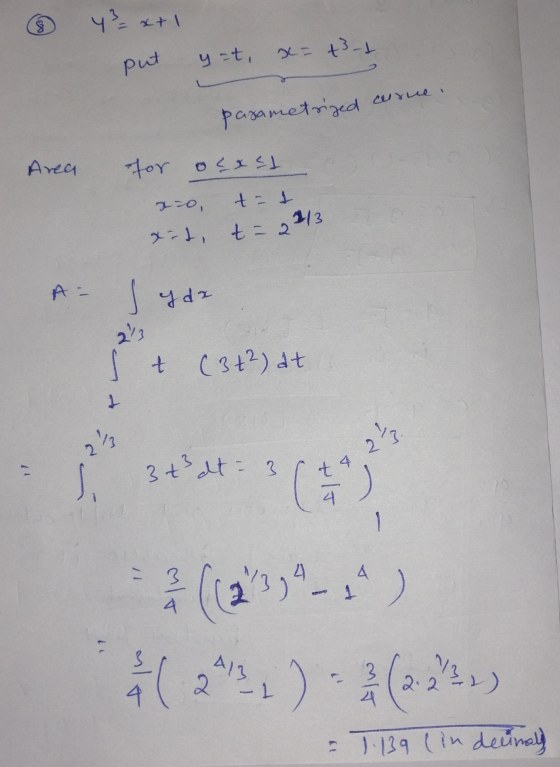
8. Find a parameterization of the curve y3 = x + 1, in terms...
(10 marks) Let C be the curve 64x – - y3 = 0 between y =...
 (10 marks) Let C be the curve 64x – - y3 = 0 between y = 0 and y = 3. Sketch the graph of this curve. In each part, set up, but do not evaluate, an integral or a sum of integrals that solves the problem. (a) Find the area of the surface generated by revolving C about the x-axis by integrating with respect to x. (b) Find the area of the surface generated by revolving C about the...
Let the curve C in the (x, y)-plane be given by the parametric equations x =...
 Let the curve C in the (x, y)-plane be given by the parametric equations x = e + 2, y = e2-1, tER. (a) Show that the point (3,0) belongs to the curve C. To which value of the parameter t does the point (3,0) correspond? (b) Find an expression for dy (dy/dt) without eliminating the parameter t, i.e., using de = (da/dt) (c) Using your result from part (b), find the value of at the point (3,0). (d) From...
(1 point) Find the length of the given curve. x = y3/6 + 1/(2), 14 25...
 (1 point) Find the length of the given curve. x = y3/6 + 1/(2), 14 25 y L= (1 point) Find the length of the given curve. cos(2t) dt, 0 x 2 0 L=
1. The area between the part of the curve-6x 8 above the x-axis and the x-axis itself is 2. The a...
 1. The area between the part of the curve-6x 8 above the x-axis and the x-axis itself is 2. The area below y 4x -x and above y 3 (for1 xS 3) is revolved around the x-axis. 3. The areas between the following portions of curves and the x-axis are revolved around the revolved by an angle 2π around the x-axis. Find the volume swept out. Find the volume swept out. y-axis. Find the volume swept out. (a) y- betweenx...
4. Parameterization a) Find the parameterization of the trajectory from A to B. b) Determine the...
 4. Parameterization a) Find the parameterization of the trajectory from A to B. b) Determine the length of the trajectory using L= =jVP.F dt and compare to the distance between the points around the section of the circle. у B С r Radius =r=3m ༽ 0 A x Use t as the angle: F(t)=( sts F'(t)=[ __ L = dt
3) Let (x, y), (X2, y2), and (X3. Y3) be three points in R2 with X1...
 3) Let (x, y), (X2, y2), and (X3. Y3) be three points in R2 with X1 < x2 < X3. Suppose that y = ax + by + c is a parabola passing through the three points (x1, yı), (x2, y), and (x3, Y3). We have that a, b, and c must satisfy i = ax + bx + C V2 = ax + bx2 + c y3 = ax} + bx3 + c Let D = x X2 1....
Find the arc length of the curve y - x over the interval 1,12 (a) 8 points Using the Fundamental Theorem, Part 2 (b)...
 Find the arc length of the curve y - x over the interval 1,12 (a) 8 points Using the Fundamental Theorem, Part 2 (b) 2 points Use your "DEFINT" program to find M,1, T1 and Sz2 (c) 2 points Using your TI-84's built-in Integral calculator using MATH >>> MATH >>9: fnlnt (d) 2 points In your text book, there are formulas that give the maximum er in approximations given by MN, T, and Sy for the integral A a f(x)...
Integrals are often introduced in Calculus 1 as an “area under the curve” problem. But does...
Integrals are often introduced in Calculus 1 as an “area under the curve” problem. But does the area under the curve make sense for the integral of a vector function? Discuss what integration might mean in the context of a vector function, where is an interval. Give specific examples of problems that illustrate your points. f:1R We were unable to transcribe this image f:1R
i BOX Number- " Parts reference Text CommentsHeader&Footer Links MATLAB Lab 8 This exercise was done previously for a full circle. Perform all the steps shown including the plot, but only...
 i BOX Number- " Parts reference Text CommentsHeader&Footer Links MATLAB Lab 8 This exercise was done previously for a full circle. Perform all the steps shown including the plot, but only for the function shown in part b). Objective: In calculus, integration allows us to find the area under a curve. Numerical methods exist which enable us to approximate the area An interesting approach is to randomly select points in an x-y plane and find the fraction of those points...
8) The part of the curve y = ex + e- x/2 between the points A...
 8) The part of the curve y = ex + e- x/2 between the points A (0,1) and B (1, e2 +1/2e) is given. a- Take and edit the derivative of the given function. b- Write and edit the integral that gives the surface area of the object formed by rotating the given part around the y axis. (Hint = write the integral according to x.) C-Solve the integral.
 (10 marks) Let C be the curve 64x – - y3 = 0 between y = 0 and y = 3. Sketch the graph of this curve. In each part, set up, but do not evaluate, an integral or a sum of integrals that solves the problem. (a) Find the area of the surface generated by revolving C about the x-axis by integrating with respect to x. (b) Find the area of the surface generated by revolving C about the...
 Let the curve C in the (x, y)-plane be given by the parametric equations x = e + 2, y = e2-1, tER. (a) Show that the point (3,0) belongs to the curve C. To which value of the parameter t does the point (3,0) correspond? (b) Find an expression for dy (dy/dt) without eliminating the parameter t, i.e., using de = (da/dt) (c) Using your result from part (b), find the value of at the point (3,0). (d) From...
 (1 point) Find the length of the given curve. x = y3/6 + 1/(2), 14 25 y L= (1 point) Find the length of the given curve. cos(2t) dt, 0 x 2 0 L=
 1. The area between the part of the curve-6x 8 above the x-axis and the x-axis itself is 2. The area below y 4x -x and above y 3 (for1 xS 3) is revolved around the x-axis. 3. The areas between the following portions of curves and the x-axis are revolved around the revolved by an angle 2π around the x-axis. Find the volume swept out. Find the volume swept out. y-axis. Find the volume swept out. (a) y- betweenx...
 4. Parameterization a) Find the parameterization of the trajectory from A to B. b) Determine the length of the trajectory using L= =jVP.F dt and compare to the distance between the points around the section of the circle. у B С r Radius =r=3m ༽ 0 A x Use t as the angle: F(t)=( sts F'(t)=[ __ L = dt
 3) Let (x, y), (X2, y2), and (X3. Y3) be three points in R2 with X1 < x2 < X3. Suppose that y = ax + by + c is a parabola passing through the three points (x1, yı), (x2, y), and (x3, Y3). We have that a, b, and c must satisfy i = ax + bx + C V2 = ax + bx2 + c y3 = ax} + bx3 + c Let D = x X2 1....
 Find the arc length of the curve y - x over the interval 1,12 (a) 8 points Using the Fundamental Theorem, Part 2 (b) 2 points Use your "DEFINT" program to find M,1, T1 and Sz2 (c) 2 points Using your TI-84's built-in Integral calculator using MATH >>> MATH >>9: fnlnt (d) 2 points In your text book, there are formulas that give the maximum er in approximations given by MN, T, and Sy for the integral A a f(x)...
 i BOX Number- " Parts reference Text CommentsHeader&Footer Links MATLAB Lab 8 This exercise was done previously for a full circle. Perform all the steps shown including the plot, but only for the function shown in part b). Objective: In calculus, integration allows us to find the area under a curve. Numerical methods exist which enable us to approximate the area An interesting approach is to randomly select points in an x-y plane and find the fraction of those points...
 8) The part of the curve y = ex + e- x/2 between the points A (0,1) and B (1, e2 +1/2e) is given. a- Take and edit the derivative of the given function. b- Write and edit the integral that gives the surface area of the object formed by rotating the given part around the y axis. (Hint = write the integral according to x.) C-Solve the integral.
Most questions answered within 3 hours.
-
Where is the error in this code sequence?
String s1 = "Hello";
String s2 = "ello";...
asked 10 months ago -
Financial data for Joel de Paris, Inc., for last year
follow:
Joel de Paris, Inc.
Balance...
asked 10 months ago -
Consider this reaction:
Al2(SO4)3 (aq)+ BaCl3
(aq) Al2Cl6 (aq)- +
3BaSO4(s) . What is the...
asked 10 months ago -
Suppose that Savneet is considering increasing her
recent random sample from 20 car rentals to 40...
asked 10 months ago -
Trucks arrive at an unloading terminal at an average rate of 120
per hour.
Trucks arrive...
asked 10 months ago -
Why are methanol and ethanol completely soluble in water while
octanol is not very little soluble....
asked 10 months ago -
A facilities manager at a university reads in a research report
that the mean amount of...
asked 10 months ago -
When the CuSO4 is rehydrated by adding water to the anhydrous
compound, is this an endothermic...
asked 10 months ago -
A ray of sunlight is passing from diamond into crown glass; the
angle of incidence is...
asked 10 months ago -
A block of mass 0.249 kg is placed on top of a light, vertical
spring of...
asked 10 months ago -
how do the kidneys compensate in the presences of acidosis
a) trigger hyperventilate
b) reserve acid...
asked 10 months ago -
Question 501 pts
The rental rate of capital to the firm increases. Which of the
following...
asked 10 months ago