(Also what are the three assumptions of the kinetic model of gases) 1. Explain the difference...
(Also what are the three assumptions of the kinetic model of gases)
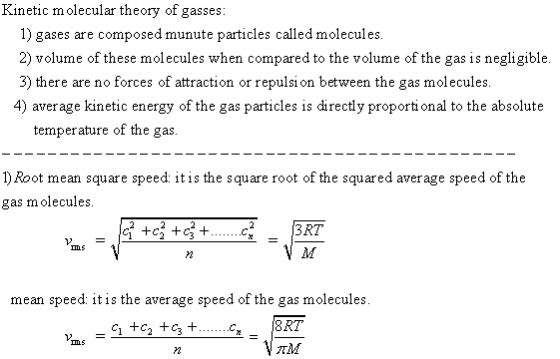
1. Explain the difference between root mean square (r.m.s.) speed and mean speed.
2. Why is r.m.s. speed a more useful quantity?
3. Sketch a comparison of Maxwell distribution of speeds plots for
a) O2 and CO2 at the same temperature
b) Ar at 270K and 1000K
Homework Answers
Add Answer to:
(Also what are the three assumptions of the kinetic model of
gases)
1. Explain the difference...
3. For a sample of CO2 at 20 ºC, calculate the most probable molecular speed, mean molecular speed and root-mean-square...
3. For a sample of CO2 at 20 ºC, calculate the most probable molecular speed, mean molecular speed and root-mean-square molecular speed. Assume behavior described by the kinetic theory of gases. Also, what would the temperature need to increase to for each of the speeds in part (a) to double? [Hint: Look at the equations! No need for extensive calculations.]
The kinetic theory of gases states that the kinetic energy of a gas is directly proportional...
 The kinetic theory of gases states that the kinetic energy of a
gas is directly proportional to the temperature of the gas. A
relationship between the microscopic properties of the gas
molecules and the macroscopic properties of the gas can be derived
using the following assumptions: The gas is composed of pointlike
particles separated by comparatively large distances. The gas
molecules are in continual random motion with collisions being
perfectly elastic. The gas molecules exert no long-range forces on
each...
The kinetic theory of gases states that the kinetic energy of a
gas is directly proportional to the temperature of the gas. A
relationship between the microscopic properties of the gas
molecules and the macroscopic properties of the gas can be derived
using the following assumptions: The gas is composed of pointlike
particles separated by comparatively large distances. The gas
molecules are in continual random motion with collisions being
perfectly elastic. The gas molecules exert no long-range forces on
each...
some context Problem 3: Use simple kinetic theory of gases discussed in section 1.3.2 as well...
 some context
Problem 3: Use simple kinetic theory of gases discussed in section 1.3.2 as well as Fourer's law of condustion to prove: 2 R373 D11 = 3113/202pm Dal We were unable to transcribe this imageof a nes. the xed the led negligible The following assumptions about the structure of the cases are made in order to investigate the statistical rules of the random motion of the molecules: The size of the gas molecules is negligible compared with the distance...
some context
Problem 3: Use simple kinetic theory of gases discussed in section 1.3.2 as well as Fourer's law of condustion to prove: 2 R373 D11 = 3113/202pm Dal We were unable to transcribe this imageof a nes. the xed the led negligible The following assumptions about the structure of the cases are made in order to investigate the statistical rules of the random motion of the molecules: The size of the gas molecules is negligible compared with the distance...
1. Name three characteristics of the atoms in a gas that are essential for the gas...
1. Name three characteristics of the atoms in a gas that are essential for the gas to be ideal. Explain why these three qualities of the atoms or molecules make the gas ideal. 2. Considering the Boltzmann distribution of atomic/molecular speeds for an ideal gas at temperature T (in K) , order the following speeds from smallest to largest: average speed, most probable speed, and root mean squared speed. Why are they different speeds? 3. What is the most important...
1,4? Part I: Choose five of these questions. (12 points each) 1. Here is the van...
 1,4?
Part I: Choose five of these questions. (12 points each) 1. Here is the van der Waals Equation for one mole of gas P Given this equation, how does the infinitesimal change in pressure, or as specific as possible. (In other words, evaluate the derivatives.) with d V and dT? B e-NV, where is the sity her of molecules and V is the fshe wall perpendicular to the 2. A sample of gas molecules of density N e e...
1,4?
Part I: Choose five of these questions. (12 points each) 1. Here is the van der Waals Equation for one mole of gas P Given this equation, how does the infinitesimal change in pressure, or as specific as possible. (In other words, evaluate the derivatives.) with d V and dT? B e-NV, where is the sity her of molecules and V is the fshe wall perpendicular to the 2. A sample of gas molecules of density N e e...
3,9? Part I: Choose five of these questions. (12 points each) Ana 1. Here is the...
 3,9?
Part I: Choose five of these questions. (12 points each) Ana 1. Here is the van der Waals Equation for one mole of gas: P -by vary with dV and dT? Bethe Given this equation, how does the infinitesimal change in pressure, dl. as specific as possible. (In other words, evaluate the derivatives.) andard 2. A sample of gas molecules of density D N / Vwhere N is the numbe volume) is moving with a speed y, in the...
3,9?
Part I: Choose five of these questions. (12 points each) Ana 1. Here is the van der Waals Equation for one mole of gas: P -by vary with dV and dT? Bethe Given this equation, how does the infinitesimal change in pressure, dl. as specific as possible. (In other words, evaluate the derivatives.) andard 2. A sample of gas molecules of density D N / Vwhere N is the numbe volume) is moving with a speed y, in the...
1. A hypothetical investigation on rider satisfaction with a particular public transit system serving commuting residents...
1. A hypothetical investigation on rider satisfaction with a particular public transit system serving commuting residents of British California (BC) and Prince Edward’s County (PEC) offers some interesting findings. The proportion of commuters from BC that indicated low satisfaction with the transit system’s service in the 2018 calendar year was 65 percent, and the proportion from PEC was 70 percent. These point estimates were based on samples of 5,380 BC commuters and 6,810 PEC commuters, whose system-using commuters number in...
please help with no 3,4,5 and 6 Thanks 1. What is standard error? Measure of statistical...
 please help with no 3,4,5 and 6
Thanks
1. What is standard error? Measure of statistical accuracy of an estimate, equal to the standard deviation of the theorental distribution of a large populanon of such estimates 2. What calculation is used to describe the variation in measurements. 3. In experiment 3.2. You will be measuring out 40ml of volume. How many times will you measure 40 ml? 4. What is the difference for each time you measure out 40ml? In...
please help with no 3,4,5 and 6
Thanks
1. What is standard error? Measure of statistical accuracy of an estimate, equal to the standard deviation of the theorental distribution of a large populanon of such estimates 2. What calculation is used to describe the variation in measurements. 3. In experiment 3.2. You will be measuring out 40ml of volume. How many times will you measure 40 ml? 4. What is the difference for each time you measure out 40ml? In...
Chapter overview 1. Reasons for international trade Resources reasons Economic reasons Other reasons 2. Difference between...
Chapter overview 1. Reasons for international trade Resources reasons Economic reasons Other reasons 2. Difference between international trade and domestic trade More complex context More difficult and risky Higher management skills required 3. Basic concept s relating to international trade Visible trade & invisible trade Favorable trade & unfavorable trade General trade system & special trade system Volume of international trade & quantum of international trade Commodity composition of international trade Geographical composition of international trade Degree / ratio of...
 The kinetic theory of gases states that the kinetic energy of a
gas is directly proportional to the temperature of the gas. A
relationship between the microscopic properties of the gas
molecules and the macroscopic properties of the gas can be derived
using the following assumptions: The gas is composed of pointlike
particles separated by comparatively large distances. The gas
molecules are in continual random motion with collisions being
perfectly elastic. The gas molecules exert no long-range forces on
each...
The kinetic theory of gases states that the kinetic energy of a
gas is directly proportional to the temperature of the gas. A
relationship between the microscopic properties of the gas
molecules and the macroscopic properties of the gas can be derived
using the following assumptions: The gas is composed of pointlike
particles separated by comparatively large distances. The gas
molecules are in continual random motion with collisions being
perfectly elastic. The gas molecules exert no long-range forces on
each...
 some context
Problem 3: Use simple kinetic theory of gases discussed in section 1.3.2 as well as Fourer's law of condustion to prove: 2 R373 D11 = 3113/202pm Dal We were unable to transcribe this imageof a nes. the xed the led negligible The following assumptions about the structure of the cases are made in order to investigate the statistical rules of the random motion of the molecules: The size of the gas molecules is negligible compared with the distance...
some context
Problem 3: Use simple kinetic theory of gases discussed in section 1.3.2 as well as Fourer's law of condustion to prove: 2 R373 D11 = 3113/202pm Dal We were unable to transcribe this imageof a nes. the xed the led negligible The following assumptions about the structure of the cases are made in order to investigate the statistical rules of the random motion of the molecules: The size of the gas molecules is negligible compared with the distance...
 1,4?
Part I: Choose five of these questions. (12 points each) 1. Here is the van der Waals Equation for one mole of gas P Given this equation, how does the infinitesimal change in pressure, or as specific as possible. (In other words, evaluate the derivatives.) with d V and dT? B e-NV, where is the sity her of molecules and V is the fshe wall perpendicular to the 2. A sample of gas molecules of density N e e...
1,4?
Part I: Choose five of these questions. (12 points each) 1. Here is the van der Waals Equation for one mole of gas P Given this equation, how does the infinitesimal change in pressure, or as specific as possible. (In other words, evaluate the derivatives.) with d V and dT? B e-NV, where is the sity her of molecules and V is the fshe wall perpendicular to the 2. A sample of gas molecules of density N e e...
 3,9?
Part I: Choose five of these questions. (12 points each) Ana 1. Here is the van der Waals Equation for one mole of gas: P -by vary with dV and dT? Bethe Given this equation, how does the infinitesimal change in pressure, dl. as specific as possible. (In other words, evaluate the derivatives.) andard 2. A sample of gas molecules of density D N / Vwhere N is the numbe volume) is moving with a speed y, in the...
3,9?
Part I: Choose five of these questions. (12 points each) Ana 1. Here is the van der Waals Equation for one mole of gas: P -by vary with dV and dT? Bethe Given this equation, how does the infinitesimal change in pressure, dl. as specific as possible. (In other words, evaluate the derivatives.) andard 2. A sample of gas molecules of density D N / Vwhere N is the numbe volume) is moving with a speed y, in the...
 please help with no 3,4,5 and 6
Thanks
1. What is standard error? Measure of statistical accuracy of an estimate, equal to the standard deviation of the theorental distribution of a large populanon of such estimates 2. What calculation is used to describe the variation in measurements. 3. In experiment 3.2. You will be measuring out 40ml of volume. How many times will you measure 40 ml? 4. What is the difference for each time you measure out 40ml? In...
please help with no 3,4,5 and 6
Thanks
1. What is standard error? Measure of statistical accuracy of an estimate, equal to the standard deviation of the theorental distribution of a large populanon of such estimates 2. What calculation is used to describe the variation in measurements. 3. In experiment 3.2. You will be measuring out 40ml of volume. How many times will you measure 40 ml? 4. What is the difference for each time you measure out 40ml? In...
Most questions answered within 3 hours.
-
Where is the error in this code sequence?
String s1 = "Hello";
String s2 = "ello";...
asked 11 months ago -
Financial data for Joel de Paris, Inc., for last year
follow:
Joel de Paris, Inc.
Balance...
asked 11 months ago -
Consider this reaction:
Al2(SO4)3 (aq)+ BaCl3
(aq) Al2Cl6 (aq)- +
3BaSO4(s) . What is the...
asked 11 months ago -
Suppose that Savneet is considering increasing her
recent random sample from 20 car rentals to 40...
asked 11 months ago -
Trucks arrive at an unloading terminal at an average rate of 120
per hour.
Trucks arrive...
asked 11 months ago -
Why are methanol and ethanol completely soluble in water while
octanol is not very little soluble....
asked 11 months ago -
A facilities manager at a university reads in a research report
that the mean amount of...
asked 11 months ago -
When the CuSO4 is rehydrated by adding water to the anhydrous
compound, is this an endothermic...
asked 11 months ago -
A ray of sunlight is passing from diamond into crown glass; the
angle of incidence is...
asked 11 months ago -
A block of mass 0.249 kg is placed on top of a light, vertical
spring of...
asked 11 months ago -
how do the kidneys compensate in the presences of acidosis
a) trigger hyperventilate
b) reserve acid...
asked 11 months ago -
Question 501 pts
The rental rate of capital to the firm increases. Which of the
following...
asked 11 months ago