The production capacity for acrylonitrile (C3H3N) in the United States is over 2 billion pounds per...
The production capacity for acrylonitrile (C3H3N) in the United States is over 2 billion pounds per year. Acrylonitrile, the building block for polyacrylonitrile fibers and a variety of plastics, is produced from gaseous propylene, ammonia, and oxygen:
2C3H6(g) + 2NH3(g) + 3O2(g) → 2C3H3N(g) + 6H2O(g)
Assuming 100% yield, determine the mass of acrylonitrile which can be produced from the mixture below:
| Mass | Reactant |
|---|---|
| 5.88×10² g | propylene |
| 5.00 x 10² g | ammonia |
| 1.00 x 10³ g | oxygen |
g = mass of acrylonitrile produced
What mass of water is formed from your mixture?
mass of water formed = g
Calculate the mass (in grams) of each reactant after the reaction is complete:
| Reactant | Mass remaining |
|---|---|
| propylene | g |
| ammonia | g |
| oxygen | g |
Homework Answers
Let us write the balanced equation
Balanced equation:
2 C3H6(g) + 2 NH3(g) + 3
O2(g) ====> 2 C3H3N(g) + 6
H2O(g)
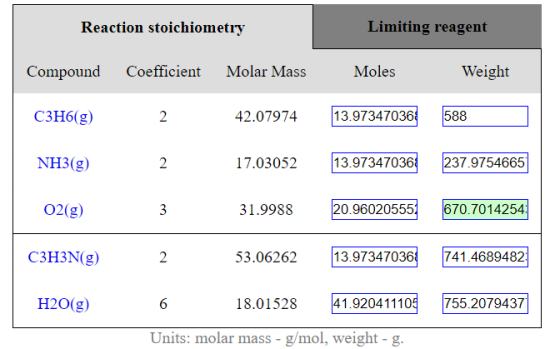
Mass of propylene = 5.88 x 10² g = 588 gm
Molar mass of propylene = 42.079 g/mol
Moles of propylene = 588 gm / 42.079 g/mol = 13.973 mol
Mass of ammonia = 5.00 x 10² g = 500 gm
Molar mass of ammonia = 17.03 g/mol
Moles of ammonia = 500 gm / 17.03 g/mol = 29.359 mol
Mass of oxygen = 1.0 x 10³ g = 1000 gm
Molar mass of oxygen = 32 g/mol
Moles of oxygen = 1000 gm / 32 g/mol = 31.25 mol
Among all reagent, propylene is the limiting reagent.
Hence moles of acetonitrile produced is equal to moles of propylene reacted
moles of acetonitrile produced = 13.973 Moles
Mass of acetonitrile produced = 13.973 Moles x 53.06 g/mol = 741.46 gm
Moles of water produced = 41.920 Moles
Mass of water produced = 41.92 mol x 18 g/mol = 755.207 gm
Remaining reactants
Mass of propylene reacted = 588 gm (It is limiting reagent)
Hence no propylene will remain.
Moles of ammonia reacted is equal to moles of propylene reacted
Moles of ammonia reacted = 13.973 moles
Mass of ammonia reacted = 13.973 x 17.03 = 237.97 gm
Mass of ammonia left = 500 gm - 237.97 gm = 262.03 gm
Moles of oxygen reacted is equal to 1.5 times of propylene (in moles) reacted
Moles of oxygen reacted = 20.960 moles
Mass of oxygen reacted = 20.960 x 32 = 670.70 gm
Mass of oxygen left = 1000 gm - 670.70 gm = 329.3 gm
Add Answer to:
The production capacity for acrylonitrile
(C3H3N) in the United States is over 2
billion pounds per...
The production capacity for acrylonitrile (C3H3N) in the United States exceeds 2 million pounds per year....
The production capacity for acrylonitrile (C3H3N) in the United States exceeds 2 million pounds per year. Acrylonitrile, the building block for polyacrylonitrile fibers and a variety of plastics, is produced from gaseous propylene, ammonia, and oxygen. 2 C3H6(g) + 2 NH3(g) + 3 O2(g) → 2 C3H3N(g) + 6 H2O(g) (a) What mass of acrylonitrile can be produced from a mixture of 1.16 kg of propylene (C3H6), 1.64 kg of ammonia, and 1.90 kg of oxygen, assuming 100% yield? (b)...
The production capacity for acrylonitrile (C3H3N) in the United States exceeds 2 million pounds per year....
The production capacity for acrylonitrile (C3H3N) in the United States exceeds 2 million pounds per year. Acrylonitrile, the building block for polyacrylonitrile fibers and a variety of plastics, is produced from gaseous propylene, ammonia, and oxygen. 2 C3H6(g) + 2 NH3(g) + 3 O2(g) → 2 C3H3N(g) + 6 H2O(g) (a) What mass of acrylonitrile can be produced from a mixture of 1.05 kg of propylene (C3H6), 1.61 kg of ammonia, and 1.91 kg of oxygen, assuming 100% yield? g...
Any help would be greatly appreciated, I've tried to solve it so many times and I'm...
 Any help would be greatly appreciated, I've tried to
solve it so many times and I'm running out of chances.
The production capacity for acrylonitrile (C3H3N) in the United States exceeds 2 million pounds per year. Acrylonitrile, the building block for polyacrylonitrile fibers and a variety of plastics, is produced from gaseous propylene, ammonia, and oxygen. 2 C3H6(g) + 2 NH3(9) + 3 02(g) - 2 C3H3N(g) + 6 H20(g) (a) What mass of acrylonitrile can be produced from a...
Any help would be greatly appreciated, I've tried to
solve it so many times and I'm running out of chances.
The production capacity for acrylonitrile (C3H3N) in the United States exceeds 2 million pounds per year. Acrylonitrile, the building block for polyacrylonitrile fibers and a variety of plastics, is produced from gaseous propylene, ammonia, and oxygen. 2 C3H6(g) + 2 NH3(9) + 3 02(g) - 2 C3H3N(g) + 6 H20(g) (a) What mass of acrylonitrile can be produced from a...
5. Acrylonitrile, C3H3N, is a molecule used to produce a plastic called Orlon. How many grams...
 5. Acrylonitrile, C3H3N, is a molecule used to produce a plastic called Orlon. How many grams of acrylonitrile could be produced by reacting 583 g of propene, C3H6 with excess ammonia, NH3 and oxygen? 2C3H6 + 2NH3 + 302 → 2C3H3N + 6H2O a. 368 g b. 1470 g c. 462 g d. 735 g e. 583 g
Acrylonitrile, C3H3N, is an important industrial chemical. Propene, C3H6, reacts with ammonia & oxygen in the...
Acrylonitrile, C3H3N, is an important industrial chemical. Propene, C3H6, reacts with ammonia & oxygen in the gas phase to produce acrylonitrile and water vapor according to the following balanced chemical equation. 150 g of propene was reacted with 270.0 L ammonia & excess oxygen (both STP). 175g of C3H3N was isolated after the reaction. C3H6(g) + 2NH3(g) + 3O2(g) -> 2 C3H3N(l) + 6H2O(g) MM: 42.080 17.0304 31.9988 53.0634 1 8.0153 (a) Calculate the theoretical yield of acrylonitrile based...
Consider the reaction of methane with ammonia and oxygen. 2CH4 (g) + 2NH3 (g) + 3O2...
Consider the reaction of methane with ammonia and oxygen. 2CH4 (g) + 2NH3 (g) + 3O2 (g) -> 2HCN (g) + 6H2O (l) Determine the limiting reactant in a mixture containing 136 g of CH4, 231 g of NH3, and 501 g of O2. Calculate the maximum mass (in grams) of hydrogen cyanide, HCN, that can be produced in the reaction. The limiting reactant is: 1. O2 2. CH4 3. NH3 Amount of HCN formed = g
1. Acrylonitrile is produced by the reaction of propylene, ammonia, and oxygen C3H6 + NH3 +...
1. Acrylonitrile is produced by the reaction of propylene, ammonia, and oxygen C3H6 + NH3 + O2 C3H3N + 3H2O The feed contains 10 mole% propylene, 12% ammonia, and 78% air. A fractional conversion of 30% of the limiting reactant is achieved. Determine which reactant is limiting, the percentage by which each of the other reactants is in excess, and the molar flow rates of all product gas constituents for a 30% conversion of the limiting reactant, taking 100...
QUESTION 1 Acrylonitrile (CaH&N) is produced by the reaction of propylene (C Ho), ammonia (NH:) and...
 QUESTION 1 Acrylonitrile (CaH&N) is produced by the reaction of propylene (C Ho), ammonia (NH:) and oxygen (02): 2 The feed contains 10 mole % propylene, 12 moles % NH, and 78% air. I. ll. Which reactant is limiting? By what percentage is each of the others in excess? Calculate the kg mole of CHN produced per kgmole of NH3 feed for a 30% conversion of the limiting reactant QUESTION 2 A distillation column separates 10 000 kg/hr of a...
1. How many moles of MgS2O3 are in 225 g of the compound? 2. Determine the...
1. How many moles of MgS2O3 are in 225 g of the compound? 2. Determine the empirical formula for a compound that is 64.8% C, 13.6% H, and 21.6% O by mass. 3.A compound is 54.53% C, 9.15% H, and 36.32% O by mass. What is its empirical formula? 4.The Ostwald process is used commercially to produce nitric acid, which is, in turn, used in many modern chemical processes. In the first step of the Ostwald process, ammonia is reacted...
Chlorine gas reacts with phosphorus to produce phosphorus pentachloride as shown in the chemical equation below. What i...
 Chlorine gas reacts with phosphorus to produce phosphorus pentachloride as shown in the chemical equation below. What is the maximum number of grams of PCls are produced from 3.5 g of Cl2 and excess P? 5C12(g) + 2P(s) → 2PC13(s) 2) What is the theoretical yield of chromium that can be produced by the reaction of 40.0 g of Cr2O3 with 8.00 g of aluminum according to the unbalanced chemical equation below? Al(s) + Cr2O3(s) → Al2O3(s) + Cr(s) Ammonia...
 Any help would be greatly appreciated, I've tried to
solve it so many times and I'm running out of chances.
The production capacity for acrylonitrile (C3H3N) in the United States exceeds 2 million pounds per year. Acrylonitrile, the building block for polyacrylonitrile fibers and a variety of plastics, is produced from gaseous propylene, ammonia, and oxygen. 2 C3H6(g) + 2 NH3(9) + 3 02(g) - 2 C3H3N(g) + 6 H20(g) (a) What mass of acrylonitrile can be produced from a...
Any help would be greatly appreciated, I've tried to
solve it so many times and I'm running out of chances.
The production capacity for acrylonitrile (C3H3N) in the United States exceeds 2 million pounds per year. Acrylonitrile, the building block for polyacrylonitrile fibers and a variety of plastics, is produced from gaseous propylene, ammonia, and oxygen. 2 C3H6(g) + 2 NH3(9) + 3 02(g) - 2 C3H3N(g) + 6 H20(g) (a) What mass of acrylonitrile can be produced from a...
 5. Acrylonitrile, C3H3N, is a molecule used to produce a plastic called Orlon. How many grams of acrylonitrile could be produced by reacting 583 g of propene, C3H6 with excess ammonia, NH3 and oxygen? 2C3H6 + 2NH3 + 302 → 2C3H3N + 6H2O a. 368 g b. 1470 g c. 462 g d. 735 g e. 583 g
 QUESTION 1 Acrylonitrile (CaH&N) is produced by the reaction of propylene (C Ho), ammonia (NH:) and oxygen (02): 2 The feed contains 10 mole % propylene, 12 moles % NH, and 78% air. I. ll. Which reactant is limiting? By what percentage is each of the others in excess? Calculate the kg mole of CHN produced per kgmole of NH3 feed for a 30% conversion of the limiting reactant QUESTION 2 A distillation column separates 10 000 kg/hr of a...
 Chlorine gas reacts with phosphorus to produce phosphorus pentachloride as shown in the chemical equation below. What is the maximum number of grams of PCls are produced from 3.5 g of Cl2 and excess P? 5C12(g) + 2P(s) → 2PC13(s) 2) What is the theoretical yield of chromium that can be produced by the reaction of 40.0 g of Cr2O3 with 8.00 g of aluminum according to the unbalanced chemical equation below? Al(s) + Cr2O3(s) → Al2O3(s) + Cr(s) Ammonia...
Most questions answered within 3 hours.
-
Where is the error in this code sequence?
String s1 = "Hello";
String s2 = "ello";...
asked 10 months ago -
Financial data for Joel de Paris, Inc., for last year
follow:
Joel de Paris, Inc.
Balance...
asked 10 months ago -
Consider this reaction:
Al2(SO4)3 (aq)+ BaCl3
(aq) Al2Cl6 (aq)- +
3BaSO4(s) . What is the...
asked 10 months ago -
Suppose that Savneet is considering increasing her
recent random sample from 20 car rentals to 40...
asked 10 months ago -
Trucks arrive at an unloading terminal at an average rate of 120
per hour.
Trucks arrive...
asked 10 months ago -
Why are methanol and ethanol completely soluble in water while
octanol is not very little soluble....
asked 10 months ago -
A facilities manager at a university reads in a research report
that the mean amount of...
asked 10 months ago -
When the CuSO4 is rehydrated by adding water to the anhydrous
compound, is this an endothermic...
asked 10 months ago -
A ray of sunlight is passing from diamond into crown glass; the
angle of incidence is...
asked 10 months ago -
A block of mass 0.249 kg is placed on top of a light, vertical
spring of...
asked 10 months ago -
how do the kidneys compensate in the presences of acidosis
a) trigger hyperventilate
b) reserve acid...
asked 10 months ago -
Question 501 pts
The rental rate of capital to the firm increases. Which of the
following...
asked 10 months ago