A golfer putts the ball on the green toward the right (positive x direction). If the...
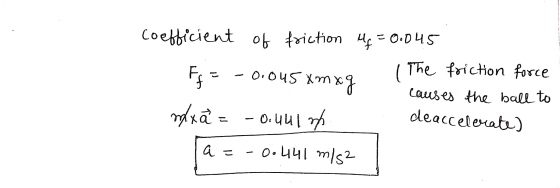
A golfer putts the ball on the green toward the right (positive x direction). If the coefficient of rolling friction is 0.045, find the ball's acceleration in m/s2. (The sign of the acceleration matters!)
Homework Answers
Add Answer to:
A golfer putts the ball on the green toward the right (positive
x direction). If the...
A golfer takes three putts to get the ball into the hole. The first putt displaces...
 A golfer takes three putts to get the ball into the hole. The first putt displaces the ball 3.75 m north, the second 1.85 m southeast, and the third 0.781 m southwest. What are (a) the magnitude and (b) the angle between the direction of the displacement needed to get the ball into the hole in just one putt and the direction due east? (a) Number Units (b) Number Units Click if you would like to Show Work for this...
A golfer puts her golf ball straight toward the hole. The ball's initial velocity is 3.97...
A golfer puts her golf ball straight toward the hole. The ball's initial velocity is 3.97 m/s, and it accelerates at a rate of -0.6 m/s2. What is the maximum distance that the golfer can be from the hole in order to make it? Give your answer in meters.
Good afternoon, Would you mind showing me the steps needed to solve this problem? If the...
Good afternoon, Would you mind showing me the steps needed to solve this problem? If the coefficient of rolling friction for a golf ball being putted on a green is 0.045, what is the ball's acceleration? Give your answer in m/s2. Mass of the ball was not given. Initially, the answer I calculated was -0.44 m/s^2; however, it was marked as incorrect. Your help is much appreciated.
A golfer hits a shot to a green that is elevated 1.17 m above the point...
A golfer hits a shot to a green that is elevated 1.17 m above the point where the ball is struck. The ball leaves the club at a speed of 16.7 m/s at an angle of 38.3o above the horizontal. It rises to its maximum height and then falls down to the green. Ignoring air resistance, find the speed of the ball just before it lands. (g = 9.80 m/s2)
A 200 g ball moving at 0.50 m/s in the + x-direction is subject to a...
A 200 g ball moving at 0.50 m/s in the + x-direction is subject to a 0.20 N force in the − y-direction for 3.0 s . Find the magnitude of the change of the ball's momentum. Find the ball's final speed. Find the angle between the ball's final velocity and the positive x direction.
A golfer, putting on a green, requires three strokes to "hole the ball." During the first...
A golfer, putting on a green, requires three strokes to "hole the ball." During the first putt, the ball rolls 3.1 m due east. For the second putt, the ball travels 3.5 m at an angle of 33.0 ° north of east. The third putt is 0.32 m due north. What displacement ((a) magnitude and (b) direction relative to due east) would have been needed to “hole the ball” on the very first putt?
3. A golfer, putting on a green, require three strokes to " hole the ball." During...
3. A golfer, putting on a green, require three strokes to " hole the ball." During the first putt, the ball rolls 5.0 m due east. For the second putt, the ball travels 2.1 m at an angle of 20.0 degree north of east. The third putt is 0.50 m due north. What displacement(magnitude and direction relative to due east) would have been needed to "hole the ball" on the very first putt?
A car is initially moving at 9.9 m/s in the positive x direction and accelerates at...
A car is initially moving at 9.9 m/s in the positive x direction and accelerates at a constant acceleration of 3.4 m/s2 in the positive x direction for 6 seconds. It then immediately has an acceleration of 6.6 m/s2 in the negative x direction. After some time, its velocity is 27.6 m/s in the negative x direction. What is the average velocity for the entire trip in m/s? Indicate the negative x direction by including a negative sign but do...
Question 14 4 points Save Answer You are pushing a 3.15-kg box toward the right as...
 Question 14 4 points Save Answer You are pushing a 3.15-kg box toward the right as it moves, in the direction of your push, over a patch of rough grass. If the magnitude of your push is 18 4 N, and the coefficient of kinetic friction with the grass is 0.350, what will be the magnitude and direction of the acceleration of the box? O a.-2.4 mis2 b. -1.2 m/s2 O c. 1.2 m/s2 d.2.4 m/s2
A bowler throws a bowling ball of radius R = 11 cm down a lane. The...
 A bowler throws a bowling ball of radius R = 11 cm down
a lane. The ball slides on the lane with initial speed
vcom,0 = 11.0 m/s and initial angular speed
ω0 = 0. The coefficient of kinetic friction
between the ball and the lane is 0.22. The kinetic frictional force
fk acting on the ball causes a
linear acceleration of the ball while producing a torque that
causes an angular acceleration of the ball. When speed
vcom has...
A bowler throws a bowling ball of radius R = 11 cm down
a lane. The ball slides on the lane with initial speed
vcom,0 = 11.0 m/s and initial angular speed
ω0 = 0. The coefficient of kinetic friction
between the ball and the lane is 0.22. The kinetic frictional force
fk acting on the ball causes a
linear acceleration of the ball while producing a torque that
causes an angular acceleration of the ball. When speed
vcom has...
 A golfer takes three putts to get the ball into the hole. The first putt displaces the ball 3.75 m north, the second 1.85 m southeast, and the third 0.781 m southwest. What are (a) the magnitude and (b) the angle between the direction of the displacement needed to get the ball into the hole in just one putt and the direction due east? (a) Number Units (b) Number Units Click if you would like to Show Work for this...
 Question 14 4 points Save Answer You are pushing a 3.15-kg box toward the right as it moves, in the direction of your push, over a patch of rough grass. If the magnitude of your push is 18 4 N, and the coefficient of kinetic friction with the grass is 0.350, what will be the magnitude and direction of the acceleration of the box? O a.-2.4 mis2 b. -1.2 m/s2 O c. 1.2 m/s2 d.2.4 m/s2
 A bowler throws a bowling ball of radius R = 11 cm down
a lane. The ball slides on the lane with initial speed
vcom,0 = 11.0 m/s and initial angular speed
ω0 = 0. The coefficient of kinetic friction
between the ball and the lane is 0.22. The kinetic frictional force
fk acting on the ball causes a
linear acceleration of the ball while producing a torque that
causes an angular acceleration of the ball. When speed
vcom has...
A bowler throws a bowling ball of radius R = 11 cm down
a lane. The ball slides on the lane with initial speed
vcom,0 = 11.0 m/s and initial angular speed
ω0 = 0. The coefficient of kinetic friction
between the ball and the lane is 0.22. The kinetic frictional force
fk acting on the ball causes a
linear acceleration of the ball while producing a torque that
causes an angular acceleration of the ball. When speed
vcom has...
Most questions answered within 3 hours.
-
Where is the error in this code sequence?
String s1 = "Hello";
String s2 = "ello";...
asked 11 months ago -
Financial data for Joel de Paris, Inc., for last year
follow:
Joel de Paris, Inc.
Balance...
asked 11 months ago -
Consider this reaction:
Al2(SO4)3 (aq)+ BaCl3
(aq) Al2Cl6 (aq)- +
3BaSO4(s) . What is the...
asked 11 months ago -
Suppose that Savneet is considering increasing her
recent random sample from 20 car rentals to 40...
asked 11 months ago -
Trucks arrive at an unloading terminal at an average rate of 120
per hour.
Trucks arrive...
asked 11 months ago -
Why are methanol and ethanol completely soluble in water while
octanol is not very little soluble....
asked 11 months ago -
A facilities manager at a university reads in a research report
that the mean amount of...
asked 11 months ago -
When the CuSO4 is rehydrated by adding water to the anhydrous
compound, is this an endothermic...
asked 11 months ago -
A ray of sunlight is passing from diamond into crown glass; the
angle of incidence is...
asked 11 months ago -
A block of mass 0.249 kg is placed on top of a light, vertical
spring of...
asked 11 months ago -
how do the kidneys compensate in the presences of acidosis
a) trigger hyperventilate
b) reserve acid...
asked 11 months ago -
Question 501 pts
The rental rate of capital to the firm increases. Which of the
following...
asked 11 months ago