
Homework Answers
Lattice Energy = Lattice energy of an ionic solid is defind as the the energy required to dissociate a solid into its gaseous ions.
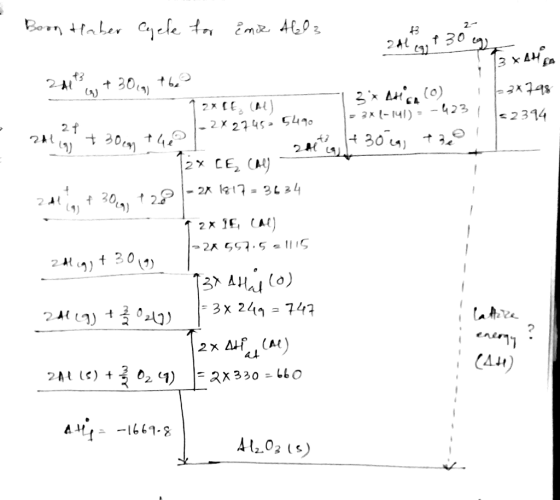
 (c) Higher
lattice energy result in higher melting
points and increased hardness
because more thermal energy is required to break
the bonds of solid to make them into gaseous ions.
(c) Higher
lattice energy result in higher melting
points and increased hardness
because more thermal energy is required to break
the bonds of solid to make them into gaseous ions.
Therefore, as given, Al2O3 has more melting point than Fe2O3, inspite of being the same cation, Al2O3 will have higher lattice energy than Fe2O3.
So the lattice energy of Fe2O3 will be less than that of Al2O3.
Add Answer to:
7) For the ionic solid AlzOs a) Determine its lattice energy using the appropriate Born-Haber cycle...
Find the experimental lattice energy of Magnesium Chloride (MgCl2) using a Born-Haber cycle. Draw the Born-Haber...
Find the experimental lattice energy of Magnesium Chloride (MgCl2) using a Born-Haber cycle. Draw the Born-Haber cycle and indicate the involved steps of the cycle. Label the cycle carefully. Some information that might be useful. Electron affinity of Cl:EA1 = -348.6kJ/mol, EA2 = +750kJ/mol. Heat of sublimation for Magnesium = 147.7 kJ/mol, Bond Dissociation Energy of Cl2 = 242 kJ/mol, Lattice energy due to electrostatic interactions in MgCl2 = -2524 kJ/mol. Ionization energy of Mg: Ei2 = 1451 kJ/mol.
1)a. Using the Born Haber cycle, determine the enthalpy for lattice formation of MgO. Mg (s),...
1)a. Using the Born Haber cycle, determine the enthalpy for lattice formation of MgO. Mg (s), ΔHsub = +148 kJ/mol bond dissociation energy for O2 = +499 kJ/mol 1st ionization energy for Mg = +738 kJ/mol 1st electron affinity for O = –141 kJ/mol 2nd ionization energy for Mg = +1450 kJ/mol 2nd electron affinity for O = +844 kJ/mol MgO(s), enthalpy of formation = –602 kJ/mol 1)b. Calculate the lattice formation energy of MgO using the Madelung constant....
Construct a Born-Haber cycle and calculate the lattice energy of CaC2 (s). Note that this solid...
Construct a Born-Haber cycle and calculate the lattice energy of CaC2 (s). Note that this solid contains the diatomic ion C22–.Useful Information:?H°f (CaC2(s)) ?Hsub (Ca (s)) ?Hsub (C (s)) Bond dissociation energy of C2 (g) = +614 kJ/molFirst ionization energy of Ca (g) = +590 kJ/mol Second ionization energy of Ca (g) = +1143 kJ/mol First electron affinity of C2 (g) = –315 kJ/mol Second electronaffinity of C2 (g) = +410 kJ/mol= –60 kJ/mol = +178 kJ/mol = +717 kJ/mol
Using the data given below, sketch a Born-Haber cycle for the formation of BaC2(s) and insert the various equations and energy values into the individual steps of your cycle Sublimation energy fo...
 Using the data given below, sketch a Born-Haber cycle for the formation of BaC2(s) and insert the various equations and energy values into the individual steps of your cycle Sublimation energy for Ba(s) +180 kJmol1 Electron affinity for Cl(g)-346 kJmol1 First ionization energy for Ba(g)-+514 kJmol1 Bond dissociation energy for Clh(g) +243 kJmol Enthalpy of formation of BaCl2: Ba(s) + Ch(g) BaCh(s)--610 kJmol Lattice energy. Ba2+(g) + 2Cl.(g) → BaCl2(s)--2075 kJmol-1 Calculate the second ionization energy for Ba+(g) → Ba2+(g)...
2) Write down a Born-Haber cycle for magnesium oxide (Mg0). Using the data provided below, determine...
 2) Write down a Born-Haber cycle for magnesium oxide (Mg0). Using the data provided below, determine the experimental value of the lattice enthalpy Uexp. Now calculate the lattice enthalpy Ucale (unit cell of Mg0 shown below). What do these values tell you about the bonding in Mg0? AHP(Mg0)--602 k]/mol Alto (Mg) = + 148 kJ/mol AH to (02) = +249 kJ/mol bond enthalpy (02)+498 k]/mol 16, (Mg) = +738 kJ/mol IE2 (Mg) +1451 k]/mol EA (O) = +142 kJ/mol EA2(0)...
 Using the data given below, sketch a Born-Haber cycle for the formation of BaC2(s) and insert the various equations and energy values into the individual steps of your cycle Sublimation energy for Ba(s) +180 kJmol1 Electron affinity for Cl(g)-346 kJmol1 First ionization energy for Ba(g)-+514 kJmol1 Bond dissociation energy for Clh(g) +243 kJmol Enthalpy of formation of BaCl2: Ba(s) + Ch(g) BaCh(s)--610 kJmol Lattice energy. Ba2+(g) + 2Cl.(g) → BaCl2(s)--2075 kJmol-1 Calculate the second ionization energy for Ba+(g) → Ba2+(g)...
 2) Write down a Born-Haber cycle for magnesium oxide (Mg0). Using the data provided below, determine the experimental value of the lattice enthalpy Uexp. Now calculate the lattice enthalpy Ucale (unit cell of Mg0 shown below). What do these values tell you about the bonding in Mg0? AHP(Mg0)--602 k]/mol Alto (Mg) = + 148 kJ/mol AH to (02) = +249 kJ/mol bond enthalpy (02)+498 k]/mol 16, (Mg) = +738 kJ/mol IE2 (Mg) +1451 k]/mol EA (O) = +142 kJ/mol EA2(0)...
Most questions answered within 3 hours.
-
Where is the error in this code sequence?
String s1 = "Hello";
String s2 = "ello";...
asked 11 months ago -
Financial data for Joel de Paris, Inc., for last year
follow:
Joel de Paris, Inc.
Balance...
asked 11 months ago -
Consider this reaction:
Al2(SO4)3 (aq)+ BaCl3
(aq) Al2Cl6 (aq)- +
3BaSO4(s) . What is the...
asked 11 months ago -
Suppose that Savneet is considering increasing her
recent random sample from 20 car rentals to 40...
asked 11 months ago -
Trucks arrive at an unloading terminal at an average rate of 120
per hour.
Trucks arrive...
asked 11 months ago -
Why are methanol and ethanol completely soluble in water while
octanol is not very little soluble....
asked 11 months ago -
A facilities manager at a university reads in a research report
that the mean amount of...
asked 11 months ago -
When the CuSO4 is rehydrated by adding water to the anhydrous
compound, is this an endothermic...
asked 11 months ago -
A ray of sunlight is passing from diamond into crown glass; the
angle of incidence is...
asked 11 months ago -
A block of mass 0.249 kg is placed on top of a light, vertical
spring of...
asked 11 months ago -
how do the kidneys compensate in the presences of acidosis
a) trigger hyperventilate
b) reserve acid...
asked 11 months ago -
Question 501 pts
The rental rate of capital to the firm increases. Which of the
following...
asked 11 months ago