 answer 3 and 4 please
Homework Answers


Add Answer to:
answer 3 and 4 please
3. Consider the model of a spring-mass damper system, where the...
S+5 Consider a system where the transfer function is given as: G(s) -tS 3+6s2+11s+6 a. Sketch a r...
 s+5 Consider a system where the transfer function is given as: G(s) -tS 3+6s2+11s+6 a. Sketch a root locus for static controller gain K b. Design a controller to meet the following specifictions: t, S 1s, 2 0.6, e(oo)Istep0
s+5 Consider a system where the transfer function is given as: G(s) -tS 3+6s2+11s+6 a. Sketch a root locus for static controller gain K b. Design a controller to meet the following specifictions: t, S 1s, 2 0.6, e(oo)Istep0
s+5 Consider a system where the transfer function is given as: G(s) -tS 3+6s2+11s+6 a. Sketch a root locus for static controller gain K b. Design a controller to meet the following specifictions: t, S 1s, 2 0.6, e(oo)Istep0
Consider the model of a spring-mass-damper system, where the following parameter values are assum...
 Consider the model of a spring-mass-damper system, where the following parameter values are assumed: m-1,b 2, k- 2. a. Write down the transfer function of the system b. Sketch a root locus for static controller gain K c. Find the range of K for stability
Consider the model of a spring-mass-damper system, where the following parameter values are assumed: m-1,b 2, k- 2. a. Write down the transfer function of the system b. Sketch a root locus for static controller...
Consider the model of a spring-mass-damper system, where the following parameter values are assumed: m-1,b 2, k- 2. a. Write down the transfer function of the system b. Sketch a root locus for static controller gain K c. Find the range of K for stability
Consider the model of a spring-mass-damper system, where the following parameter values are assumed: m-1,b 2, k- 2. a. Write down the transfer function of the system b. Sketch a root locus for static controller...
5. Consider the model of a spring-mass-damper system, where the following parameter values are as...
 5. Consider the model of a spring-mass-damper system, where the following parameter values are assumed: m 1,b 2, k 2 a. Design a rate feedback controller to meet the following step response specifictions: ts 1 s, ζ 206. b. Compare the step response of the closed-loop systems in Probs. 3&5
5. Consider the model of a spring-mass-damper system, where the following parameter values are assumed: m 1,b 2, k 2 a. Design a rate feedback controller to meet the following...
5. Consider the model of a spring-mass-damper system, where the following parameter values are assumed: m 1,b 2, k 2 a. Design a rate feedback controller to meet the following step response specifictions: ts 1 s, ζ 206. b. Compare the step response of the closed-loop systems in Probs. 3&5
5. Consider the model of a spring-mass-damper system, where the following parameter values are assumed: m 1,b 2, k 2 a. Design a rate feedback controller to meet the following...
Consider the model of a spring-mass-damper system, where the following parameter values are assum...
 answer 3 and 4 please
Consider the model of a spring-mass-damper system, where the following parameter values are assumed: m 1,b 2,k 2. 3. a. Write down the transfer function of the system b. Choose a sample time for the system c. Find the pulse transfer function (use MATLAB 'c2d' command) d. Find the range of K for stability for the closed-loop sampled-data system 4. Consider a series RLC circuit driven by a voltage source with capacitor voltage as output....
answer 3 and 4 please
Consider the model of a spring-mass-damper system, where the following parameter values are assumed: m 1,b 2,k 2. 3. a. Write down the transfer function of the system b. Choose a sample time for the system c. Find the pulse transfer function (use MATLAB 'c2d' command) d. Find the range of K for stability for the closed-loop sampled-data system 4. Consider a series RLC circuit driven by a voltage source with capacitor voltage as output....
3. A mass on frictionless rollers is attached to a wall using a spring-damper mechanism: 99m...
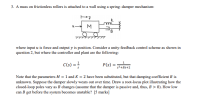 3. A mass on frictionless rollers is attached to a wall using a spring-damper mechanism: 99m where input u is force and output y is position. Consider a unity-feedback control scheme as shown in question 2, but where the controller and plant are the following: C(s)1 P(s) Note that the parameters M1 and K 2 have been substituted, but that damping coefficient B is unknown. Suppose the damper slowly wears out over time. Draw a root-locus plot illustrating how the...
3) (10 pts) Consider the unity feedback system as shown in Figure 1, where s(s+1)(s+5s+6) (a) For...
 3) (10 pts) Consider the unity feedback system as shown in Figure 1, where s(s+1)(s+5s+6) (a) For C(s) K, sketch the root locus (b) Based on your root locus in (a), can you find a value of gain K, such that the closed- loop system will have a settling time of 1 second under a step input? Justify your answer.
3) (10 pts) Consider the unity feedback system as shown in Figure 1, where s(s+1)(s+5s+6) (a) For C(s) K, sketch...
3) (10 pts) Consider the unity feedback system as shown in Figure 1, where s(s+1)(s+5s+6) (a) For C(s) K, sketch the root locus (b) Based on your root locus in (a), can you find a value of gain K, such that the closed- loop system will have a settling time of 1 second under a step input? Justify your answer.
3) (10 pts) Consider the unity feedback system as shown in Figure 1, where s(s+1)(s+5s+6) (a) For C(s) K, sketch...
[7] Sketch the root locus for the unity feedback system whose open loop transfer function is K G(s) Draw the root lo...
 [7] Sketch the root locus for the unity feedback system whose open loop transfer function is K G(s) Draw the root locus of the system with the gain Kas a variable. s(s+4) (s2+4s+20) Determine asymptotes, centroid, breakaway point, angle of departure, and the gain at which root locus crosses ja-axis. A control system with type-0 process and a PID controller is shown below. Design the [8 parameters of the PID controller so that the following specifications are satisfied. =100 a)...
10. Consider the system shown in Figure 1. Assuming a second-order system approximation, design the following controllers based on the root locus shown in Figure 2 o esign a gain adjustment contr...
 10. Consider the system shown in Figure 1. Assuming a second-order system approximation, design the following controllers based on the root locus shown in Figure 2 o esign a gain adjustment controller Co) -K such that the damping ratio amping ratio ζ = 0.5 Design a lag compern 348+pe such that the steady-state error under a step ensator C(s) input ess is 1o of that in the case of gain adjustment with K 64 s + Pe Figure 1: System...
Consider a mass-spring-damper system whose motion is described by the following system of differe...
 Consider a mass-spring-damper system whose motion is described by the following system of differentiat equations [c1(f-k)+k,(f-х)-c2(x-9), f=f(t), y:' y(t) with x=x( t), where the function fit) is the input displacement function (known), while xit) and yt) are the two generalized coordinates (both unknown) of the mass-spring-damper systenm. 1. Identify the type of equations (e.g. H/NH, ODE/PDE, L/NL, order, type of coefficients, etc.J. 2. Express this system of differential equations in matrix form, assume f 0 and then determine its general...
Consider the mass-spring-damper system depicted in the figure below, where the input of the system is...
 Consider the mass-spring-damper system depicted in the figure below, where the input of the system is the applied force F(t) and the output of the system is xít) that is the displacement of the mass according to the coordinate system defined in that figure. Assume that force F(t) is applied for t> 0 and the system is in static equilibrium before t=0 and z(t) is measured from the static equilibrium. b m F Also, the mass of the block, the...
 s+5 Consider a system where the transfer function is given as: G(s) -tS 3+6s2+11s+6 a. Sketch a root locus for static controller gain K b. Design a controller to meet the following specifictions: t, S 1s, 2 0.6, e(oo)Istep0
s+5 Consider a system where the transfer function is given as: G(s) -tS 3+6s2+11s+6 a. Sketch a root locus for static controller gain K b. Design a controller to meet the following specifictions: t, S 1s, 2 0.6, e(oo)Istep0
s+5 Consider a system where the transfer function is given as: G(s) -tS 3+6s2+11s+6 a. Sketch a root locus for static controller gain K b. Design a controller to meet the following specifictions: t, S 1s, 2 0.6, e(oo)Istep0
 Consider the model of a spring-mass-damper system, where the following parameter values are assumed: m-1,b 2, k- 2. a. Write down the transfer function of the system b. Sketch a root locus for static controller gain K c. Find the range of K for stability
Consider the model of a spring-mass-damper system, where the following parameter values are assumed: m-1,b 2, k- 2. a. Write down the transfer function of the system b. Sketch a root locus for static controller...
Consider the model of a spring-mass-damper system, where the following parameter values are assumed: m-1,b 2, k- 2. a. Write down the transfer function of the system b. Sketch a root locus for static controller gain K c. Find the range of K for stability
Consider the model of a spring-mass-damper system, where the following parameter values are assumed: m-1,b 2, k- 2. a. Write down the transfer function of the system b. Sketch a root locus for static controller...
 5. Consider the model of a spring-mass-damper system, where the following parameter values are assumed: m 1,b 2, k 2 a. Design a rate feedback controller to meet the following step response specifictions: ts 1 s, ζ 206. b. Compare the step response of the closed-loop systems in Probs. 3&5
5. Consider the model of a spring-mass-damper system, where the following parameter values are assumed: m 1,b 2, k 2 a. Design a rate feedback controller to meet the following...
5. Consider the model of a spring-mass-damper system, where the following parameter values are assumed: m 1,b 2, k 2 a. Design a rate feedback controller to meet the following step response specifictions: ts 1 s, ζ 206. b. Compare the step response of the closed-loop systems in Probs. 3&5
5. Consider the model of a spring-mass-damper system, where the following parameter values are assumed: m 1,b 2, k 2 a. Design a rate feedback controller to meet the following...
 answer 3 and 4 please
Consider the model of a spring-mass-damper system, where the following parameter values are assumed: m 1,b 2,k 2. 3. a. Write down the transfer function of the system b. Choose a sample time for the system c. Find the pulse transfer function (use MATLAB 'c2d' command) d. Find the range of K for stability for the closed-loop sampled-data system 4. Consider a series RLC circuit driven by a voltage source with capacitor voltage as output....
answer 3 and 4 please
Consider the model of a spring-mass-damper system, where the following parameter values are assumed: m 1,b 2,k 2. 3. a. Write down the transfer function of the system b. Choose a sample time for the system c. Find the pulse transfer function (use MATLAB 'c2d' command) d. Find the range of K for stability for the closed-loop sampled-data system 4. Consider a series RLC circuit driven by a voltage source with capacitor voltage as output....
 3. A mass on frictionless rollers is attached to a wall using a spring-damper mechanism: 99m where input u is force and output y is position. Consider a unity-feedback control scheme as shown in question 2, but where the controller and plant are the following: C(s)1 P(s) Note that the parameters M1 and K 2 have been substituted, but that damping coefficient B is unknown. Suppose the damper slowly wears out over time. Draw a root-locus plot illustrating how the...
 3) (10 pts) Consider the unity feedback system as shown in Figure 1, where s(s+1)(s+5s+6) (a) For C(s) K, sketch the root locus (b) Based on your root locus in (a), can you find a value of gain K, such that the closed- loop system will have a settling time of 1 second under a step input? Justify your answer.
3) (10 pts) Consider the unity feedback system as shown in Figure 1, where s(s+1)(s+5s+6) (a) For C(s) K, sketch...
3) (10 pts) Consider the unity feedback system as shown in Figure 1, where s(s+1)(s+5s+6) (a) For C(s) K, sketch the root locus (b) Based on your root locus in (a), can you find a value of gain K, such that the closed- loop system will have a settling time of 1 second under a step input? Justify your answer.
3) (10 pts) Consider the unity feedback system as shown in Figure 1, where s(s+1)(s+5s+6) (a) For C(s) K, sketch...
 [7] Sketch the root locus for the unity feedback system whose open loop transfer function is K G(s) Draw the root locus of the system with the gain Kas a variable. s(s+4) (s2+4s+20) Determine asymptotes, centroid, breakaway point, angle of departure, and the gain at which root locus crosses ja-axis. A control system with type-0 process and a PID controller is shown below. Design the [8 parameters of the PID controller so that the following specifications are satisfied. =100 a)...
 10. Consider the system shown in Figure 1. Assuming a second-order system approximation, design the following controllers based on the root locus shown in Figure 2 o esign a gain adjustment controller Co) -K such that the damping ratio amping ratio ζ = 0.5 Design a lag compern 348+pe such that the steady-state error under a step ensator C(s) input ess is 1o of that in the case of gain adjustment with K 64 s + Pe Figure 1: System...
 Consider a mass-spring-damper system whose motion is described by the following system of differentiat equations [c1(f-k)+k,(f-х)-c2(x-9), f=f(t), y:' y(t) with x=x( t), where the function fit) is the input displacement function (known), while xit) and yt) are the two generalized coordinates (both unknown) of the mass-spring-damper systenm. 1. Identify the type of equations (e.g. H/NH, ODE/PDE, L/NL, order, type of coefficients, etc.J. 2. Express this system of differential equations in matrix form, assume f 0 and then determine its general...
 Consider the mass-spring-damper system depicted in the figure below, where the input of the system is the applied force F(t) and the output of the system is xít) that is the displacement of the mass according to the coordinate system defined in that figure. Assume that force F(t) is applied for t> 0 and the system is in static equilibrium before t=0 and z(t) is measured from the static equilibrium. b m F Also, the mass of the block, the...
Most questions answered within 3 hours.
-
Where is the error in this code sequence?
String s1 = "Hello";
String s2 = "ello";...
asked 11 months ago -
Financial data for Joel de Paris, Inc., for last year
follow:
Joel de Paris, Inc.
Balance...
asked 11 months ago -
Consider this reaction:
Al2(SO4)3 (aq)+ BaCl3
(aq) Al2Cl6 (aq)- +
3BaSO4(s) . What is the...
asked 11 months ago -
Suppose that Savneet is considering increasing her
recent random sample from 20 car rentals to 40...
asked 11 months ago -
Trucks arrive at an unloading terminal at an average rate of 120
per hour.
Trucks arrive...
asked 11 months ago -
Why are methanol and ethanol completely soluble in water while
octanol is not very little soluble....
asked 11 months ago -
A facilities manager at a university reads in a research report
that the mean amount of...
asked 11 months ago -
When the CuSO4 is rehydrated by adding water to the anhydrous
compound, is this an endothermic...
asked 11 months ago -
A ray of sunlight is passing from diamond into crown glass; the
angle of incidence is...
asked 11 months ago -
A block of mass 0.249 kg is placed on top of a light, vertical
spring of...
asked 11 months ago -
how do the kidneys compensate in the presences of acidosis
a) trigger hyperventilate
b) reserve acid...
asked 11 months ago -
Question 501 pts
The rental rate of capital to the firm increases. Which of the
following...
asked 11 months ago