![11.At a certain temperature Kc =25 and a reaction vessel contains a mixture with the following concentrations: [H.] =0.10 M,](http://img.homeworklib.com/questions/442abfe0-861d-11eb-b854-7946f678afb6.png?x-oss-process=image/resize,w_560)
Homework Answers
Reaction Quotient:
![Q=\frac{[Product]}{[Reactant]}](http://img.homeworklib.com/questions/e27548c0-8673-11eb-b51b-35f17b1b13ca.png?x-oss-process=image/resize,w_560)
If Q>Kc , then concentration of product will be more , reaction proceed towards left.
If Q<Kc , then concentration of product will be less , reaction proceed towards right.
If Q=Kc ,then they are in equilibrium.
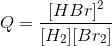
Putting value of concentration given,
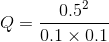

Answer: a) Q=Kc
Add Answer to:
11.At a certain temperature Kc =25 and a reaction vessel contains a mixture with the following...
At a certain temperature Kc = 25 and a reaction vessel contains a mixture with the...
At a certain temperature Kc = 25 and a reaction vessel contains a mixture with the following concentrations: [H2] = 0.10 M, [Br2] = 0.10 M and [HBr] = 0.45 M Which of the following statements concerning the reaction and the reaction quotient Q, is true? A. Q<Kc; more H2 and Br2 will be produced B. Q<Kc; more HBr will be produced
At a certain temperature Kc = 25 and a reaction vessel contains a mixture with the...
At a certain temperature Kc = 25 and a reaction vessel contains a mixture with the following concentrations: [H2] = 0.10 M, [Br2] = 0.10 M and [HBr] = 0.50 M. Solve using math please.
At 445°C, Kc for the following reaction is 0.020. 2 HI(g) <->H, (g) +1, (g) A...
 At 445°C, Kc for the following reaction is 0.020. 2 HI(g) <->H, (g) +1, (g) A mixture of H2, I2, and Hl in a vessel at 445°C has the following concentrations: [HI] = 1.5 M, [H2) = 2.50 M and [12] = 0.05 M. Which one of the following statements concerning the reaction quotient, Qc, is TRUE for the above system? a. Qc = Kc; the system is at equilibrium. b. Qc is less than Kc; more H2 and 12...
MULTIPLE CHOICE. Cether of the core circled, and one of which is correct half credit will...
 MULTIPLE CHOICE. Cether of the core circled, and one of which is correct half credit will be given 12 circled, and CHOICE. Circle the and 1. Which of the following statements concerning mis on A) A system that is disturbed from an gurumo responds in a to restore equilibrium B) Equilibrium in molecular systems is dynamic with two opposing process balancing one another ) The value of the equilibrium constant for a diven reaction mode is the same regardless of...
A reaction vessel contains NH3, N2, and H2 at equilibrium at a certain temperature. The equilibrium...
A reaction vessel contains NH3, N2, and H2 at equilibrium at a certain temperature. The equilibrium concentrations are [N2] = 0.61 M, [H2] = 1.26 M, and [NH3] = 0.30 M. Calculate the equilibrium constant, Kc, if the reaction is represented as ( 1 2 ) N2(g) + ( 3 2 ) H2(g) ⇌ NH3(g)
11. For the reaction: CO(g) + 2H2(g) ⇄ CH3OH(g) Kc = 15.0 at a certain temperature....
11. For the reaction: CO(g) + 2H2(g) ⇄ CH3OH(g) Kc = 15.0 at a certain temperature. Is a reaction mixture that contains 0.40 M CO, 0.80 M H2, and 0.10 M CH3OH at equilibrium? If not, in which direction will the net reaction occur? What will be their concentrations when equilibrium is established? 12. Discuss the hydrolysis of a (a) salt of weak acid and strong base (b) salt of strong acid weak base.
Be sure to answer all parts. The equilibrium constant Kc for the reaction H2(g) + Br2(g)...
Be sure to answer all parts. The equilibrium constant Kc for the reaction H2(g) + Br2(g) ⇆ 2HBr(g) is 2.180 × 10⁶ at 730°C. Starting with 2.20 moles of HBr in a 18.1−L reaction vessel, calculate the concentrations of H2, Br2, and HBr at equilibrium. [H2] =___ M Br2] = ___M [HBr] = ____M
The following reaction was carried out in a 3.75 L reaction vessel at 1100 K: C(s)+H2O(g)⇌CO(g)+H2(g)...
The following reaction was carried out in a 3.75 L reaction vessel at 1100 K: C(s)+H2O(g)⇌CO(g)+H2(g) If during the course of the reaction, the vessel is found to contain 8.50 mol of C, 12.7 mol of H2O, 4.00 mol of CO, and 6.20 mol of H2, what is the reaction quotient Q? Enter the reaction quotient numerically. Q = Consider the reaction CO(g)+NH3(g)⇌HCONH2(g), Kc=0.810 If a reaction vessel initially contains only CO and NH3 at concentrations of 1.00 M and 2.00...
10. The equilibrium constant Kc for the reaction H2(g) + Br2(g) ⇆ 2HBr(g) is 2.180 ×...
10. The equilibrium constant Kc for the reaction H2(g) + Br2(g) ⇆ 2HBr(g) is 2.180 × 10⁶ at 730°C. Starting with 2.20 moles of HBr in a 13.7−L reaction vessel, calculate the concentrations of H2, Br2, and HBr at equilibrium. [H2] = [Br2] = [HBr] =
The equilibrium constant Kc for the reaction H2(g) + Br2(g) ⇆ 2HBr(g) is 2.180 × 10⁶...
The equilibrium constant Kc for the reaction H2(g) + Br2(g) ⇆ 2HBr(g) is 2.180 × 10⁶ at 730°C. Starting with 1.20 moles of HBr in a 21.3−L reaction vessel, calculate the concentrations of H2, Br2, and HBr at equilibrium.
 At 445°C, Kc for the following reaction is 0.020. 2 HI(g) <->H, (g) +1, (g) A mixture of H2, I2, and Hl in a vessel at 445°C has the following concentrations: [HI] = 1.5 M, [H2) = 2.50 M and [12] = 0.05 M. Which one of the following statements concerning the reaction quotient, Qc, is TRUE for the above system? a. Qc = Kc; the system is at equilibrium. b. Qc is less than Kc; more H2 and 12...
 MULTIPLE CHOICE. Cether of the core circled, and one of which is correct half credit will be given 12 circled, and CHOICE. Circle the and 1. Which of the following statements concerning mis on A) A system that is disturbed from an gurumo responds in a to restore equilibrium B) Equilibrium in molecular systems is dynamic with two opposing process balancing one another ) The value of the equilibrium constant for a diven reaction mode is the same regardless of...
Most questions answered within 3 hours.
-
Where is the error in this code sequence?
String s1 = "Hello";
String s2 = "ello";...
asked 10 months ago -
Financial data for Joel de Paris, Inc., for last year
follow:
Joel de Paris, Inc.
Balance...
asked 10 months ago -
Consider this reaction:
Al2(SO4)3 (aq)+ BaCl3
(aq) Al2Cl6 (aq)- +
3BaSO4(s) . What is the...
asked 10 months ago -
Suppose that Savneet is considering increasing her
recent random sample from 20 car rentals to 40...
asked 10 months ago -
Trucks arrive at an unloading terminal at an average rate of 120
per hour.
Trucks arrive...
asked 10 months ago -
Why are methanol and ethanol completely soluble in water while
octanol is not very little soluble....
asked 10 months ago -
A facilities manager at a university reads in a research report
that the mean amount of...
asked 10 months ago -
When the CuSO4 is rehydrated by adding water to the anhydrous
compound, is this an endothermic...
asked 10 months ago -
A ray of sunlight is passing from diamond into crown glass; the
angle of incidence is...
asked 10 months ago -
A block of mass 0.249 kg is placed on top of a light, vertical
spring of...
asked 10 months ago -
how do the kidneys compensate in the presences of acidosis
a) trigger hyperventilate
b) reserve acid...
asked 10 months ago -
Question 501 pts
The rental rate of capital to the firm increases. Which of the
following...
asked 10 months ago