write the mechanism for the hydrolysis of ethyl acetoacetate in an acidic environment and the decarboxylation...
write the mechanism for the hydrolysis of ethyl acetoacetate in an acidic environment and the decarboxylation of the acetoacetic acid product.
Homework Answers

Add Answer to:
write the mechanism for the hydrolysis of ethyl acetoacetate in an
acidic environment and the decarboxylation...
4. Conversion of B into C involves hydrolysis of the ester followed by decarboxylation. On the...
 4. Conversion of B into C involves hydrolysis of the ester followed by decarboxylation. On the structures provided below, show the electron flow for the decarboxylation step. CH2Ph 5. The initial product formed on decarboxylation is an enol, which rapidly equilibrates to its keto form under the acidic reaction conditions. Write the complete stepwise mechanism for the acid-catalyzed conversion of the enol into its keto form, Compound C. Ph Ph
Draw the product of ethyl acetoacetate, base, 3-bromopentane, hydrolysis and heat.
 Draw the product of ethyl acetoacetate, base, 3-bromopentane, hydrolysis and heat.
Draw and explain the mechanism of the reduction of ethyl acetoacetate using LiAlH4 (Hint: ketone and...
Draw and explain the mechanism of the reduction of ethyl acetoacetate using LiAlH4 (Hint: ketone and ester are converted into alcohols)
Write an equation for hydrolysis via acid catalysis. Using ethyl acetate, ethyl benzoate, ethyl formate or...
Write an equation for hydrolysis via acid catalysis. Using ethyl acetate, ethyl benzoate, ethyl formate or ethyl butyrate. Write an equation for hydrolysis via base catalysis. Using ethyl acetate, ethyl benzoate, ethyl formate or ethyl butyrate.
question 1: Propose a synthesis of the compound below on the left from ethyl acetoacetate (ethyl...
 question 1: Propose a synthesis of the compound below on the
left from ethyl acetoacetate (ethyl 3-oxobutanoate). You may use
any of the reagents in the table.
question 2:
Each of the compounds below is treated with a large molar excess
of D2O containing a catalytic amount of NaOD. When this
is done all of the acidic hydrogens are exchanged for deuteriums.
Indicate the number of hydrogens exchanged on each compound.
question 3: Indicate whether the compounds below undergo
racemization...
question 1: Propose a synthesis of the compound below on the
left from ethyl acetoacetate (ethyl 3-oxobutanoate). You may use
any of the reagents in the table.
question 2:
Each of the compounds below is treated with a large molar excess
of D2O containing a catalytic amount of NaOD. When this
is done all of the acidic hydrogens are exchanged for deuteriums.
Indicate the number of hydrogens exchanged on each compound.
question 3: Indicate whether the compounds below undergo
racemization...
please don't use any abbreviations! like I don't know how to draw anything like oet or...
 please don't use any abbreviations! like I
don't know how to draw anything like oet or an R group like please
just draw out the whole thing!
CH3 CO2Et Hagemann's ester The compound known as Hagemann's ester is prepared by treatment of a mixture of formaldehyde and ethyl acetoacetate with base, followed by acid-catalyzed decarboxylation. The reaction involves the following steps: 1. Deprotonation of ethyl acetoacetate to form enolate ion 1; 2. Reaction of the enolate ion with formaldehyde to...
please don't use any abbreviations! like I
don't know how to draw anything like oet or an R group like please
just draw out the whole thing!
CH3 CO2Et Hagemann's ester The compound known as Hagemann's ester is prepared by treatment of a mixture of formaldehyde and ethyl acetoacetate with base, followed by acid-catalyzed decarboxylation. The reaction involves the following steps: 1. Deprotonation of ethyl acetoacetate to form enolate ion 1; 2. Reaction of the enolate ion with formaldehyde to...
Draw the detailed mechanism of ethyl propyolate’s hydrolysis under basic conditions
Draw the detailed mechanism of ethyl propyolate’s hydrolysis under basic conditions
You will be starting with 1.0 mL ethyl acetoacetate and 800 mg (0.800 g) resorcinol. Determine...
You will be starting with 1.0 mL ethyl acetoacetate and 800 mg (0.800 g) resorcinol. Determine which compound is the limiting reagent. Based on your result, calculate the theoretical yield of product for the synthesis. Mechanism: dehydration of 4-methyl-7-hydroxycoumarin.
please show all steps (a) Write the reaction mechanism for the hydrolysis of the amide under...
 please show all steps
(a) Write the reaction mechanism for the hydrolysis of the amide under acidic conditions: 2 Et Н,о° heat OH + EtzNH2 Et (b) Write the reaction mechanism for the base catalyzed hydrolysis of the ester Na +n-BuOH OBu NaOH (aq)
please show all steps
(a) Write the reaction mechanism for the hydrolysis of the amide under acidic conditions: 2 Et Н,о° heat OH + EtzNH2 Et (b) Write the reaction mechanism for the base catalyzed hydrolysis of the ester Na +n-BuOH OBu NaOH (aq)
Complete the mechanism for the acidic hydrolysis of an amide by drawing curved arrows in each step.
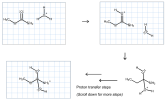 Complete the mechanism for the acidic hydrolysis of an amide by drawing curved arrows in each step.
 4. Conversion of B into C involves hydrolysis of the ester followed by decarboxylation. On the structures provided below, show the electron flow for the decarboxylation step. CH2Ph 5. The initial product formed on decarboxylation is an enol, which rapidly equilibrates to its keto form under the acidic reaction conditions. Write the complete stepwise mechanism for the acid-catalyzed conversion of the enol into its keto form, Compound C. Ph Ph
 Draw the product of ethyl acetoacetate, base, 3-bromopentane, hydrolysis and heat.
 question 1: Propose a synthesis of the compound below on the
left from ethyl acetoacetate (ethyl 3-oxobutanoate). You may use
any of the reagents in the table.
question 2:
Each of the compounds below is treated with a large molar excess
of D2O containing a catalytic amount of NaOD. When this
is done all of the acidic hydrogens are exchanged for deuteriums.
Indicate the number of hydrogens exchanged on each compound.
question 3: Indicate whether the compounds below undergo
racemization...
question 1: Propose a synthesis of the compound below on the
left from ethyl acetoacetate (ethyl 3-oxobutanoate). You may use
any of the reagents in the table.
question 2:
Each of the compounds below is treated with a large molar excess
of D2O containing a catalytic amount of NaOD. When this
is done all of the acidic hydrogens are exchanged for deuteriums.
Indicate the number of hydrogens exchanged on each compound.
question 3: Indicate whether the compounds below undergo
racemization...
 please don't use any abbreviations! like I
don't know how to draw anything like oet or an R group like please
just draw out the whole thing!
CH3 CO2Et Hagemann's ester The compound known as Hagemann's ester is prepared by treatment of a mixture of formaldehyde and ethyl acetoacetate with base, followed by acid-catalyzed decarboxylation. The reaction involves the following steps: 1. Deprotonation of ethyl acetoacetate to form enolate ion 1; 2. Reaction of the enolate ion with formaldehyde to...
please don't use any abbreviations! like I
don't know how to draw anything like oet or an R group like please
just draw out the whole thing!
CH3 CO2Et Hagemann's ester The compound known as Hagemann's ester is prepared by treatment of a mixture of formaldehyde and ethyl acetoacetate with base, followed by acid-catalyzed decarboxylation. The reaction involves the following steps: 1. Deprotonation of ethyl acetoacetate to form enolate ion 1; 2. Reaction of the enolate ion with formaldehyde to...
 please show all steps
(a) Write the reaction mechanism for the hydrolysis of the amide under acidic conditions: 2 Et Н,о° heat OH + EtzNH2 Et (b) Write the reaction mechanism for the base catalyzed hydrolysis of the ester Na +n-BuOH OBu NaOH (aq)
please show all steps
(a) Write the reaction mechanism for the hydrolysis of the amide under acidic conditions: 2 Et Н,о° heat OH + EtzNH2 Et (b) Write the reaction mechanism for the base catalyzed hydrolysis of the ester Na +n-BuOH OBu NaOH (aq)
Most questions answered within 3 hours.
-
Where is the error in this code sequence?
String s1 = "Hello";
String s2 = "ello";...
asked 11 months ago -
Financial data for Joel de Paris, Inc., for last year
follow:
Joel de Paris, Inc.
Balance...
asked 11 months ago -
Consider this reaction:
Al2(SO4)3 (aq)+ BaCl3
(aq) Al2Cl6 (aq)- +
3BaSO4(s) . What is the...
asked 11 months ago -
Suppose that Savneet is considering increasing her
recent random sample from 20 car rentals to 40...
asked 11 months ago -
Trucks arrive at an unloading terminal at an average rate of 120
per hour.
Trucks arrive...
asked 11 months ago -
Why are methanol and ethanol completely soluble in water while
octanol is not very little soluble....
asked 11 months ago -
A facilities manager at a university reads in a research report
that the mean amount of...
asked 11 months ago -
When the CuSO4 is rehydrated by adding water to the anhydrous
compound, is this an endothermic...
asked 11 months ago -
A ray of sunlight is passing from diamond into crown glass; the
angle of incidence is...
asked 11 months ago -
A block of mass 0.249 kg is placed on top of a light, vertical
spring of...
asked 11 months ago -
how do the kidneys compensate in the presences of acidosis
a) trigger hyperventilate
b) reserve acid...
asked 11 months ago -
Question 501 pts
The rental rate of capital to the firm increases. Which of the
following...
asked 11 months ago