 please help me with this as
fast as you can i have test and please show work
please help me with this as
fast as you can i have test and please show work
Homework Answers


(a) Positions of the object at t = 1, 2, 3,4 seconds are taken as x1, x2 , x3 ,x4




(b)Object 's displacement between between t=2s and t= 4s,, S= x4 - x2

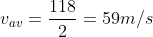
(c) Average velocity between t=2s and t= 4s ,, vav = Total displacement / total time taken
(d) Instantaneous velocity is taken as v = dx/ dt
so we differntiate x





(e) Average accelartion between t=2s and t= 4s
aav = change in velocity / time duration


(a) Positions of the object at t = 1, 2, 3,4 seconds are taken as x1, x2 , x3 ,x4




(b)Object 's displacement between between t=2s and t= 4s,, S= x4 - x2

(c) Average velocity between t=2s and t= 4s ,, vav = Total displacement / total time taken

(d) Instantaneous velocity is taken as v = dx/ dt
so we differntiate x





(e) Average accelartion between t=2s and t= 4s
aav = change in velocity / time duration

Add Answer to:
please help me with this as
fast as you can i have test and please show...
I have three questions I need assistance on please: 1. To make an object start moving...
I have three questions I need assistance on please: 1. To make an object start moving on a surface with friction requires (a) less force than it takes to keep it moving on the surface at constant velocity (b) the same force as to keep it moving on the surface at constant velocity (c) more force than it takes to keep it moving on the surface at constant velocity (d) a force equal to the weight of the object (2)...
The position of an object moving along an x axis is given by x = 3.03...
The position of an object moving along an x axis is given by x = 3.03 t - 4.04 t2 + 1.08 t3, where x is in meters and t in seconds. Find the position of the object at the following values of t: (a) 1 s, (b) 2 s, (c) 3 s, and (d) 4 s. (e) What is the object's displacement between t = 0 and t = 4 s? (f) What is its average velocity from t...
8. A student rolls a marble alongside a meterstick to measure its velocity. At t1 =...
 8. A student rolls a marble alongside a meterstick to measure
its velocity. At t1 = -2.5 s, its position is x1 = 4.3 cm, and at
t2 = 4.5 s it is at x2 = 18.5 cm. Determine its average velocity
during this time interval.
9. The position of a ball rolling along a straight line is given by
? = 1.8−3.6? +1.5?2, where x is in meters and t is in seconds.
Determine the average velocity of the...
8. A student rolls a marble alongside a meterstick to measure
its velocity. At t1 = -2.5 s, its position is x1 = 4.3 cm, and at
t2 = 4.5 s it is at x2 = 18.5 cm. Determine its average velocity
during this time interval.
9. The position of a ball rolling along a straight line is given by
? = 1.8−3.6? +1.5?2, where x is in meters and t is in seconds.
Determine the average velocity of the...
Please show steps to solve 9) At time -0 s, an object is observed at x...
 Please show steps to solve
9) At time -0 s, an object is observed at x 0 m; and its position along the x axis follows this expression: x--5t+ 212, where the units for distance and time are meters and seconds, respectively. What is the object's displacement Ar between t 2.0 s and i 4.0 s? A) +14 m B) -14 m C) +10 m D) -12 m E) -5 m
Please show steps to solve
9) At time -0 s, an object is observed at x 0 m; and its position along the x axis follows this expression: x--5t+ 212, where the units for distance and time are meters and seconds, respectively. What is the object's displacement Ar between t 2.0 s and i 4.0 s? A) +14 m B) -14 m C) +10 m D) -12 m E) -5 m
1) . You repeat the same experiment that you did in the lab with the force...
1) . You repeat the same experiment that you did in the lab with the force table using two 100 g masses at 135° and 225°. (a) Complete the table below. Force Mass (kg) Magnitude of Force (N) Angle (degrees) Ax (N) Ay (N) F1 0.100 135 F2 0.100 225 (b) Determine (by calculation) the value of F3 needed to balance the two forces F1 and F2. F3x = F3y = magnitude F3 = direction θ3 = ° counterclockwise from...
The position of a particle moving with constant acceleration is given by x(t) = 2t2 +...
The position of a particle moving with constant acceleration is given by x(t) = 2t2 + 4t + 4 where x is in meters and t is in seconds. (a) Calculate the average velocity of this particle between t = 2 seconds and t = 4 seconds. 16 m/s Correct: Your answer is correct. (b) At what time during this interval is the average velocity equal to the instantaneous velocity? (c) How does this time compare to the average time...
please answer the entire question (all the parts 1-10) for thumbs up. thanks 14.0 m/s [R]...
 please answer the entire question (all the parts 1-10)
for thumbs up.
thanks
14.0 m/s [R] 5 mis?[R] bamy 5*[L] -10.0+ -20.0 + 1. The acceleration at t=2.999s Sn 2. The acceleration at t=20.5s 3. The displacement from t=0.0s to t=4.0s 4. The displacement from t=12.0s to t=32.0s 5. The average velocity from t=12.0s to t=32.0s 6. The object's velocity at 13.5 seconds. 7. The time interval when the object travelled in uniform motion 8. The time(s) when the object...
please answer the entire question (all the parts 1-10)
for thumbs up.
thanks
14.0 m/s [R] 5 mis?[R] bamy 5*[L] -10.0+ -20.0 + 1. The acceleration at t=2.999s Sn 2. The acceleration at t=20.5s 3. The displacement from t=0.0s to t=4.0s 4. The displacement from t=12.0s to t=32.0s 5. The average velocity from t=12.0s to t=32.0s 6. The object's velocity at 13.5 seconds. 7. The time interval when the object travelled in uniform motion 8. The time(s) when the object...
3.) The position of a particle is given by x(t) = 3t3 – 2t2 – 5t...
 3.) The position of a particle is given by x(t) = 3t3 – 2t2 – 5t + 10, where t is in seconds and x is in meters. Find the initial position of the particle. Find the position of the particle after 5 seconds. Find the average velocity from 0 sec to t = 5sec Find the instantaneous velocity as a function of time Find the instantaneous velocity at t = 2 seconds. Find the instantaneous velocity at t=4 seconds...
Given position x = 2t + 5t2 (where x is in meters and t is in...
Given position x = 2t + 5t2 (where x is in meters and t is in seconds): A. Calculate the average velocity over the time interval t = 1 s to t = 4 s. Units: m.s-1 B. What is the instantaneous velocity at t = 4 s? Units: m.s-1 C. What is the acceleration of the object? Units: m.s-2 D. In which direction is the object accelerating?
Help me please 7. (Lesson 1.4) Express the net area of the shaded region in Figure...
 Help me please
7. (Lesson 1.4) Express the net area of the shaded region in Figure 2 below with a definite integral. Then use the Fundamental Theorem to evaluate it Fieure 2. Figure 3 (Lesson 1.4) Find the equation of the line in Figure 3 above and express the net area of the shaded region with a definite integral. Then use geometry to compute it 8. 9. (Lesson 1.5) (a) If an object travels along a line with constant velocity...
Help me please
7. (Lesson 1.4) Express the net area of the shaded region in Figure 2 below with a definite integral. Then use the Fundamental Theorem to evaluate it Fieure 2. Figure 3 (Lesson 1.4) Find the equation of the line in Figure 3 above and express the net area of the shaded region with a definite integral. Then use geometry to compute it 8. 9. (Lesson 1.5) (a) If an object travels along a line with constant velocity...
 8. A student rolls a marble alongside a meterstick to measure
its velocity. At t1 = -2.5 s, its position is x1 = 4.3 cm, and at
t2 = 4.5 s it is at x2 = 18.5 cm. Determine its average velocity
during this time interval.
9. The position of a ball rolling along a straight line is given by
? = 1.8−3.6? +1.5?2, where x is in meters and t is in seconds.
Determine the average velocity of the...
8. A student rolls a marble alongside a meterstick to measure
its velocity. At t1 = -2.5 s, its position is x1 = 4.3 cm, and at
t2 = 4.5 s it is at x2 = 18.5 cm. Determine its average velocity
during this time interval.
9. The position of a ball rolling along a straight line is given by
? = 1.8−3.6? +1.5?2, where x is in meters and t is in seconds.
Determine the average velocity of the...
 Please show steps to solve
9) At time -0 s, an object is observed at x 0 m; and its position along the x axis follows this expression: x--5t+ 212, where the units for distance and time are meters and seconds, respectively. What is the object's displacement Ar between t 2.0 s and i 4.0 s? A) +14 m B) -14 m C) +10 m D) -12 m E) -5 m
Please show steps to solve
9) At time -0 s, an object is observed at x 0 m; and its position along the x axis follows this expression: x--5t+ 212, where the units for distance and time are meters and seconds, respectively. What is the object's displacement Ar between t 2.0 s and i 4.0 s? A) +14 m B) -14 m C) +10 m D) -12 m E) -5 m
 please answer the entire question (all the parts 1-10)
for thumbs up.
thanks
14.0 m/s [R] 5 mis?[R] bamy 5*[L] -10.0+ -20.0 + 1. The acceleration at t=2.999s Sn 2. The acceleration at t=20.5s 3. The displacement from t=0.0s to t=4.0s 4. The displacement from t=12.0s to t=32.0s 5. The average velocity from t=12.0s to t=32.0s 6. The object's velocity at 13.5 seconds. 7. The time interval when the object travelled in uniform motion 8. The time(s) when the object...
please answer the entire question (all the parts 1-10)
for thumbs up.
thanks
14.0 m/s [R] 5 mis?[R] bamy 5*[L] -10.0+ -20.0 + 1. The acceleration at t=2.999s Sn 2. The acceleration at t=20.5s 3. The displacement from t=0.0s to t=4.0s 4. The displacement from t=12.0s to t=32.0s 5. The average velocity from t=12.0s to t=32.0s 6. The object's velocity at 13.5 seconds. 7. The time interval when the object travelled in uniform motion 8. The time(s) when the object...
 3.) The position of a particle is given by x(t) = 3t3 – 2t2 – 5t + 10, where t is in seconds and x is in meters. Find the initial position of the particle. Find the position of the particle after 5 seconds. Find the average velocity from 0 sec to t = 5sec Find the instantaneous velocity as a function of time Find the instantaneous velocity at t = 2 seconds. Find the instantaneous velocity at t=4 seconds...
 Help me please
7. (Lesson 1.4) Express the net area of the shaded region in Figure 2 below with a definite integral. Then use the Fundamental Theorem to evaluate it Fieure 2. Figure 3 (Lesson 1.4) Find the equation of the line in Figure 3 above and express the net area of the shaded region with a definite integral. Then use geometry to compute it 8. 9. (Lesson 1.5) (a) If an object travels along a line with constant velocity...
Help me please
7. (Lesson 1.4) Express the net area of the shaded region in Figure 2 below with a definite integral. Then use the Fundamental Theorem to evaluate it Fieure 2. Figure 3 (Lesson 1.4) Find the equation of the line in Figure 3 above and express the net area of the shaded region with a definite integral. Then use geometry to compute it 8. 9. (Lesson 1.5) (a) If an object travels along a line with constant velocity...
Most questions answered within 3 hours.
-
Where is the error in this code sequence?
String s1 = "Hello";
String s2 = "ello";...
asked 11 months ago -
Financial data for Joel de Paris, Inc., for last year
follow:
Joel de Paris, Inc.
Balance...
asked 11 months ago -
Consider this reaction:
Al2(SO4)3 (aq)+ BaCl3
(aq) Al2Cl6 (aq)- +
3BaSO4(s) . What is the...
asked 11 months ago -
Suppose that Savneet is considering increasing her
recent random sample from 20 car rentals to 40...
asked 11 months ago -
Trucks arrive at an unloading terminal at an average rate of 120
per hour.
Trucks arrive...
asked 11 months ago -
Why are methanol and ethanol completely soluble in water while
octanol is not very little soluble....
asked 11 months ago -
A facilities manager at a university reads in a research report
that the mean amount of...
asked 11 months ago -
When the CuSO4 is rehydrated by adding water to the anhydrous
compound, is this an endothermic...
asked 11 months ago -
A ray of sunlight is passing from diamond into crown glass; the
angle of incidence is...
asked 11 months ago -
A block of mass 0.249 kg is placed on top of a light, vertical
spring of...
asked 11 months ago -
how do the kidneys compensate in the presences of acidosis
a) trigger hyperventilate
b) reserve acid...
asked 11 months ago -
Question 501 pts
The rental rate of capital to the firm increases. Which of the
following...
asked 11 months ago