
Homework Answers


Add Answer to:
Prelaboratory Assignment 1. Which part of this experiment must be performed under a fume hood? The...
Date POLYMERS Prelaboratory Assignment 1. Which part of this experiment must be performed under a fume...
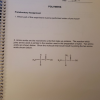 Date POLYMERS Prelaboratory Assignment 1. Which part of this experiment must be performed under a fume hood? 2. Amino acids are the monomeric units that make up proteins. The reaction which joins amino acids is similar to the reaction used in the preparation of nylon. Two amino acids are shown below. Show the molecule that would result by joining the two amino acids shown below. CH, 0
Part A of experiment: Working in the fume hood, combine 4.0 mL of 10% NaOH solution and 4 mL EtOH in a 50 mL round bot...
 Part A of experiment:
Working in the fume hood, combine 4.0 mL of 10% NaOH solution
and 4 mL EtOH in a 50 mL round bottom flask.
Dissolve 1.0 mL (8.6 mmol) of acetophenone into your
solution.
Add 1.0 mL (9.8 mmol) of benzaldehyde and a magnetic stir bar to
your flask. Clamp the flask
above a stir plate.
Monitor the reaction for 45 minutes by TLC. Acetophenone needs
to be diluted prior to TLC, and
cannot be spotted neat....
Part A of experiment:
Working in the fume hood, combine 4.0 mL of 10% NaOH solution
and 4 mL EtOH in a 50 mL round bottom flask.
Dissolve 1.0 mL (8.6 mmol) of acetophenone into your
solution.
Add 1.0 mL (9.8 mmol) of benzaldehyde and a magnetic stir bar to
your flask. Clamp the flask
above a stir plate.
Monitor the reaction for 45 minutes by TLC. Acetophenone needs
to be diluted prior to TLC, and
cannot be spotted neat....
Name_Rachel A Date TITILLEELELE PROTEINSI Questions 1. Which amino acids used in this experiment have acidic...
 Name_Rachel A Date TITILLEELELE PROTEINSI Questions 1. Which amino acids used in this experiment have acidic R-groups, which have basic R-groups, and which have neutral R-groups? Write acidic", "basic" or "neutral next to each amino acid below. • Glycine: • Glutamic acid: • Arginine: • Tyrosine: 1. Circle all the charged carboxyl groups (carboxylate groups) in the amino acid structures below. | HN-CH-- HN-CH-C-ộ HN-CH-C ó Glycine (Gly) Glutamic acid or glutamate (Glu) C=NH2 NH2 Arginine (Arg) UUUUU Proteins Chemistry...
not sure if im on thr right track and stuck on 13 and 14 PART III:...
 not
sure if im on thr right track and stuck on 13 and 14
PART III: ARE BIOPOLYMERS FORMED THE SAME WAY? REACTIONS OF AMINO ACIDS In Part I, you looked at reactions between difunctional acids and amines to form the amide bond found in polymers such as nylon. In Part II, you explored reactions between alcohols and carboxylic acids to form esters and polyesters. In this section, you will be applying what you learned to biopolymers such as proteins....
not
sure if im on thr right track and stuck on 13 and 14
PART III: ARE BIOPOLYMERS FORMED THE SAME WAY? REACTIONS OF AMINO ACIDS In Part I, you looked at reactions between difunctional acids and amines to form the amide bond found in polymers such as nylon. In Part II, you explored reactions between alcohols and carboxylic acids to form esters and polyesters. In this section, you will be applying what you learned to biopolymers such as proteins....
1 Proteins are long chains of amino acids. There are 4 parts to each amino acid. Which part is responsible for st...
 1 Proteins are long chains of amino acids. There are 4 parts to each amino acid. Which part is responsible for structural variation in proteins? The side chain The carboxylic acid group The amino group The alpha carbon 2. Why is it important to examine the shapes of complex biological molecules and drugs? All of the choices given So scientists can explain biochemical reactions So scientists can design medications So scientists can determine how molecules fit together 3. Determine the...
Question 1 (0.5 points) Saved Proteins are formed by joining together. carboxylic acids fatty acids amino...
 Question 1 (0.5 points) Saved Proteins are formed by joining together. carboxylic acids fatty acids amino acids none of the above Question 2 (0.5 points) Which two functional groups does an amino acid contain? amine and carboxylic acid carboxylic acid and amide amide and heterocyclic ring heterocyclic ring and amine Question 3 (0.5 points) Do amino acids commonly exist in nature as neutral molecules with all uncharged atoms? Yes No Question 1 (0.5 points) What is a protein? A polymer...
Imagine a biochemistry lab is testing out a new procedure to improve the synthesis of a...
 Imagine a biochemistry lab is testing out a new procedure to improve the synthesis of a dipeptide molecule made with the amino acids Valine and Threonine. The hypothesis is that acid as a catalyst will improve the condensation reaction between the amino acids and create a greater yield of a dipeptide (molecule formed with these two amino acids). The procedure compares the result of 10 samples using the common older procedure (A) to ten samples using the newer acid synthesis...
I only need answer to 4 4- Which is stronger - the bond between water molecules...
 I only need answer to 4
4- Which is stronger - the bond between water molecules or the bond between the two amino acids (formed from the dehydration synthesis above)? Explain why? (2pt) Imagine a biochemistry lab is testing out a new procedure to improve the synthesis of a dipeptide molecule made with the amino acids Valine and Threonine. The hypothesis is that acid as a catalyst will improve the condensation reaction between the amino acids and create a greater...
I only need answer to 4
4- Which is stronger - the bond between water molecules or the bond between the two amino acids (formed from the dehydration synthesis above)? Explain why? (2pt) Imagine a biochemistry lab is testing out a new procedure to improve the synthesis of a dipeptide molecule made with the amino acids Valine and Threonine. The hypothesis is that acid as a catalyst will improve the condensation reaction between the amino acids and create a greater...
PRE-LAB QUIZ for EXPERIMENT 27 Name 1. In Experiment 27, a modified Perkin reaction is performed....
 PRE-LAB QUIZ for EXPERIMENT 27 Name 1. In Experiment 27, a modified Perkin reaction is performed. The Perkin reaction is a carbonyl condensation reaction that is related to the Claisen condensation and aldol condensation. In this experiment, the reactants are benzaldehyde and 3-benzoylpropionic acid with sodium acetate and acetic anhydride as catalysts. Draw the structures of these compounds in the space below. benzaldehyde 3-benzoylpropionic acid acetic anhydride 2. The first step of the reaction is the formation of the mixed...
5. Based on your understanding of the mechanism of proteases A. the figure below shows a part of the active sit...
 5. Based on your understanding of the mechanism of proteases A. the figure below shows a part of the active site of the enzyme chymotrypsin. what are the identities of amino acids x and Y and what is this particular type of spatial arrangement of amino acids called? Alkoxide on X ? B. from the strucutres shown below, identify the two that represent the first and the second tetrahedral intermediates in the chymotrypsin catalyzed reaction. what type of attack and...
 Date POLYMERS Prelaboratory Assignment 1. Which part of this experiment must be performed under a fume hood? 2. Amino acids are the monomeric units that make up proteins. The reaction which joins amino acids is similar to the reaction used in the preparation of nylon. Two amino acids are shown below. Show the molecule that would result by joining the two amino acids shown below. CH, 0
 Part A of experiment:
Working in the fume hood, combine 4.0 mL of 10% NaOH solution
and 4 mL EtOH in a 50 mL round bottom flask.
Dissolve 1.0 mL (8.6 mmol) of acetophenone into your
solution.
Add 1.0 mL (9.8 mmol) of benzaldehyde and a magnetic stir bar to
your flask. Clamp the flask
above a stir plate.
Monitor the reaction for 45 minutes by TLC. Acetophenone needs
to be diluted prior to TLC, and
cannot be spotted neat....
Part A of experiment:
Working in the fume hood, combine 4.0 mL of 10% NaOH solution
and 4 mL EtOH in a 50 mL round bottom flask.
Dissolve 1.0 mL (8.6 mmol) of acetophenone into your
solution.
Add 1.0 mL (9.8 mmol) of benzaldehyde and a magnetic stir bar to
your flask. Clamp the flask
above a stir plate.
Monitor the reaction for 45 minutes by TLC. Acetophenone needs
to be diluted prior to TLC, and
cannot be spotted neat....
 Name_Rachel A Date TITILLEELELE PROTEINSI Questions 1. Which amino acids used in this experiment have acidic R-groups, which have basic R-groups, and which have neutral R-groups? Write acidic", "basic" or "neutral next to each amino acid below. • Glycine: • Glutamic acid: • Arginine: • Tyrosine: 1. Circle all the charged carboxyl groups (carboxylate groups) in the amino acid structures below. | HN-CH-- HN-CH-C-ộ HN-CH-C ó Glycine (Gly) Glutamic acid or glutamate (Glu) C=NH2 NH2 Arginine (Arg) UUUUU Proteins Chemistry...
 not
sure if im on thr right track and stuck on 13 and 14
PART III: ARE BIOPOLYMERS FORMED THE SAME WAY? REACTIONS OF AMINO ACIDS In Part I, you looked at reactions between difunctional acids and amines to form the amide bond found in polymers such as nylon. In Part II, you explored reactions between alcohols and carboxylic acids to form esters and polyesters. In this section, you will be applying what you learned to biopolymers such as proteins....
not
sure if im on thr right track and stuck on 13 and 14
PART III: ARE BIOPOLYMERS FORMED THE SAME WAY? REACTIONS OF AMINO ACIDS In Part I, you looked at reactions between difunctional acids and amines to form the amide bond found in polymers such as nylon. In Part II, you explored reactions between alcohols and carboxylic acids to form esters and polyesters. In this section, you will be applying what you learned to biopolymers such as proteins....
 1 Proteins are long chains of amino acids. There are 4 parts to each amino acid. Which part is responsible for structural variation in proteins? The side chain The carboxylic acid group The amino group The alpha carbon 2. Why is it important to examine the shapes of complex biological molecules and drugs? All of the choices given So scientists can explain biochemical reactions So scientists can design medications So scientists can determine how molecules fit together 3. Determine the...
 Question 1 (0.5 points) Saved Proteins are formed by joining together. carboxylic acids fatty acids amino acids none of the above Question 2 (0.5 points) Which two functional groups does an amino acid contain? amine and carboxylic acid carboxylic acid and amide amide and heterocyclic ring heterocyclic ring and amine Question 3 (0.5 points) Do amino acids commonly exist in nature as neutral molecules with all uncharged atoms? Yes No Question 1 (0.5 points) What is a protein? A polymer...
 Imagine a biochemistry lab is testing out a new procedure to improve the synthesis of a dipeptide molecule made with the amino acids Valine and Threonine. The hypothesis is that acid as a catalyst will improve the condensation reaction between the amino acids and create a greater yield of a dipeptide (molecule formed with these two amino acids). The procedure compares the result of 10 samples using the common older procedure (A) to ten samples using the newer acid synthesis...
 I only need answer to 4
4- Which is stronger - the bond between water molecules or the bond between the two amino acids (formed from the dehydration synthesis above)? Explain why? (2pt) Imagine a biochemistry lab is testing out a new procedure to improve the synthesis of a dipeptide molecule made with the amino acids Valine and Threonine. The hypothesis is that acid as a catalyst will improve the condensation reaction between the amino acids and create a greater...
I only need answer to 4
4- Which is stronger - the bond between water molecules or the bond between the two amino acids (formed from the dehydration synthesis above)? Explain why? (2pt) Imagine a biochemistry lab is testing out a new procedure to improve the synthesis of a dipeptide molecule made with the amino acids Valine and Threonine. The hypothesis is that acid as a catalyst will improve the condensation reaction between the amino acids and create a greater...
 PRE-LAB QUIZ for EXPERIMENT 27 Name 1. In Experiment 27, a modified Perkin reaction is performed. The Perkin reaction is a carbonyl condensation reaction that is related to the Claisen condensation and aldol condensation. In this experiment, the reactants are benzaldehyde and 3-benzoylpropionic acid with sodium acetate and acetic anhydride as catalysts. Draw the structures of these compounds in the space below. benzaldehyde 3-benzoylpropionic acid acetic anhydride 2. The first step of the reaction is the formation of the mixed...
 5. Based on your understanding of the mechanism of proteases A. the figure below shows a part of the active site of the enzyme chymotrypsin. what are the identities of amino acids x and Y and what is this particular type of spatial arrangement of amino acids called? Alkoxide on X ? B. from the strucutres shown below, identify the two that represent the first and the second tetrahedral intermediates in the chymotrypsin catalyzed reaction. what type of attack and...
Most questions answered within 3 hours.
-
Where is the error in this code sequence?
String s1 = "Hello";
String s2 = "ello";...
asked 10 months ago -
Financial data for Joel de Paris, Inc., for last year
follow:
Joel de Paris, Inc.
Balance...
asked 10 months ago -
Consider this reaction:
Al2(SO4)3 (aq)+ BaCl3
(aq) Al2Cl6 (aq)- +
3BaSO4(s) . What is the...
asked 10 months ago -
Suppose that Savneet is considering increasing her
recent random sample from 20 car rentals to 40...
asked 10 months ago -
Trucks arrive at an unloading terminal at an average rate of 120
per hour.
Trucks arrive...
asked 10 months ago -
Why are methanol and ethanol completely soluble in water while
octanol is not very little soluble....
asked 10 months ago -
A facilities manager at a university reads in a research report
that the mean amount of...
asked 10 months ago -
When the CuSO4 is rehydrated by adding water to the anhydrous
compound, is this an endothermic...
asked 10 months ago -
A ray of sunlight is passing from diamond into crown glass; the
angle of incidence is...
asked 10 months ago -
A block of mass 0.249 kg is placed on top of a light, vertical
spring of...
asked 10 months ago -
how do the kidneys compensate in the presences of acidosis
a) trigger hyperventilate
b) reserve acid...
asked 10 months ago -
Question 501 pts
The rental rate of capital to the firm increases. Which of the
following...
asked 10 months ago