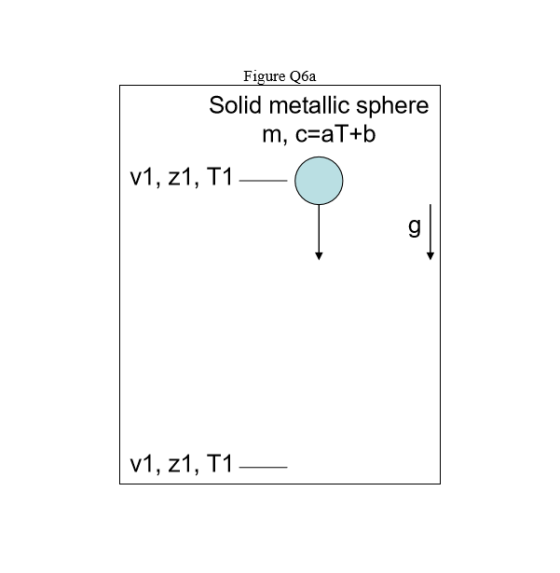
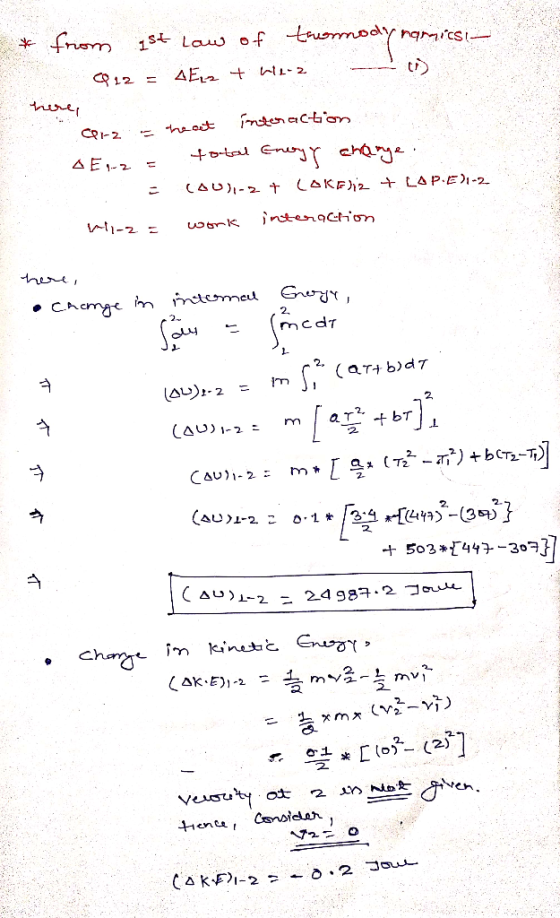
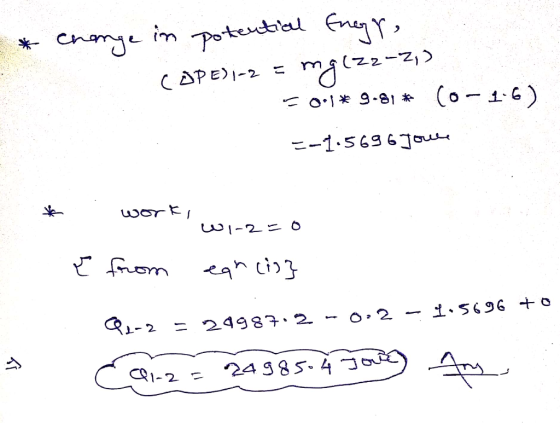
As shown in Figure Q6a, a solid metallic sphere of mass m = 0.1 kg, initial temperature T1 = 307 K and initial velocity v1 = 2 m/s is allowed to fall from an initial height of z1 = 1.6 m. The specific heat capacity of the sphere material, c, is a linear function of temperature T, c = aT + b (in J/kg/K), where a and b are constants of value 3.4 and 503, respectively. By the time the sphere has descended to its final height z2 = 0 m, its final temperature is T2 = 447 K. Calculate the size of that heat transfer interaction experienced by the sphere Q12 (in J) during its descent. You may assume a value of g = 9.81 m/s2.
Homework Answers
Add Answer to:
As shown in Figure Q6a, a solid metallic sphere of mass m = 0.1
kg, initial...
A solid, homogeneous sphere with of mass of M = 2.95 kg and a radius of...
A solid, homogeneous sphere with of mass of M = 2.95 kg and a radius of R = 18.1 cm is resting at the top of an incline as shown in the figure. The height of the incline is h = 1.71 m, and the angle of the incline is θ = 17.5°. The sphere is rolled over the edge very slowly. Then it rolls down to the bottom of the incline without slipping. What is the final speed of...
A uniform solid sphere of mass M=2kg and radius R=0.42m is given an initial angular speed...
 A uniform solid sphere of mass M=2kg and radius R=0.42m is given an initial angular speed w=10.1rad/s when it is at the bottom of an inclined plane of height h=2.5m, as shown in the figure. The sphere rolls without slipping. Find w if the sphere comes to rest at the top of the inclined plane. (Take g=9.81 m/s2, Isphere = 2/5 MR2 ). Express your answer using one decimal place. M.R
A mass M of solid metal at temperature T is put into 3.0kg of water which...
A mass M of solid metal at temperature T is put into 3.0kg of water which is initially at 90◦C. The metal and water are placed in an insulated container. The specific heat for water is 4186 J/ kg K . The metal has a melting point of 60◦C. The latent heat associated with the solid-liquid transition of the metal is 7.5 × 10^4 J/kg . The specific heat for the metal is 600 J/kg in the solid phase and...
Physical Chemistry Calculate the change in entropy when one mole of metallic aluminum is heated at...
 Physical Chemistry
Calculate the change in entropy when one mole of metallic aluminum is heated at one bar pressure from an initial temperature of 25 °C to a final temperature of 750 °C. The molar heat capacities of solid and liquid aluminum at one bar pressure are 29.2 J mol K1 and 31.75 J mol K, respectively. The specific enthalpy of fusion of aluminum at its melting point (660.46 °C) is 396.57 J g1. The molar mass of aluminum is...
Physical Chemistry
Calculate the change in entropy when one mole of metallic aluminum is heated at one bar pressure from an initial temperature of 25 °C to a final temperature of 750 °C. The molar heat capacities of solid and liquid aluminum at one bar pressure are 29.2 J mol K1 and 31.75 J mol K, respectively. The specific enthalpy of fusion of aluminum at its melting point (660.46 °C) is 396.57 J g1. The molar mass of aluminum is...
Mass of beaker plus solid Mass of water,mno 1.229 4,298-g 41-949 Mass of solid, m Initial...
 Mass of beaker plus solid Mass of water,mno 1.229 4,298-g 41-949 Mass of solid, m Initial temperature Final temperature a1,0 for the reaction (Eq. 1 ) (SH. = 4.18 J/g°C) ΔH for the reaction (Eq.5) The quantity you have just calculated is approximately" equal to the heat of solution of your sample. Calculate OC - joules joules the heat of solution per gram of solid sample. The solution reaction is endothermic exothermic. (Underline the correct answer.) Give your reasoning. Solid...
Calculate the change in entropy when one mole of metallic aluminum is heated at one bar...
 Calculate the change in entropy when one mole of metallic aluminum is heated at one bar pressure from an initial temperature of 25 °C to a final temperature of 750 °C. The molar heat capacities of solid and liquid aluminum at one bar pressure are 29.2 J mol' K and 31.75 J mol' K, respectively. The specific enthalpy of fusion of aluminum at its melting point (660.46 °C) is 396.57 J g! The molar mass of aluminum is 26.98 g...
A solid steel ball with mass = 1.0 kg and radius 0.25 m is held at...
A solid steel ball with mass = 1.0 kg and radius 0.25 m is held at rest on top of a ramp at height h = 2.0 m. The moment of inertia, I = (2/5)mR2 for a solid sphere. What is the final velocity of its center of mass, vcm, when it gets to the bottom of the ramp?
A solid homogeneous sphere of mass M = 1.80 kg is released from rest at the...
A solid homogeneous sphere of mass M = 1.80 kg is released from rest at the top of an incline of height H=1.33 m and rolls without slipping to the bottom. The ramp is at an angle of θ = 26.9o to the horizontal. Calculate the speed of the sphere's CM at the bottom of the incline. Determine the rotational kinetic energy of the sphere at the bottom of the incline.
A solid homogeneous sphere of mass M = 4.70 kg is released from rest at the...
 A solid homogeneous sphere of mass M = 4.70 kg is released from
rest at the top of an incline of height H=1.21 m and rolls without
slipping to the bottom. The ramp is at an angle of θ = 27.7o to the
horizontal.
a) Calculate the speed of the sphere's CM at the bottom of the
incline.
b) Determine the rotational kinetic energy of the sphere at the
bottom of the incline.
A solid homogeneous sphere of mass M = 4.70 kg is released from
rest at the top of an incline of height H=1.21 m and rolls without
slipping to the bottom. The ramp is at an angle of θ = 27.7o to the
horizontal.
a) Calculate the speed of the sphere's CM at the bottom of the
incline.
b) Determine the rotational kinetic energy of the sphere at the
bottom of the incline.
A solid, uniform sphere of mass 2.0 kg and radius 1.7 m rolls without slipping down...
A solid, uniform sphere of mass 2.0 kg and radius 1.7 m rolls without slipping down an inclined plane of height 2.9 m. What is the angular velocity of the sphere at the bottom of the inclined plane?
 A uniform solid sphere of mass M=2kg and radius R=0.42m is given an initial angular speed w=10.1rad/s when it is at the bottom of an inclined plane of height h=2.5m, as shown in the figure. The sphere rolls without slipping. Find w if the sphere comes to rest at the top of the inclined plane. (Take g=9.81 m/s2, Isphere = 2/5 MR2 ). Express your answer using one decimal place. M.R
 Physical Chemistry
Calculate the change in entropy when one mole of metallic aluminum is heated at one bar pressure from an initial temperature of 25 °C to a final temperature of 750 °C. The molar heat capacities of solid and liquid aluminum at one bar pressure are 29.2 J mol K1 and 31.75 J mol K, respectively. The specific enthalpy of fusion of aluminum at its melting point (660.46 °C) is 396.57 J g1. The molar mass of aluminum is...
Physical Chemistry
Calculate the change in entropy when one mole of metallic aluminum is heated at one bar pressure from an initial temperature of 25 °C to a final temperature of 750 °C. The molar heat capacities of solid and liquid aluminum at one bar pressure are 29.2 J mol K1 and 31.75 J mol K, respectively. The specific enthalpy of fusion of aluminum at its melting point (660.46 °C) is 396.57 J g1. The molar mass of aluminum is...
 Mass of beaker plus solid Mass of water,mno 1.229 4,298-g 41-949 Mass of solid, m Initial temperature Final temperature a1,0 for the reaction (Eq. 1 ) (SH. = 4.18 J/g°C) ΔH for the reaction (Eq.5) The quantity you have just calculated is approximately" equal to the heat of solution of your sample. Calculate OC - joules joules the heat of solution per gram of solid sample. The solution reaction is endothermic exothermic. (Underline the correct answer.) Give your reasoning. Solid...
 Calculate the change in entropy when one mole of metallic aluminum is heated at one bar pressure from an initial temperature of 25 °C to a final temperature of 750 °C. The molar heat capacities of solid and liquid aluminum at one bar pressure are 29.2 J mol' K and 31.75 J mol' K, respectively. The specific enthalpy of fusion of aluminum at its melting point (660.46 °C) is 396.57 J g! The molar mass of aluminum is 26.98 g...
 A solid homogeneous sphere of mass M = 4.70 kg is released from
rest at the top of an incline of height H=1.21 m and rolls without
slipping to the bottom. The ramp is at an angle of θ = 27.7o to the
horizontal.
a) Calculate the speed of the sphere's CM at the bottom of the
incline.
b) Determine the rotational kinetic energy of the sphere at the
bottom of the incline.
A solid homogeneous sphere of mass M = 4.70 kg is released from
rest at the top of an incline of height H=1.21 m and rolls without
slipping to the bottom. The ramp is at an angle of θ = 27.7o to the
horizontal.
a) Calculate the speed of the sphere's CM at the bottom of the
incline.
b) Determine the rotational kinetic energy of the sphere at the
bottom of the incline.
Most questions answered within 3 hours.
-
Where is the error in this code sequence?
String s1 = "Hello";
String s2 = "ello";...
asked 10 months ago -
Financial data for Joel de Paris, Inc., for last year
follow:
Joel de Paris, Inc.
Balance...
asked 10 months ago -
Consider this reaction:
Al2(SO4)3 (aq)+ BaCl3
(aq) Al2Cl6 (aq)- +
3BaSO4(s) . What is the...
asked 10 months ago -
Suppose that Savneet is considering increasing her
recent random sample from 20 car rentals to 40...
asked 10 months ago -
Trucks arrive at an unloading terminal at an average rate of 120
per hour.
Trucks arrive...
asked 10 months ago -
Why are methanol and ethanol completely soluble in water while
octanol is not very little soluble....
asked 10 months ago -
A facilities manager at a university reads in a research report
that the mean amount of...
asked 10 months ago -
When the CuSO4 is rehydrated by adding water to the anhydrous
compound, is this an endothermic...
asked 10 months ago -
A ray of sunlight is passing from diamond into crown glass; the
angle of incidence is...
asked 10 months ago -
A block of mass 0.249 kg is placed on top of a light, vertical
spring of...
asked 10 months ago -
how do the kidneys compensate in the presences of acidosis
a) trigger hyperventilate
b) reserve acid...
asked 10 months ago -
Question 501 pts
The rental rate of capital to the firm increases. Which of the
following...
asked 10 months ago