one practical application of oxalic acid (H2C2O4) is as a rust remover. Rust is primarily composed...
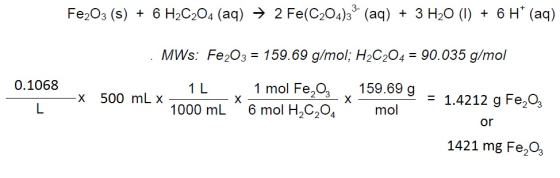
one practical application of oxalic acid (H2C2O4) is as a rust remover. Rust is primarily composed of Fe2O3, which reacts with oxalic acid according to the unbalanced equation shown below.
Fe2O3 (s) + H2C2O3 (aq) --> Fe(C22O4)3-3 (aq) + H2O (l) + H+ (aq)
Calculate the number of milligrams of Fe2O3 that can be removed using 500.0 mL of 0.1068 M H2C2O4.
Homework Answers
Add Answer to:
one practical application of oxalic acid (H2C2O4) is as a rust
remover. Rust is primarily composed...
One of the uses of oxalic acid, (H2C2O4) is rust removal. It reacts with rust, (Fe2O3)...
One of the uses of oxalic acid, (H2C2O4) is rust removal. It reacts with rust, (Fe2O3) according to the equation: 2Fe2O3(s) + 6H2C2O4(aq) = 2Fe2(C2O4)3^-3(aq) + 3H2O(l) + 6H+(aq) Calculate the number of grams of rust that can be removed by 5x10^2mL of a 0.100 mol L-1 solution of oxalic acid.
2. Rust stains can be removed by washing a surface with a dilute solution of oxalic...
 2. Rust stains can be removed by washing a surface with a dilute solution of oxalic acid (H2C204). The reaction is Fe,03(s) + H, C,04(aq) Fe(C,04), (aq) + H2O(l) + H+ (aq) Is this a redox reaction? What mass of rust can be removed by 500 mL of 0.15 M 224 solution of oxalic acid?
One of the main components of rust is a hydrated iron (III) oxide – Fe2O3•nH2O. This...
One of the main components of rust is a hydrated iron (III) oxide – Fe2O3•nH2O. This compound can react with acids such as hydrochloric acid. The unbalanced reaction is shown below: Fe2O3•nH2O(s) + HCl(aq) FeCl3(aq) + H2O(l) If it takes 103 mL of 1.25 M HCl to completely react with 5.00 grams of Fe2O3•nH2O then what is the value of n? You must show all of your work to receive any credit. Round your value of n to the...
1) 0.0675 moles of sodium reacts with hydrochloric acid. The skeleton equation is: Na (s) Chem...
 1) 0.0675 moles of sodium reacts with hydrochloric acid. The skeleton equation is: Na (s) Chem 120 Worksheet: Gas Stoichiometry HCl(aq) → NaCl(aq). a) Balance the equation b) Determine the volume of hydrogen gas that will be produced at STP. H, (B) 2) 0.425 moles of ethane undergoes combustion. The skeleton equation is: CaHs (8) + Oz (6) ► co, el a) Balance the equation. b) Determine the volume of carbon dioxide that will be produced at STP. H2O(g) 3)...
1. Elemental boron (as a gas) is produced in one industrial process by heating diboron trioxide...
1. Elemental boron (as a gas) is produced in one industrial process by heating diboron trioxide with magnesium metal, also producing magnesium oxide as a by-product. Write the unbalanced chemical equation for this process. (Omit states-of-matter from your answer.) 2. Nitrous oxide gas (systematic name: dinitrogen monoxide) is used by some dental practitioners as an anesthetic. Nitrous oxide (and water vapor as byproduct) can be produced in small quantities in the laboratory by careful heating of ammonium nitrate. Write the...
Part 1.) Calculate the pH of each of the following strong acid solutions. (a) 0.00555 M...
 Part 1.)
Calculate the pH of each of the following strong acid
solutions.
(a) 0.00555 M HClO4
pH =
(b) 0.314 g of HBrO4 in 21.0 L of solution
pH =
(c) 39.0 mL of 3.50 M HClO4 diluted to 1.90 L
pH =
(d) a mixture formed by adding 59.0 mL of 0.00582 M
HClO4 to 16.0 mL of 0.00676 M HBrO4
pH =
Part 2.)
Using values from Appendix C of your textbook, calculate the
value of Keq...
Part 1.)
Calculate the pH of each of the following strong acid
solutions.
(a) 0.00555 M HClO4
pH =
(b) 0.314 g of HBrO4 in 21.0 L of solution
pH =
(c) 39.0 mL of 3.50 M HClO4 diluted to 1.90 L
pH =
(d) a mixture formed by adding 59.0 mL of 0.00582 M
HClO4 to 16.0 mL of 0.00676 M HBrO4
pH =
Part 2.)
Using values from Appendix C of your textbook, calculate the
value of Keq...
please write legible 1. Identify each of the following reactions as a precipitation reaction, an acid-base...
 please write legible
1. Identify each of the following reactions as a precipitation reaction, an acid-base reaction, or as a redox reaction + a. Pb(NO3)2 (aq) + 2 HCl(aq) PbCl (s) + 2 HNO, (aq) b. 2 Hxe + O2 + 2 H2O c. HNO, (aq) + KOH(aq) KNO, (aq) + H20 (1) d. Zna + 2HCl(a) - ZnClaraq) + Halle e. Ba?'(aq) + 2 Br(aq) + 2 Na(aq) + SO/"(aq) BaSO. (s) + 2 Na'(aq) + 2 Br" (aq)...
please write legible
1. Identify each of the following reactions as a precipitation reaction, an acid-base reaction, or as a redox reaction + a. Pb(NO3)2 (aq) + 2 HCl(aq) PbCl (s) + 2 HNO, (aq) b. 2 Hxe + O2 + 2 H2O c. HNO, (aq) + KOH(aq) KNO, (aq) + H20 (1) d. Zna + 2HCl(a) - ZnClaraq) + Halle e. Ba?'(aq) + 2 Br(aq) + 2 Na(aq) + SO/"(aq) BaSO. (s) + 2 Na'(aq) + 2 Br" (aq)...
1 . If a buffer solution is 0.260 M in a weak acid (?a=8.3×10⁻⁵)and 0.480 M in its conjugate base, what is the pH? pH= 2...
1 . If a buffer solution is 0.260 M in a weak acid (?a=8.3×10⁻⁵)and 0.480 M in its conjugate base, what is the pH? pH= 2. If a buffer solution is 0.200 M in a weak base (?b=5.0×10⁻⁵) and 0.530 M in its conjugate acid, what is the ph 3. Phosphoric acid is a triprotic acid (?a1=6.9×10⁻³, ?a2=6.2×10⁻⁸ , and ?a3=4.8×10⁻¹³ To find the pH of a buffer composed of H2PO4 - (aq) ) and HPO4 2− (aq) , which...
1) Which one of the following is a Bronsted-Lowry acid? A) (CH3)3NH+ B) CH3COOH C) HNO2...
1) Which one of the following is a Bronsted-Lowry acid? A) (CH3)3NH+ B) CH3COOH C) HNO2 D) all of the above 2) Which one of the following statements regarding Kw is false? A) pKw is 14.00 at 25 °C. B) The value of Kw is always 1.0 × 10⁻¹⁴. C) Kw changes with temperature. D) The value of Kw shows that water is a weak acid. 3) The Ka of benzoic acid is 6.30 × 10⁻⁵. The pH of a...
2. Balance the following reaction that occurs in acid, using the half-reaction method. I-1(aq) + CrO4-1(aq)...
2. Balance the following reaction that occurs in acid, using the half-reaction method. I-1(aq) + CrO4-1(aq) --> I2(s) + Cr+3(aq) When this reaction is balanced, there will be (A) H+(aq) and (B) H2O(l) in the final balanced equation. (Enter numbers without the plus sign.) 3. Ca(NO3)2(aq) + K2CO3(aq) --> CaCO3(s) + 2 KNO3(aq) 50 mL of 1.000 M Ca(NO3)2 was reacted with excess potassium carbonate. What mass of calcium carbonate will be made? Repeat your answer to two sig figs...
 2. Rust stains can be removed by washing a surface with a dilute solution of oxalic acid (H2C204). The reaction is Fe,03(s) + H, C,04(aq) Fe(C,04), (aq) + H2O(l) + H+ (aq) Is this a redox reaction? What mass of rust can be removed by 500 mL of 0.15 M 224 solution of oxalic acid?
 1) 0.0675 moles of sodium reacts with hydrochloric acid. The skeleton equation is: Na (s) Chem 120 Worksheet: Gas Stoichiometry HCl(aq) → NaCl(aq). a) Balance the equation b) Determine the volume of hydrogen gas that will be produced at STP. H, (B) 2) 0.425 moles of ethane undergoes combustion. The skeleton equation is: CaHs (8) + Oz (6) ► co, el a) Balance the equation. b) Determine the volume of carbon dioxide that will be produced at STP. H2O(g) 3)...
 Part 1.)
Calculate the pH of each of the following strong acid
solutions.
(a) 0.00555 M HClO4
pH =
(b) 0.314 g of HBrO4 in 21.0 L of solution
pH =
(c) 39.0 mL of 3.50 M HClO4 diluted to 1.90 L
pH =
(d) a mixture formed by adding 59.0 mL of 0.00582 M
HClO4 to 16.0 mL of 0.00676 M HBrO4
pH =
Part 2.)
Using values from Appendix C of your textbook, calculate the
value of Keq...
Part 1.)
Calculate the pH of each of the following strong acid
solutions.
(a) 0.00555 M HClO4
pH =
(b) 0.314 g of HBrO4 in 21.0 L of solution
pH =
(c) 39.0 mL of 3.50 M HClO4 diluted to 1.90 L
pH =
(d) a mixture formed by adding 59.0 mL of 0.00582 M
HClO4 to 16.0 mL of 0.00676 M HBrO4
pH =
Part 2.)
Using values from Appendix C of your textbook, calculate the
value of Keq...
 please write legible
1. Identify each of the following reactions as a precipitation reaction, an acid-base reaction, or as a redox reaction + a. Pb(NO3)2 (aq) + 2 HCl(aq) PbCl (s) + 2 HNO, (aq) b. 2 Hxe + O2 + 2 H2O c. HNO, (aq) + KOH(aq) KNO, (aq) + H20 (1) d. Zna + 2HCl(a) - ZnClaraq) + Halle e. Ba?'(aq) + 2 Br(aq) + 2 Na(aq) + SO/"(aq) BaSO. (s) + 2 Na'(aq) + 2 Br" (aq)...
please write legible
1. Identify each of the following reactions as a precipitation reaction, an acid-base reaction, or as a redox reaction + a. Pb(NO3)2 (aq) + 2 HCl(aq) PbCl (s) + 2 HNO, (aq) b. 2 Hxe + O2 + 2 H2O c. HNO, (aq) + KOH(aq) KNO, (aq) + H20 (1) d. Zna + 2HCl(a) - ZnClaraq) + Halle e. Ba?'(aq) + 2 Br(aq) + 2 Na(aq) + SO/"(aq) BaSO. (s) + 2 Na'(aq) + 2 Br" (aq)...
Most questions answered within 3 hours.
-
Where is the error in this code sequence?
String s1 = "Hello";
String s2 = "ello";...
asked 10 months ago -
Financial data for Joel de Paris, Inc., for last year
follow:
Joel de Paris, Inc.
Balance...
asked 10 months ago -
Consider this reaction:
Al2(SO4)3 (aq)+ BaCl3
(aq) Al2Cl6 (aq)- +
3BaSO4(s) . What is the...
asked 10 months ago -
Suppose that Savneet is considering increasing her
recent random sample from 20 car rentals to 40...
asked 10 months ago -
Trucks arrive at an unloading terminal at an average rate of 120
per hour.
Trucks arrive...
asked 10 months ago -
Why are methanol and ethanol completely soluble in water while
octanol is not very little soluble....
asked 10 months ago -
A facilities manager at a university reads in a research report
that the mean amount of...
asked 10 months ago -
When the CuSO4 is rehydrated by adding water to the anhydrous
compound, is this an endothermic...
asked 10 months ago -
A ray of sunlight is passing from diamond into crown glass; the
angle of incidence is...
asked 10 months ago -
A block of mass 0.249 kg is placed on top of a light, vertical
spring of...
asked 10 months ago -
how do the kidneys compensate in the presences of acidosis
a) trigger hyperventilate
b) reserve acid...
asked 10 months ago -
Question 501 pts
The rental rate of capital to the firm increases. Which of the
following...
asked 10 months ago