
Homework Answers
N2(g) + 3
H2(g)  2 NH3(g)
1mole N2 react with 3 moles of H2 gives 2 moles of NH3
mass relation: 28 g N2 react with 6 g of H2
30 g N2 needs 30x6/28 = 6.43g H2
so H2 is excess reagent
Excess reagent remains = 10-6,43 = 3.57g
Add Answer to:
help please
13. Ammonia, NHs, is produced industrially from nitrogen and hydrogen as follows: N2(g)+ 3H2(g)...
26.) Ammonia is produced by the reaction of hydrogen and nitrogen as follows: N2(g)+3H2(g)→2NH3(g)ammonia Express the...
26.) Ammonia is produced by the reaction of hydrogen and nitrogen as follows: N2(g)+3H2(g)→2NH3(g)ammonia Express the number of moles to two significant figures. (A.) How many moles of H2 are needed to react with 1.0 mol of N2? (B.) How many moles of N2 reacted if 0.50 mol of NH3 is produced? (C.) How many moles of NH3 are produced when 1.7 mol of H2 reacts?
Ammonia is produced by the reaction of hydrogen and nitrogen as follows:
Ammonia is produced by the reaction of hydrogen and nitrogen as follows: N2(g) + 3H2(g) → 2NH3(g) ammonia You may want to reference (Page) Section 7.6 while completing this problem. Part A How many moles of H2 are needed to react with 0.70 mol of N2? Part B How many moles of N2 reacted if 0.75 mol of NH3 is produced? EPart How many moles of NH3 are produced when 13 mol of H2 reacts ?
Ammonia is produced by the reaction of nitrogen and hydrogen according to the equation N2(g) + 3H2(g) → 2NH3(g) Calculat...
Ammonia is produced by the reaction of nitrogen and hydrogen according to the equation N2(g) + 3H2(g) → 2NH3(g) Calculate the mass of ammonia produced when 32.0 g of nitrogen react with 13.5 g of hydrogen. ___________NH3 Which is the excess reactant and how much of it will be left over when the reaction is complete? hydrogen or nitrogen ________ g
Nitrogen and hydrogen react to create ammonia. N2 + 3 H2 + 2NH3 Bob Cat reacted...
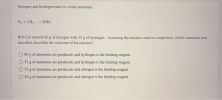 Nitrogen and hydrogen react to create ammonia. N2 + 3 H2 + 2NH3 Bob Cat reacted 42 g of nitrogen with 15 g of hydrogen. Assuming the reaction went to completion, which statement best describes describes the outcome of his reaction? 85 g of ammonia are produced, and hydrogen is the limiting reagent. 51 g of ammonia are produced, and hydrogen is the limiting reagent. 51 g of ammonia are produced, and nitrogen is the limiting reagent. 85 g of...
Nitrogen gas (N2) and hydrogen gas (H2) react to make ammonia gas (NH3) N2(g)+3H2(g)-->2NH3(g) you know...
Nitrogen gas (N2) and hydrogen gas (H2) react to make ammonia gas (NH3) N2(g)+3H2(g)-->2NH3(g) you know tat this process gives a 55% yield for ammonia. Your job is to make 610g of ammonia. what mass of nitrogen do you need?
Ammonia (NH3) is produced by the reaction of nitrogen and hydrogen according to the chemical equation:...
Ammonia (NH3) is produced by the reaction of nitrogen and hydrogen according to the chemical equation: N2+ 3H2 → 2NH3. What mass of nitrogen is necessary to react completely with 100.0 g of hydrogen?
Question Ammonia is made from a rxn of nitrogen and hydrogen: N2(g)+3H2(g)--> 2NH3 a) What mass...
Question Ammonia is made from a rxn of nitrogen and hydrogen: N2(g)+3H2(g)--> 2NH3 a) What mass of the ammonia is made from 2000g of N2 and 1000 g of H2? b) What is the mass of the excess reactant?
Nitrogen and hydrogen combine at high temperature, in the presence of a catalyst, to produce ammonia
Nitrogen and hydrogen combine at high temperature, in the presence of a catalyst, to produce ammonia. N2(g)+3H2(g)-->2NH3(g) Assume 4 molecules of nitrogen and 9 molecules of hydrogen are present. After complete reaction, how many molecules of ammonia are produced? How many molecules of H2 remain? How many molecules of N2 remain? What is the limiting reactant?
After complete reaction, how many molecules of ammonia are produced?
 After complete reaction, how many molecules of ammonia are
produced?
Nitrogen and hydrogen combine at high temperature, in the presence of a catalyst, to produce ammonia. N2(g)+3H2(g) ? 2NH3(g) Assume 4 molecules of nitrogen and 9 molecules of hydrogen are present. After complete reaction, how many molecules of ammonia are produced? ___________ Number How many molecules of H2 remain? Number How many molecules of N2 remain? Number _________ What is the limiting reactant? nitrogen hydrogen
Nitrogen and hydrogen combine at...
After complete reaction, how many molecules of ammonia are
produced?
Nitrogen and hydrogen combine at high temperature, in the presence of a catalyst, to produce ammonia. N2(g)+3H2(g) ? 2NH3(g) Assume 4 molecules of nitrogen and 9 molecules of hydrogen are present. After complete reaction, how many molecules of ammonia are produced? ___________ Number How many molecules of H2 remain? Number How many molecules of N2 remain? Number _________ What is the limiting reactant? nitrogen hydrogen
Nitrogen and hydrogen combine at...
Nitrogen and hydrogen can react to form ammonia. N2(g)+3H2(g)→2NH3(g) 1. Choose ratios showing the relationships between...
Nitrogen and hydrogen can react to form ammonia. N2(g)+3H2(g)→2NH3(g) 1. Choose ratios showing the relationships between moles of each of the reactants and products in the reaction. Multiple choice, which one? A. 2 mol N2 : 2 mol H2 : 3 mol NH3 B.1 mol N2 : 1/3 mol H2 : 1/2 mol NH3 C. 1 mol N2 : 1 mol H2 : 1 mol NH3 D. 1 mol N2 : 3 mol H2 : 2 mol NH3 2. How...
 Nitrogen and hydrogen react to create ammonia. N2 + 3 H2 + 2NH3 Bob Cat reacted 42 g of nitrogen with 15 g of hydrogen. Assuming the reaction went to completion, which statement best describes describes the outcome of his reaction? 85 g of ammonia are produced, and hydrogen is the limiting reagent. 51 g of ammonia are produced, and hydrogen is the limiting reagent. 51 g of ammonia are produced, and nitrogen is the limiting reagent. 85 g of...
 After complete reaction, how many molecules of ammonia are
produced?
Nitrogen and hydrogen combine at high temperature, in the presence of a catalyst, to produce ammonia. N2(g)+3H2(g) ? 2NH3(g) Assume 4 molecules of nitrogen and 9 molecules of hydrogen are present. After complete reaction, how many molecules of ammonia are produced? ___________ Number How many molecules of H2 remain? Number How many molecules of N2 remain? Number _________ What is the limiting reactant? nitrogen hydrogen
Nitrogen and hydrogen combine at...
After complete reaction, how many molecules of ammonia are
produced?
Nitrogen and hydrogen combine at high temperature, in the presence of a catalyst, to produce ammonia. N2(g)+3H2(g) ? 2NH3(g) Assume 4 molecules of nitrogen and 9 molecules of hydrogen are present. After complete reaction, how many molecules of ammonia are produced? ___________ Number How many molecules of H2 remain? Number How many molecules of N2 remain? Number _________ What is the limiting reactant? nitrogen hydrogen
Nitrogen and hydrogen combine at...
Most questions answered within 3 hours.
-
Where is the error in this code sequence?
String s1 = "Hello";
String s2 = "ello";...
asked 10 months ago -
Financial data for Joel de Paris, Inc., for last year
follow:
Joel de Paris, Inc.
Balance...
asked 10 months ago -
Consider this reaction:
Al2(SO4)3 (aq)+ BaCl3
(aq) Al2Cl6 (aq)- +
3BaSO4(s) . What is the...
asked 10 months ago -
Suppose that Savneet is considering increasing her
recent random sample from 20 car rentals to 40...
asked 10 months ago -
Trucks arrive at an unloading terminal at an average rate of 120
per hour.
Trucks arrive...
asked 10 months ago -
Why are methanol and ethanol completely soluble in water while
octanol is not very little soluble....
asked 10 months ago -
A facilities manager at a university reads in a research report
that the mean amount of...
asked 10 months ago -
When the CuSO4 is rehydrated by adding water to the anhydrous
compound, is this an endothermic...
asked 10 months ago -
A ray of sunlight is passing from diamond into crown glass; the
angle of incidence is...
asked 10 months ago -
A block of mass 0.249 kg is placed on top of a light, vertical
spring of...
asked 10 months ago -
how do the kidneys compensate in the presences of acidosis
a) trigger hyperventilate
b) reserve acid...
asked 10 months ago -
Question 501 pts
The rental rate of capital to the firm increases. Which of the
following...
asked 10 months ago