
Homework Answers
a) Suppose  is maximally acyclic. Let
  ; we will show that there is a path in
  connecting
  .
.
If  then of course this itself is a path in
. Suppose that
then of course this itself is a path in
. Suppose that  . Then
  contains a cycle, and this cycle must contain the edge
  because otherwise it will be a cycle in
which is acyclic. But then, this cycle must be of the form
because otherwise it will be a cycle in
which is acyclic. But then, this cycle must be of the form
 ,
,
showing that
contains the path  connecting
.
connecting
.
This proves that
is connected. To show that it is minimally connected, consider any
edge  , say
, say  . If
. If  is connected, then there is a path

in
, showing that

is a cycle in
. Again, this is impossible since
is acyclic. Thus,
is not connected. This shows that
is minimally connected.
Conversely, suppose
is minimally connected. We will show that it is acyclic.
Assume, if possible, that there is a cycle

in
. Then  is connected because every vertex in
  is connected to
  via a path in
and if this path contains
via a path in
and if this path contains  we can replace it with
This contradicts that
is minimally connected. Thus,
must be acyclic.
Now consider vertices  such that
  . Since
connected, there is a path
. Since
connected, there is a path

in
, showing that  contains the cycle
This proves that
is maximally acyclic.
This proves the equivalence.
b) Suppose that
is connected acyclic graph. We will use induction on  to prove that
  .
.
If  then
then  , and
, and  , showing
if
.
, showing
if
.
Suppose that  is connected acyclic, such that
  for some
  . Suppose that
holds for all
such that
. Suppose that
holds for all
such that  . Let
. Let  . Since
is connected acyclic,
. Since
is connected acyclic,  can not have any path between
. Thus,
is not connected, and since this is obtained by removing just one
vertex from a connected graph, it has two connected components,
say
can not have any path between
. Thus,
is not connected, and since this is obtained by removing just one
vertex from a connected graph, it has two connected components,
say

Being connected components, these are connected; being subgraph of acyclic graph, these are acyclic. Thus, by induction hypothesis, we know

This shows
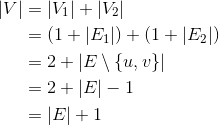
By induction, we have
for all
connected acyclic.
By Euler's formula, we have  . If
is connected acyclic, then
. If
is connected acyclic, then

so that 
Add Answer to:
e:= 3. (i) Let T = (V, E) be a graph. Prove that the following are...
3. Given graph G = (V,E), prove that the following statements are equivalent. [Note: the following statements are e...
 3. Given graph G = (V,E), prove that the following statements are equivalent. [Note: the following statements are equivalent definitions of a "tree graph".] 1) There exist exactly one path between any of two vertices u, v EV in the graph G 2) Graph G is connected and does not contain any cycles. 3) Graph G does not contain any cycles, and a cycle is formed if any edge (u, v) E E is added to G
3. Given graph...
3. Given graph G = (V,E), prove that the following statements are equivalent. [Note: the following statements are equivalent definitions of a "tree graph".] 1) There exist exactly one path between any of two vertices u, v EV in the graph G 2) Graph G is connected and does not contain any cycles. 3) Graph G does not contain any cycles, and a cycle is formed if any edge (u, v) E E is added to G
3. Given graph...
3. Given graph G-(V, E), prove that the following statements are equivalent. [Note: the following statements...
 3. Given graph G-(V, E), prove that the following statements are equivalent. [Note: the following statements are equivalent definitions of a "tree graph".] 4) Graph G is connected, but would become disconnected if any edge (u,v) E E is removed from G 5) Graph G is connected and has IV 1 edges 6) Graph G has no cycles and has |V| -1 edges.
Let G= (V, E) be a connected undirected graph and let v be a vertex in...
Let G= (V, E) be a connected undirected graph and let v be a vertex in G. Let T be the depth-first search tree of G starting from v, and let U be the breadth-first search tree of G starting from v. Prove that the height of T is at least as great as the height of U
1) Professor Sabatier conjectures the following converse of Theorem 23.1. Let G=(V,E) be a connected, undirected...
1) Professor Sabatier conjectures the following converse of Theorem 23.1. Let G=(V,E) be a connected, undirected graph with a real-valued weight function w defined on E. Let A be a subset of E that is included in some minimum spanning tree for G, let (S,V−S) be any cut of G that respects A, and let (u,v) be a safe edge for A crossing (S,V−S). Then, (u,v) is a light edge for the cut. Show that the professor's conjecture is incorrect...
Let G=(V, E) be a connected graph with a weight w(e) associated with each edge e....
Let G=(V, E) be a connected graph with a weight w(e) associated with each edge e. Suppose G has n vertices and m edges. Let E’ be a given subset of the edges of E such that the edges of E’ do not form a cycle. (E’ is given as part of input.) Design an O(mlogn) time algorithm for finding a minimum spanning tree of G induced by E’. Prove that your algorithm indeed runs in O(mlogn) time. A minimum...
Let G = (V, E) be a weighted undirected connected graph that contains a cycle. Let...
Let G = (V, E) be a weighted undirected connected graph that contains a cycle. Let k ∈ E be the edge with maximum weight among all edges in the cycle. Prove that G has a minimum spanning tree NOT including k.
Let G = (V, E) be a finite graph. We will use a few definitions for...
 Let G = (V, E) be a finite graph. We will use a few definitions for the statement of this problem. The Tutte polynomial is defined as the polynomial in 2 variables, 2 and y, given by: Definition 1 Tg(x,y) = (x - 1)*(A)-k(E)(y - 1)*(A)+|A1-1V1 ACE where for A CE, k(A) is the number of connected components of the graph (V, A). For this problem we will need the following definition: Definition 2 (Acyclic Graph) A graph is called...
3. Given graph G = (V,E), prove that the following statements are equivalent. [Note: the following statements are equivalent definitions of a tree graph" 1) There exist exactly one path b...
 3. Given graph G = (V,E), prove that the following statements are equivalent. [Note: the following statements are equivalent definitions of a tree graph" 1) There exist exactly one path between any of two vertices u,vEV in the graph G
3. Given graph G = (V,E), prove that the following statements are equivalent. [Note: the following statements are equivalent definitions of a tree graph"
1) There exist exactly one path between any of two vertices u,vEV in the graph G
3. Given graph G = (V,E), prove that the following statements are equivalent. [Note: the following statements are equivalent definitions of a tree graph" 1) There exist exactly one path between any of two vertices u,vEV in the graph G
3. Given graph G = (V,E), prove that the following statements are equivalent. [Note: the following statements are equivalent definitions of a tree graph"
1) There exist exactly one path between any of two vertices u,vEV in the graph G
1. Prove the following properties of scalar multiplication and addition for vectors. Let s,t e R...
 1. Prove the following properties of scalar multiplication and addition for vectors. Let s,t e R and v,w E Rn (a) (st)v s(tv) (b) (st)(vw) = sv + tv + sw + tw) (c) Use a special form of w and part (b) to instantly prove (s + t)v = sv + tv.
1. Prove the following properties of scalar multiplication and addition for vectors. Let s,t e R and v,w E Rn (a) (st)v s(tv) (b) (st)(vw) = sv...
1. Prove the following properties of scalar multiplication and addition for vectors. Let s,t e R and v,w E Rn (a) (st)v s(tv) (b) (st)(vw) = sv + tv + sw + tw) (c) Use a special form of w and part (b) to instantly prove (s + t)v = sv + tv.
1. Prove the following properties of scalar multiplication and addition for vectors. Let s,t e R and v,w E Rn (a) (st)v s(tv) (b) (st)(vw) = sv...
For any n ≥ 1 let Kn,n be the complete bipartite graph (V, E) where V...
For any n ≥ 1 let Kn,n be the complete bipartite graph (V, E) where V = {xi : 1 ≤ i ≤ n} ∪ {yi : 1 ≤ i ≤ n} E = {{xi , yj} : 1 ≤ i ≤ n, 1 ≤ j ≤ n} (a) Prove that Kn,n is connected for all n ≤ 1. (b) For any n ≥ 3 find two subsets of edges E 0 ⊆ E and E 00 ⊆ E such...
 3. Given graph G = (V,E), prove that the following statements are equivalent. [Note: the following statements are equivalent definitions of a "tree graph".] 1) There exist exactly one path between any of two vertices u, v EV in the graph G 2) Graph G is connected and does not contain any cycles. 3) Graph G does not contain any cycles, and a cycle is formed if any edge (u, v) E E is added to G
3. Given graph...
3. Given graph G = (V,E), prove that the following statements are equivalent. [Note: the following statements are equivalent definitions of a "tree graph".] 1) There exist exactly one path between any of two vertices u, v EV in the graph G 2) Graph G is connected and does not contain any cycles. 3) Graph G does not contain any cycles, and a cycle is formed if any edge (u, v) E E is added to G
3. Given graph...
 3. Given graph G-(V, E), prove that the following statements are equivalent. [Note: the following statements are equivalent definitions of a "tree graph".] 4) Graph G is connected, but would become disconnected if any edge (u,v) E E is removed from G 5) Graph G is connected and has IV 1 edges 6) Graph G has no cycles and has |V| -1 edges.
 Let G = (V, E) be a finite graph. We will use a few definitions for the statement of this problem. The Tutte polynomial is defined as the polynomial in 2 variables, 2 and y, given by: Definition 1 Tg(x,y) = (x - 1)*(A)-k(E)(y - 1)*(A)+|A1-1V1 ACE where for A CE, k(A) is the number of connected components of the graph (V, A). For this problem we will need the following definition: Definition 2 (Acyclic Graph) A graph is called...
 3. Given graph G = (V,E), prove that the following statements are equivalent. [Note: the following statements are equivalent definitions of a tree graph" 1) There exist exactly one path between any of two vertices u,vEV in the graph G
3. Given graph G = (V,E), prove that the following statements are equivalent. [Note: the following statements are equivalent definitions of a tree graph"
1) There exist exactly one path between any of two vertices u,vEV in the graph G
3. Given graph G = (V,E), prove that the following statements are equivalent. [Note: the following statements are equivalent definitions of a tree graph" 1) There exist exactly one path between any of two vertices u,vEV in the graph G
3. Given graph G = (V,E), prove that the following statements are equivalent. [Note: the following statements are equivalent definitions of a tree graph"
1) There exist exactly one path between any of two vertices u,vEV in the graph G
 1. Prove the following properties of scalar multiplication and addition for vectors. Let s,t e R and v,w E Rn (a) (st)v s(tv) (b) (st)(vw) = sv + tv + sw + tw) (c) Use a special form of w and part (b) to instantly prove (s + t)v = sv + tv.
1. Prove the following properties of scalar multiplication and addition for vectors. Let s,t e R and v,w E Rn (a) (st)v s(tv) (b) (st)(vw) = sv...
1. Prove the following properties of scalar multiplication and addition for vectors. Let s,t e R and v,w E Rn (a) (st)v s(tv) (b) (st)(vw) = sv + tv + sw + tw) (c) Use a special form of w and part (b) to instantly prove (s + t)v = sv + tv.
1. Prove the following properties of scalar multiplication and addition for vectors. Let s,t e R and v,w E Rn (a) (st)v s(tv) (b) (st)(vw) = sv...
Most questions answered within 3 hours.
-
Where is the error in this code sequence?
String s1 = "Hello";
String s2 = "ello";...
asked 10 months ago -
Financial data for Joel de Paris, Inc., for last year
follow:
Joel de Paris, Inc.
Balance...
asked 10 months ago -
Consider this reaction:
Al2(SO4)3 (aq)+ BaCl3
(aq) Al2Cl6 (aq)- +
3BaSO4(s) . What is the...
asked 10 months ago -
Suppose that Savneet is considering increasing her
recent random sample from 20 car rentals to 40...
asked 10 months ago -
Trucks arrive at an unloading terminal at an average rate of 120
per hour.
Trucks arrive...
asked 10 months ago -
Why are methanol and ethanol completely soluble in water while
octanol is not very little soluble....
asked 10 months ago -
A facilities manager at a university reads in a research report
that the mean amount of...
asked 10 months ago -
When the CuSO4 is rehydrated by adding water to the anhydrous
compound, is this an endothermic...
asked 10 months ago -
A ray of sunlight is passing from diamond into crown glass; the
angle of incidence is...
asked 10 months ago -
A block of mass 0.249 kg is placed on top of a light, vertical
spring of...
asked 10 months ago -
how do the kidneys compensate in the presences of acidosis
a) trigger hyperventilate
b) reserve acid...
asked 10 months ago -
Question 501 pts
The rental rate of capital to the firm increases. Which of the
following...
asked 10 months ago