![Question 1 Select the rate law for the following reaction CH3CH2CH2CH2Br + OH → CH3CH2CH2CH2OH + Br- O a. Rate = k [RBr]? [OH](http://img.homeworklib.com/questions/0f93c550-876f-11eb-8445-45a96c89bca0.png?x-oss-process=image/resize,w_560)
Homework Answers
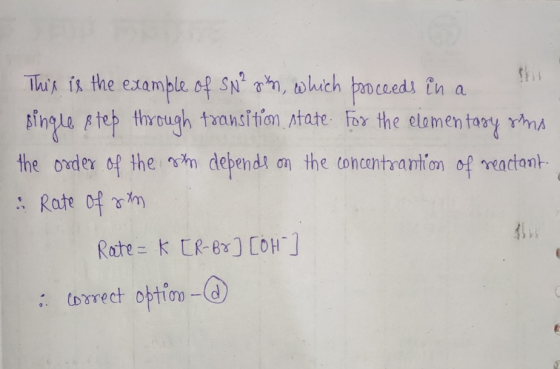
Your one thumbs up will help me lot. Thanks!
Add Answer to:
Question 1 Select the rate law for the following reaction CH3CH2CH2CH2Br + OH → CH3CH2CH2CH2OH +...
Which of the following compounds has the highest boiling point? Select one: CH3CH2CH2CH2NH2 ob. CH3CH2CH2CH2Br c....
 Which of the following compounds has the highest boiling point? Select one: CH3CH2CH2CH2NH2 ob. CH3CH2CH2CH2Br c. CH3CH2CH2CH2CI d. CH3CH2OCH2CH3 e CH3CH2CH2CH2OH it e Which of the following compounds has the highest boiling point? Select one: a. CH3CH2CH2CH2NH2 O b. CH3CH2CH2CH2Br c. CH3CH2CH2CH2CI O d. CH3CH2OCH2CH3 e. CH3CH2CH2CH OH Now Bi в е
Question 17 (1 point) C Determine the rate law for the following elementary reaction: H20H+OH. rate-k[H20]2...
 Question 17 (1 point) C Determine the rate law for the following elementary reaction: H20H+OH. rate-k[H20]2 rate-k[H OH-] rate-kH 12[OH-] rate-k[H2O]
What is the product of the following reaction? 12, KOH of CI OH 5. IV Select...
 What is the product of the following reaction? 12, KOH of CI OH 5. IV Select one: a. 11 O b. IV O c. 1 O d. III What is the starting material for the following reaction? Brz Br HOA O OH OH all IV Select one: a. O c.V
Consider the following reaction and its associated rate law A + B - C; rate =...
 Consider the following reaction and its associated rate law A + B - C; rate = k[A]2 Which of the following will not increase the rate of the reaction? Select one: a. increasing the concentration of reactant A O b. increasing the concentration of reactant B O c. increasing the temperature of the reaction d. adding a suitable catalyst O e. all of the above
QUESTION 6 OET -CH3 Et Et + OH OH Et Select the major product (or no reaction) and mechanism for the reaction above...
 QUESTION 6 OET -CH3 Et Et + OH OH Et Select the major product (or no reaction) and mechanism for the reaction above. Compound A Compound B Compound Compound D No Reaction S1 E15N2 E2 QUESTION 7 Br Me OCH, Et oh + O MeOH Ph Ph Select the major product (or no reaction) and mechanism for the reaction above. Compound A Compound B Compound C Compound D No Reaction SN 1 SN2 E2
What is the major product of the reaction below? 1) BHY-THF 2) H2O2, NaOH Select one:...
 What is the major product of the reaction below? 1) BHY-THF 2) H2O2, NaOH Select one: OH a. OH ob. OH OH d. Which is the most stable conformation of butane? Select one: CH3 H H a. H CH3 H Сна H. CH3 b. H I I- CH3 CH I C. H H CH3 Question 21 Not yet answered Marked out of 3.00 p Flag question What is the IUPAC name of the molecule shown below HO Br Select one:...
SIITTIUSSUTI-BUTIL BRUMIDE CH3CH2CH2CH2OH + HBr CH3CH2CH2CH2Br+H2O H2SO4 1-Butanol Hydrobromic Acid 1-Bromobutane Bp 118°C Den 1.49 Bp...
 SIITTIUSSUTI-BUTIL BRUMIDE CH3CH2CH2CH2OH + HBr CH3CH2CH2CH2Br+H2O H2SO4 1-Butanol Hydrobromic Acid 1-Bromobutane Bp 118°C Den 1.49 Bp 101.6°C Den 0.810 MW 80.9 Den 1.275 (a)which is the limiting reagent, (b) Calculate the theoretical yield, and (c) percent yield of the above reaction if you were to react 48 mmol of 1-Butanol with 66 mmol of aqueous hydrobromic acid and you obtained 3.7g of 1-Bromobutane? SHOW ALL CALCULATIONS (a) Theoretical Yield: (b) Limiting Reagent: (c) Percent Yield:
44) Which of the following represents the integrated rate law for a first-order reaction? A) In...
 44) Which of the following represents the integrated rate law for a first-order reaction? A) In Alt E-kt TA) B) 1 . 1 .kt Alt Alo C) [Alt-[Al= kt D) k = Ae(Ea/RT) E) IN (1+ Ina 45) Which of the following represents the integrated rate law for a second-order reaction? A) ISAI. -- - B) TÁL TAL. - Lt C) [A]o - [A] =-kt D) k = Ac(Ea/RT) E 1). Ina 46) Which of the following represents the integrated...
44) Which of the following represents the integrated rate law for a first-order reaction? A) I...
 44) Which of the following represents the integrated rate law for a first-order reaction? A) I (Alt kt Α) ΙΑ]ο. B) 1 . 1 .kt [A] [A] C) [A]:-[A]o - kt D) k = Ae(Ea/RT) E) Inkla (1) 5) mk2 RW 45) Which of the following represents the integrated rate law for a second-order reaction? A) ITALO B) [A] [A]. = kt C) [A]o - [A] = - kt D) k = Ae(Ea/RT) E E) In ki - Ea (1)...
8. The rate law for the reaction H2O2 + 2H+212 + 2H2O is rate-k[H202][1]. The following...
 8. The rate law for the reaction H2O2 + 2H+212 + 2H2O is rate-k[H202][1]. The following mechanism has been suggested. H2O2+1 - HOI + OH - slow OH + H H20 fast HỘI + H+ + + I2 + H2O fast Identify all intermediates included in this mechanism. A) H and I D) Honly B) H and HOI E) H20 and OH C) HOI and OH 9. Which of the following statements is false? A) A catalyst increases the rate...
 Which of the following compounds has the highest boiling point? Select one: CH3CH2CH2CH2NH2 ob. CH3CH2CH2CH2Br c. CH3CH2CH2CH2CI d. CH3CH2OCH2CH3 e CH3CH2CH2CH2OH it e Which of the following compounds has the highest boiling point? Select one: a. CH3CH2CH2CH2NH2 O b. CH3CH2CH2CH2Br c. CH3CH2CH2CH2CI O d. CH3CH2OCH2CH3 e. CH3CH2CH2CH OH Now Bi в е
 Question 17 (1 point) C Determine the rate law for the following elementary reaction: H20H+OH. rate-k[H20]2 rate-k[H OH-] rate-kH 12[OH-] rate-k[H2O]
 What is the product of the following reaction? 12, KOH of CI OH 5. IV Select one: a. 11 O b. IV O c. 1 O d. III What is the starting material for the following reaction? Brz Br HOA O OH OH all IV Select one: a. O c.V
 Consider the following reaction and its associated rate law A + B - C; rate = k[A]2 Which of the following will not increase the rate of the reaction? Select one: a. increasing the concentration of reactant A O b. increasing the concentration of reactant B O c. increasing the temperature of the reaction d. adding a suitable catalyst O e. all of the above
 QUESTION 6 OET -CH3 Et Et + OH OH Et Select the major product (or no reaction) and mechanism for the reaction above. Compound A Compound B Compound Compound D No Reaction S1 E15N2 E2 QUESTION 7 Br Me OCH, Et oh + O MeOH Ph Ph Select the major product (or no reaction) and mechanism for the reaction above. Compound A Compound B Compound C Compound D No Reaction SN 1 SN2 E2
 What is the major product of the reaction below? 1) BHY-THF 2) H2O2, NaOH Select one: OH a. OH ob. OH OH d. Which is the most stable conformation of butane? Select one: CH3 H H a. H CH3 H Сна H. CH3 b. H I I- CH3 CH I C. H H CH3 Question 21 Not yet answered Marked out of 3.00 p Flag question What is the IUPAC name of the molecule shown below HO Br Select one:...
 SIITTIUSSUTI-BUTIL BRUMIDE CH3CH2CH2CH2OH + HBr CH3CH2CH2CH2Br+H2O H2SO4 1-Butanol Hydrobromic Acid 1-Bromobutane Bp 118°C Den 1.49 Bp 101.6°C Den 0.810 MW 80.9 Den 1.275 (a)which is the limiting reagent, (b) Calculate the theoretical yield, and (c) percent yield of the above reaction if you were to react 48 mmol of 1-Butanol with 66 mmol of aqueous hydrobromic acid and you obtained 3.7g of 1-Bromobutane? SHOW ALL CALCULATIONS (a) Theoretical Yield: (b) Limiting Reagent: (c) Percent Yield:
 44) Which of the following represents the integrated rate law for a first-order reaction? A) In Alt E-kt TA) B) 1 . 1 .kt Alt Alo C) [Alt-[Al= kt D) k = Ae(Ea/RT) E) IN (1+ Ina 45) Which of the following represents the integrated rate law for a second-order reaction? A) ISAI. -- - B) TÁL TAL. - Lt C) [A]o - [A] =-kt D) k = Ac(Ea/RT) E 1). Ina 46) Which of the following represents the integrated...
 44) Which of the following represents the integrated rate law for a first-order reaction? A) I (Alt kt Α) ΙΑ]ο. B) 1 . 1 .kt [A] [A] C) [A]:-[A]o - kt D) k = Ae(Ea/RT) E) Inkla (1) 5) mk2 RW 45) Which of the following represents the integrated rate law for a second-order reaction? A) ITALO B) [A] [A]. = kt C) [A]o - [A] = - kt D) k = Ae(Ea/RT) E E) In ki - Ea (1)...
 8. The rate law for the reaction H2O2 + 2H+212 + 2H2O is rate-k[H202][1]. The following mechanism has been suggested. H2O2+1 - HOI + OH - slow OH + H H20 fast HỘI + H+ + + I2 + H2O fast Identify all intermediates included in this mechanism. A) H and I D) Honly B) H and HOI E) H20 and OH C) HOI and OH 9. Which of the following statements is false? A) A catalyst increases the rate...
Most questions answered within 3 hours.
-
Where is the error in this code sequence?
String s1 = "Hello";
String s2 = "ello";...
asked 10 months ago -
Financial data for Joel de Paris, Inc., for last year
follow:
Joel de Paris, Inc.
Balance...
asked 10 months ago -
Consider this reaction:
Al2(SO4)3 (aq)+ BaCl3
(aq) Al2Cl6 (aq)- +
3BaSO4(s) . What is the...
asked 10 months ago -
Suppose that Savneet is considering increasing her
recent random sample from 20 car rentals to 40...
asked 10 months ago -
Trucks arrive at an unloading terminal at an average rate of 120
per hour.
Trucks arrive...
asked 10 months ago -
Why are methanol and ethanol completely soluble in water while
octanol is not very little soluble....
asked 10 months ago -
A facilities manager at a university reads in a research report
that the mean amount of...
asked 10 months ago -
When the CuSO4 is rehydrated by adding water to the anhydrous
compound, is this an endothermic...
asked 10 months ago -
A ray of sunlight is passing from diamond into crown glass; the
angle of incidence is...
asked 10 months ago -
A block of mass 0.249 kg is placed on top of a light, vertical
spring of...
asked 10 months ago -
how do the kidneys compensate in the presences of acidosis
a) trigger hyperventilate
b) reserve acid...
asked 10 months ago -
Question 501 pts
The rental rate of capital to the firm increases. Which of the
following...
asked 10 months ago