
Homework Answers
The movement of ankle joint ventrally down that allows the toes to point downward is known as plantar flexion.Ankle joint has dorsiflexion and plantar flexion movements.Dorsiflexion is the movement of the toe upwards.
Add Answer to:
Question 13 of 50 EX Skoletal muscos A movement of the ankle joint ventrally that allows...
2 Describe the movement(s) of the ankle joint shown in Figures 9.10 through 9.12 and write...
 2 Describe the movement(s) of the ankle joint shown in Figures 9.10 through 9.12 and write down the muscle or muscles that are responsible for that movement. IGUR9.10 Example 1 Right ankle joint movement(s) Right ankle muscle(s): B FIGURE 9.11 Example 2 Ankle joint movement(s): Muscle(s): Ankle joint movement(s): Muscle(s): FIGURE 9.12 Example 3.. Discovering Anatomy: A Guided Examination of the Cadaver 170
Extension of the shoulder joint is described as a. Movement of the humerus straight posteriorly from...
Extension of the shoulder joint is described as a. Movement of the humerus straight posteriorly from any point in the sagittal plane b. Downward lateral movement of the humerus in the frontal plane medially toward the body c. Upward lateral movement of the humerus in the frontal plane d. Movement of the humerus straight anteriorly from any point in the sagittal plane
match the joint -Plantar Flexion -Antagonistic muscles -Flexion -Extension -Pronation -Torticollis -Supination -Bone -Hyperextension -Abduction -Adduction...
 match the joint
-Plantar Flexion -Antagonistic muscles -Flexion -Extension -Pronation -Torticollis -Supination -Bone -Hyperextension -Abduction -Adduction - Internal Rotation -Eversion -Inversion -External Rotation -Dersiflexion -Bursitis - Muscle -Joint -Dislocation -Subluxation 1. The most common signs and symptoms of disease are pain, swelling, decreased mobility, and deformity. 2. Weakness is the most common sign or symptom of disorders. cause movement at a joint. is the complete separation of a bone from its normal position in a joint. is the inflammation of...
match the joint
-Plantar Flexion -Antagonistic muscles -Flexion -Extension -Pronation -Torticollis -Supination -Bone -Hyperextension -Abduction -Adduction - Internal Rotation -Eversion -Inversion -External Rotation -Dersiflexion -Bursitis - Muscle -Joint -Dislocation -Subluxation 1. The most common signs and symptoms of disease are pain, swelling, decreased mobility, and deformity. 2. Weakness is the most common sign or symptom of disorders. cause movement at a joint. is the complete separation of a bone from its normal position in a joint. is the inflammation of...
Kinesiology Biomechanics Question. Please answer the question, then give an explanation in detail as to why...
 Kinesiology Biomechanics Question. Please answer the question,
then give an explanation in detail as to why that is the answer
(step by step).
Please answer all parts of the question. Thanks in
advanced.
We were unable to transcribe this image2. One the first poses taught in yoga class is called the downward facing dog. Please see stick figure on the back of your equation sheet. Only consider the knee and ankle joints Name just a single one-joint muscle that could...
Kinesiology Biomechanics Question. Please answer the question,
then give an explanation in detail as to why that is the answer
(step by step).
Please answer all parts of the question. Thanks in
advanced.
We were unable to transcribe this image2. One the first poses taught in yoga class is called the downward facing dog. Please see stick figure on the back of your equation sheet. Only consider the knee and ankle joints Name just a single one-joint muscle that could...
Can you find all the forces using methods of joint and methods of section? Ex, Ey,...
 Can you find all the forces using methods of joint and methods
of section? Ex, Ey, Dy, Force EA, Force EF, Force EB, Force FG,
Force FB, Force FC, Force GD, Force GC, Force GH, Force HD. Thank
you!
Question Completion Status: Question 3 10 points What is the force on member FG (KN)? 4 m -4 m 4 m Ey Ex E F G H 2.5 m D A B с [: 13 kN 3 kN 3 kN DY
Can you find all the forces using methods of joint and methods
of section? Ex, Ey, Dy, Force EA, Force EF, Force EB, Force FG,
Force FB, Force FC, Force GD, Force GC, Force GH, Force HD. Thank
you!
Question Completion Status: Question 3 10 points What is the force on member FG (KN)? 4 m -4 m 4 m Ey Ex E F G H 2.5 m D A B с [: 13 kN 3 kN 3 kN DY
QUESTION 1 Dip Exercise List the movements that occur in each joint as the subject moves...
 QUESTION 1
Dip Exercise
List the movements that occur in each joint as the subject moves
the body up and down in performing dips.
Choose your movement from the following list (movements may be
used multiple times):
Flexion
Extension
Abduction
Adduction
Internal rotation
External rotation
Horizontal abduction
Horizontal adduction
Diagonal abduction
Diagonal adduction
Elevation
Depression
Upward rotation
Downward rotation
For each joint movement, list the agonist muscle primarily
responsible, and indicate whether it is contracting concentrically
or eccentrically with a...
QUESTION 1
Dip Exercise
List the movements that occur in each joint as the subject moves
the body up and down in performing dips.
Choose your movement from the following list (movements may be
used multiple times):
Flexion
Extension
Abduction
Adduction
Internal rotation
External rotation
Horizontal abduction
Horizontal adduction
Diagonal abduction
Diagonal adduction
Elevation
Depression
Upward rotation
Downward rotation
For each joint movement, list the agonist muscle primarily
responsible, and indicate whether it is contracting concentrically
or eccentrically with a...
QUESTION 50 The application programming interface allows communication between the program and the __________. A. computer...
QUESTION 50 The application programming interface allows communication between the program and the __________. A. computer B. application C. network
Hi, could someone please help me answer all parts of this question QUESTION 5 TOTAL MARKS: 25] [5 Marks] Q 5(a) Describe, with the aid of a sketch, the main features of a knee ankle foot orthosis (KA...
 Hi, could someone please help me answer all parts of this
question
QUESTION 5 TOTAL MARKS: 25] [5 Marks] Q 5(a) Describe, with the aid of a sketch, the main features of a knee ankle foot orthosis (KAFO). Q 5(b) Figure 5.1 (a) and (b) show the sagittal plane joint kinematics for the ankle and knee of a patient with Spina Bifida with and without a conventional KAFO Knee Flexion 70 50 40 30 20 10 to 03 07 Time...
Hi, could someone please help me answer all parts of this
question
QUESTION 5 TOTAL MARKS: 25] [5 Marks] Q 5(a) Describe, with the aid of a sketch, the main features of a knee ankle foot orthosis (KAFO). Q 5(b) Figure 5.1 (a) and (b) show the sagittal plane joint kinematics for the ankle and knee of a patient with Spina Bifida with and without a conventional KAFO Knee Flexion 70 50 40 30 20 10 to 03 07 Time...
Question 13 (2 points) If two events are mutually exclusive, then their probabilities can be added...
 Question 13 (2 points) If two events are mutually exclusive, then their probabilities can be added all of the choices are correct they may also be collectively exhaustive if one occurs, the other cannot occur the joint probability is equal to O Question 14 (1 point) The area under the normal distribution to the left of the mean is always 0.5 or 50 percent. True False
Are these the correct answers? QUESTION 13 IFRS allows for revaluation of PP&E with the differences...
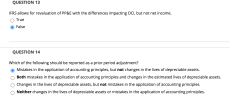 Are these the correct answers?
QUESTION 13 IFRS allows for revaluation of PP&E with the differences impacting OCI, but not net income. True False QUESTION 14 Which of the following should be reported as a prior period adjustment? Mistakes in the application of accounting principles, but not changes in the lives of depreciable assets. Both mistakes in the application of accounting principles and changes in the estimated lives of depreciable assets. Changes in the lives of depreciable assets, but not...
Are these the correct answers?
QUESTION 13 IFRS allows for revaluation of PP&E with the differences impacting OCI, but not net income. True False QUESTION 14 Which of the following should be reported as a prior period adjustment? Mistakes in the application of accounting principles, but not changes in the lives of depreciable assets. Both mistakes in the application of accounting principles and changes in the estimated lives of depreciable assets. Changes in the lives of depreciable assets, but not...
 2 Describe the movement(s) of the ankle joint shown in Figures 9.10 through 9.12 and write down the muscle or muscles that are responsible for that movement. IGUR9.10 Example 1 Right ankle joint movement(s) Right ankle muscle(s): B FIGURE 9.11 Example 2 Ankle joint movement(s): Muscle(s): Ankle joint movement(s): Muscle(s): FIGURE 9.12 Example 3.. Discovering Anatomy: A Guided Examination of the Cadaver 170
 match the joint
-Plantar Flexion -Antagonistic muscles -Flexion -Extension -Pronation -Torticollis -Supination -Bone -Hyperextension -Abduction -Adduction - Internal Rotation -Eversion -Inversion -External Rotation -Dersiflexion -Bursitis - Muscle -Joint -Dislocation -Subluxation 1. The most common signs and symptoms of disease are pain, swelling, decreased mobility, and deformity. 2. Weakness is the most common sign or symptom of disorders. cause movement at a joint. is the complete separation of a bone from its normal position in a joint. is the inflammation of...
match the joint
-Plantar Flexion -Antagonistic muscles -Flexion -Extension -Pronation -Torticollis -Supination -Bone -Hyperextension -Abduction -Adduction - Internal Rotation -Eversion -Inversion -External Rotation -Dersiflexion -Bursitis - Muscle -Joint -Dislocation -Subluxation 1. The most common signs and symptoms of disease are pain, swelling, decreased mobility, and deformity. 2. Weakness is the most common sign or symptom of disorders. cause movement at a joint. is the complete separation of a bone from its normal position in a joint. is the inflammation of...
 Kinesiology Biomechanics Question. Please answer the question,
then give an explanation in detail as to why that is the answer
(step by step).
Please answer all parts of the question. Thanks in
advanced.
We were unable to transcribe this image2. One the first poses taught in yoga class is called the downward facing dog. Please see stick figure on the back of your equation sheet. Only consider the knee and ankle joints Name just a single one-joint muscle that could...
Kinesiology Biomechanics Question. Please answer the question,
then give an explanation in detail as to why that is the answer
(step by step).
Please answer all parts of the question. Thanks in
advanced.
We were unable to transcribe this image2. One the first poses taught in yoga class is called the downward facing dog. Please see stick figure on the back of your equation sheet. Only consider the knee and ankle joints Name just a single one-joint muscle that could...
 Can you find all the forces using methods of joint and methods
of section? Ex, Ey, Dy, Force EA, Force EF, Force EB, Force FG,
Force FB, Force FC, Force GD, Force GC, Force GH, Force HD. Thank
you!
Question Completion Status: Question 3 10 points What is the force on member FG (KN)? 4 m -4 m 4 m Ey Ex E F G H 2.5 m D A B с [: 13 kN 3 kN 3 kN DY
Can you find all the forces using methods of joint and methods
of section? Ex, Ey, Dy, Force EA, Force EF, Force EB, Force FG,
Force FB, Force FC, Force GD, Force GC, Force GH, Force HD. Thank
you!
Question Completion Status: Question 3 10 points What is the force on member FG (KN)? 4 m -4 m 4 m Ey Ex E F G H 2.5 m D A B с [: 13 kN 3 kN 3 kN DY
 QUESTION 1
Dip Exercise
List the movements that occur in each joint as the subject moves
the body up and down in performing dips.
Choose your movement from the following list (movements may be
used multiple times):
Flexion
Extension
Abduction
Adduction
Internal rotation
External rotation
Horizontal abduction
Horizontal adduction
Diagonal abduction
Diagonal adduction
Elevation
Depression
Upward rotation
Downward rotation
For each joint movement, list the agonist muscle primarily
responsible, and indicate whether it is contracting concentrically
or eccentrically with a...
QUESTION 1
Dip Exercise
List the movements that occur in each joint as the subject moves
the body up and down in performing dips.
Choose your movement from the following list (movements may be
used multiple times):
Flexion
Extension
Abduction
Adduction
Internal rotation
External rotation
Horizontal abduction
Horizontal adduction
Diagonal abduction
Diagonal adduction
Elevation
Depression
Upward rotation
Downward rotation
For each joint movement, list the agonist muscle primarily
responsible, and indicate whether it is contracting concentrically
or eccentrically with a...
 Hi, could someone please help me answer all parts of this
question
QUESTION 5 TOTAL MARKS: 25] [5 Marks] Q 5(a) Describe, with the aid of a sketch, the main features of a knee ankle foot orthosis (KAFO). Q 5(b) Figure 5.1 (a) and (b) show the sagittal plane joint kinematics for the ankle and knee of a patient with Spina Bifida with and without a conventional KAFO Knee Flexion 70 50 40 30 20 10 to 03 07 Time...
Hi, could someone please help me answer all parts of this
question
QUESTION 5 TOTAL MARKS: 25] [5 Marks] Q 5(a) Describe, with the aid of a sketch, the main features of a knee ankle foot orthosis (KAFO). Q 5(b) Figure 5.1 (a) and (b) show the sagittal plane joint kinematics for the ankle and knee of a patient with Spina Bifida with and without a conventional KAFO Knee Flexion 70 50 40 30 20 10 to 03 07 Time...
 Question 13 (2 points) If two events are mutually exclusive, then their probabilities can be added all of the choices are correct they may also be collectively exhaustive if one occurs, the other cannot occur the joint probability is equal to O Question 14 (1 point) The area under the normal distribution to the left of the mean is always 0.5 or 50 percent. True False
 Are these the correct answers?
QUESTION 13 IFRS allows for revaluation of PP&E with the differences impacting OCI, but not net income. True False QUESTION 14 Which of the following should be reported as a prior period adjustment? Mistakes in the application of accounting principles, but not changes in the lives of depreciable assets. Both mistakes in the application of accounting principles and changes in the estimated lives of depreciable assets. Changes in the lives of depreciable assets, but not...
Are these the correct answers?
QUESTION 13 IFRS allows for revaluation of PP&E with the differences impacting OCI, but not net income. True False QUESTION 14 Which of the following should be reported as a prior period adjustment? Mistakes in the application of accounting principles, but not changes in the lives of depreciable assets. Both mistakes in the application of accounting principles and changes in the estimated lives of depreciable assets. Changes in the lives of depreciable assets, but not...
Most questions answered within 3 hours.
-
Where is the error in this code sequence?
String s1 = "Hello";
String s2 = "ello";...
asked 10 months ago -
Financial data for Joel de Paris, Inc., for last year
follow:
Joel de Paris, Inc.
Balance...
asked 10 months ago -
Consider this reaction:
Al2(SO4)3 (aq)+ BaCl3
(aq) Al2Cl6 (aq)- +
3BaSO4(s) . What is the...
asked 10 months ago -
Suppose that Savneet is considering increasing her
recent random sample from 20 car rentals to 40...
asked 10 months ago -
Trucks arrive at an unloading terminal at an average rate of 120
per hour.
Trucks arrive...
asked 10 months ago -
Why are methanol and ethanol completely soluble in water while
octanol is not very little soluble....
asked 10 months ago -
A facilities manager at a university reads in a research report
that the mean amount of...
asked 10 months ago -
When the CuSO4 is rehydrated by adding water to the anhydrous
compound, is this an endothermic...
asked 10 months ago -
A ray of sunlight is passing from diamond into crown glass; the
angle of incidence is...
asked 10 months ago -
A block of mass 0.249 kg is placed on top of a light, vertical
spring of...
asked 10 months ago -
how do the kidneys compensate in the presences of acidosis
a) trigger hyperventilate
b) reserve acid...
asked 10 months ago -
Question 501 pts
The rental rate of capital to the firm increases. Which of the
following...
asked 10 months ago