
Homework Answers
Ans:
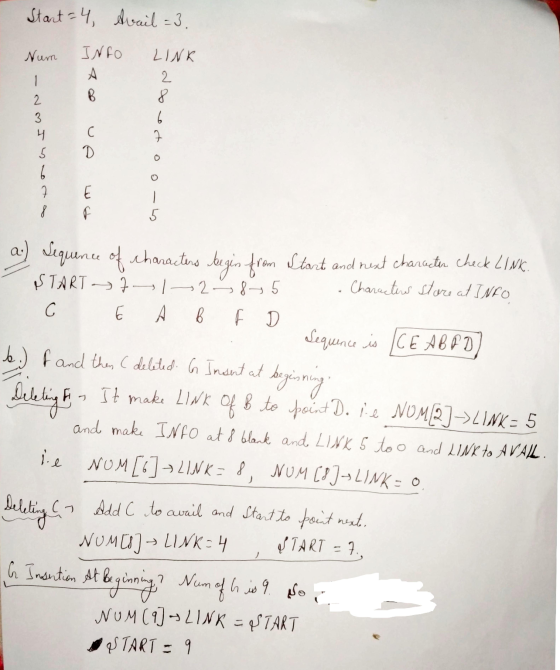
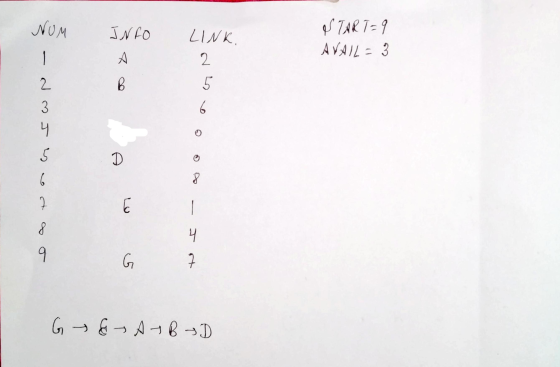
If any doubt, ask in the comments.
Stay safe and keep Chegging.
Add Answer to:
3. Fig. 3 pictures a linked list in memory: START = 4, AVAIL = 3 Num...
#1. Single linked list - find... Extra info/hint? It's free For this problem, I have a...
#1. Single linked list - find... Extra info/hint? It's free For this problem, I have a complete linked list program which supports the following commands from the user: insert, display, delete, average, find, insertBefore, insertAfter. insert allows them to insert a number into the current list, display will display the numbers in the current list etc. The program is complete except that I have removed the body of the method for find. Given the following class for the nodes in...
Write a MIPS assembly language program that uses dynamic memory allocation to create and manage a...
Write a MIPS assembly language program that uses dynamic memory allocation to create and manage a linked list data structure. Gives the user the following options: 1. To create and add the first node to a linked list. 2. To add a single node to the pre-existing linked list. The list must already exist before a new node can be added. The nodes should be maintained in ascending order based on the data value within the nodes...
Programming in C: I am trying to modify this linked list to be doubly linked list....
Programming in C: I am trying to modify this linked list to be doubly linked list. I’m also trying to add a print in reverse function. I’m really struggling with how to change the insert function to doubly link the nodes without effecting the alphabetical sorting mechanism. Example of desired output: Enter your choice: 1 to insert an element into the list. 2 to delete an element from the list. 3 to end. ? 1 Enter a character: a The...
C++ assignment about doubly linked list
 You are required to write the following functions using this class:
class Doubly_linked_list // Use a class Doubly_linked_list to represent an object
{
public:
// constructor initialize the nextPtr
Doubly_linked_list()
{
prevPtr = 0; // point to null at the beginning
nextPtr = 0; // point to null at the beginning
}
// get a number
int GetNum()
{
return number;
}
// set a number
void SetNum(int num)
{
number = num;
}
// get the prev pointer
Doubly_linked_list ...
You are required to write the following functions using this class:
class Doubly_linked_list // Use a class Doubly_linked_list to represent an object
{
public:
// constructor initialize the nextPtr
Doubly_linked_list()
{
prevPtr = 0; // point to null at the beginning
nextPtr = 0; // point to null at the beginning
}
// get a number
int GetNum()
{
return number;
}
// set a number
void SetNum(int num)
{
number = num;
}
// get the prev pointer
Doubly_linked_list ...
Creating linked list data structure Overview The purpose of this assignment is for you to write...
Creating linked list data structure Overview The purpose of this assignment is for you to write a data structure called a Linked List, which utilizes templates (similar to Java’s generics), in order to store any type of data. In addition, the nature of a Linked List will give you some experience dealing with non-contiguous memory organization. This will also give you more experience using pointers and memory management. Pointers, memory allocation, and understand how data is stored in memory will...
C++ Linked List Implementation Motivation As we discussed in class, the data structures that you use...
C++ Linked List Implementation Motivation As we discussed in class, the data structures that you use to implement your program can have a profound impact on it's overall performance. A poorly written program will often need much more RAM and CPU time then a well-written implementation. One of the most basic data structure questions revolves around the difference between an array and a linked list. After you finish this assignment you should have a firm understanding of their operation. Problem...
C programming A linked list is a linear data structure that allows us to add and remove items fro...
c programming A linked list is a linear data structure that allows us to add and remove items from the list very quickly, by simply changing a few pointers. There are many different variations of linked lists. We have studied the doubly-linked, circular, with a dummy-header-node version of a linked list. In the class notes we studied several functions to manipulate a Linked List. For this assignment you must write the code for the following additional linked list functions: addFirst,...
4. 20 points (Ex 21.2-3 of text book) Adapt the aggregate proof of Theorem 21.1 in...
 4. 20 points (Ex 21.2-3 of text book) Adapt the aggregate proof of Theorem 21.1 in the text book (slide 44 of Lecture5) to obtain amortized time bounds of O(1) for Make-Set and Find-Set and O(log n) for Union using linked list representation and weighted-union heuristic. Theorem 21.1 Using the linked-list representation of disjoint sets and the weighted-union heuris- tic, a sequence of m MAKE-SET, UNION, and FIND-SET operations, n of which are MAKE-SET operations, takes O(m + n lgn)...
Using the provided Linked List example code, linkedlist.c, as an example Make a node struct that...
Using the provided Linked List example code, linkedlist.c, as an example Make a node struct that holds ints instead of strings. In your main, insert 25 to 75 random integers with range (0 to 100) into a linked list of your nodes. Use a random to determine how many to make. Write a function int sum(NodePointer current) that returns the sum of the integers in the list by looping through the linked list. Write a function int count(NodePointer current) that...
Part 1: Implement a singly linked list -------------------------------------- (a) Your job is to implement a generic...
Part 1: Implement a singly linked list -------------------------------------- (a) Your job is to implement a generic singly linked list that can hold any data type. The interface has been specified and provided to you in a header file called mylist.h. So your job is to write mylist.c that implements each function whose prototype is included in mylist.h. Specifically, you are asked to write the following functions: struct Node *addFront(struct List *list, void *data) void traverseList(struct List *list, void (*f)(void *))...
 4. 20 points (Ex 21.2-3 of text book) Adapt the aggregate proof of Theorem 21.1 in the text book (slide 44 of Lecture5) to obtain amortized time bounds of O(1) for Make-Set and Find-Set and O(log n) for Union using linked list representation and weighted-union heuristic. Theorem 21.1 Using the linked-list representation of disjoint sets and the weighted-union heuris- tic, a sequence of m MAKE-SET, UNION, and FIND-SET operations, n of which are MAKE-SET operations, takes O(m + n lgn)...
Most questions answered within 3 hours.
-
Where is the error in this code sequence?
String s1 = "Hello";
String s2 = "ello";...
asked 10 months ago -
Financial data for Joel de Paris, Inc., for last year
follow:
Joel de Paris, Inc.
Balance...
asked 10 months ago -
Consider this reaction:
Al2(SO4)3 (aq)+ BaCl3
(aq) Al2Cl6 (aq)- +
3BaSO4(s) . What is the...
asked 10 months ago -
Suppose that Savneet is considering increasing her
recent random sample from 20 car rentals to 40...
asked 10 months ago -
Trucks arrive at an unloading terminal at an average rate of 120
per hour.
Trucks arrive...
asked 10 months ago -
Why are methanol and ethanol completely soluble in water while
octanol is not very little soluble....
asked 10 months ago -
A facilities manager at a university reads in a research report
that the mean amount of...
asked 10 months ago -
When the CuSO4 is rehydrated by adding water to the anhydrous
compound, is this an endothermic...
asked 10 months ago -
A ray of sunlight is passing from diamond into crown glass; the
angle of incidence is...
asked 10 months ago -
A block of mass 0.249 kg is placed on top of a light, vertical
spring of...
asked 10 months ago -
how do the kidneys compensate in the presences of acidosis
a) trigger hyperventilate
b) reserve acid...
asked 10 months ago -
Question 501 pts
The rental rate of capital to the firm increases. Which of the
following...
asked 10 months ago