For the following reaction: Zn (s) + Ag2O (s) --> ZnO (s) + Ag (s) (a.)...
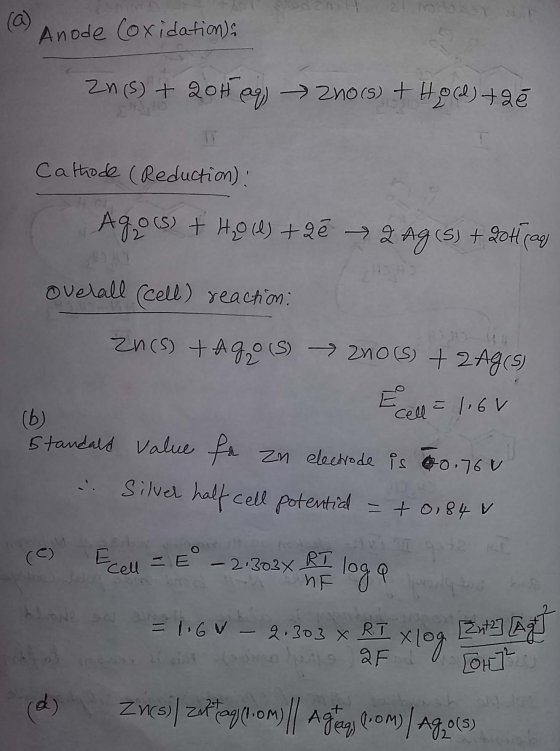
For the following reaction: Zn (s) + Ag2O (s) --> ZnO (s) + Ag (s)
(a.) write the balanced half-cell reactions.
(b.) Use E-knot cell = 1.6 V, and the half cell potential of the Zinc half-cell, to solve for the half cell potential of the silver half-cell.
(c.) Set up the nerst equation for each half-cell with the appropriate Q species.
(d.) write the line notation for the galvanic cell.
Homework Answers
Add Answer to:
For the following reaction: Zn (s) + Ag2O (s) --> ZnO (s) +
Ag (s)
(a.)...
A voltaic (galvanic) cell consists of an Ag(s)/Ag+1(aq) half-cell and a Zn(s)/Zn(s)+2(aq) half - cell connected...
A voltaic (galvanic) cell consists of an Ag(s)/Ag+1(aq) half-cell and a Zn(s)/Zn(s)+2(aq) half - cell connected by a salt bridge. Reduction occurs in the silver half- cell. The cell can be represented in standard notation as
The silver oxide-zinc battery used in watches delivers a voltage of 1.60 V. Using this information...
 The silver oxide-zinc battery used in watches delivers a voltage of 1.60 V. Using this information and the balanced chemical equation, calculate the standard free energy change for the cell reaction at 25C. Balanced equation: Zn(s) + Ag2O(s) --> ZnO(s) + 2 Ag(s)
1. Draw the cell, give the balanced chemical equation, and determine the potential for a Galvanic...
 1. Draw the cell, give the balanced chemical equation, and determine the potential for a Galvanic Cell based on the following line notation: Pt | Cut (0.5 M), Cu²+ (0.8 M) || Ag+ (1.2 M) Ag 2. Given the two following half reactions: Cu²+ + 2 e → Cu Zn2+ + 2e → Zn SRP = 0.34 V SRP = -0.76 V perform the following: - Set up a galvanic cell under standard conditions. Predict the cell potential, balanced chemical...
For a voltaic (or galvanic) cell using Ag, Ag+ (1.0M) and Zn Zn2+ (1.0 M) half-cells, which of the following statements is incorrect
For a voltaic (or galvanic) cell using Ag, Ag+ (1.0M) and Zn Zn2+ (1.0 M) half-cells, which of the following statements is incorrect? (a) The zinc electrode is the anode. (b) Electrons will flow through the external circuit from the zinc electrode to the silver electrode. (c) The mass of the zinc electrode will decrease as the cell operates. (d) The concentration of Ag will decrease as the cell operates. (e) Reduction occurs at the zinc electrode as the cell operates.
1. Balance the following under basic conditions in: Ag(s) + Zn2+(aq)→ Ag2O(aq) + Zn(s) 2) PbO2(s)...
1. Balance the following under basic conditions in: Ag(s) + Zn2+(aq)→ Ag2O(aq) + Zn(s) 2) PbO2(s) + I- (aq) → Pb+2(aq) + I2(s) under acidic conditions 3) Al(s) + MnO4-(aq) → MnO2(s) + Al(OH)4- (aq) under basic conditions a) Balance the following under the conditions described. b) State the number of electrons transferred. c) Write a reaction quotient, Q, for each of the two final balanced reactions. Remember equilibrium rules) d) determine Eocell for each using the attached tables
Suppose the galvanic cell sketched below is powered by the following reaction: Zn(s)+FeCl2(aq) → ZnCl2(aq)+Fe(s) Write...
 Suppose the galvanic cell sketched below is powered by the following reaction: Zn(s)+FeCl2(aq) → ZnCl2(aq)+Fe(s) Write a balanced equation for the half-reaction that happens at the cathode of this cell. Write a balanced equation for the half-reaction that happens at the anode of this cell. Of what substance is E1 made? Of what substance is E2 made? What are the chemical species in solution S1? What are the chemical species in solution S2? Explanation Check © 2020 McGraw-Hill Education. All...
In a galvanic cell, a spontaneous redox reaction occurs. However the reactants are separated such that...
 In a galvanic cell, a spontaneous redox reaction occurs. However the reactants are separated such that the transfer of electrons is forced to occur across a wire. The resulting electricity is measured in volts (V) and is the sum of the potentials of the oxidation and reduction half-reactions: E^o cell = E^o red + E^o ox By reversing the reduction half-reactions, you get the corresponding oxidation half-reaction, for which E^o ox has the opposite sign of E^o red You can...
Consider the galvanic cell that uses the reaction 2 Ag^+ (aq) + Cu(s) rightarrow Cu^2+ (aq)...
 Consider the galvanic cell that uses the reaction 2 Ag^+ (aq) + Cu(s) rightarrow Cu^2+ (aq) + 2 Ag (s) Clearly sketch the experimental set-up, write down the anode and cathode half-reactions, and give the shorthand notation for the cell.
Consider the following reaction. 2Ag^+(aq) + Zn(s) --> 2Ag(s) +Zn(aq) a) write the individual oxidation and...
Consider the following reaction. 2Ag^+(aq) + Zn(s) --> 2Ag(s) +Zn(aq) a) write the individual oxidation and reduction half-reactions, specifying which is the anode and which is the cathode reaction. b) calculate the cell potential for a cell containing 0.10M Ag^+ and 0.25M Zn^2+ at 298K. (E ag= 0.80 V and E zn= -0.76 V)
A voltaic cell is based on the reduction of Ag^+(aq) to Ag(s) and the oxidation of...
 A voltaic cell is based on the reduction of Ag^+(aq) to Ag(s) and the oxidation of Sn(s) to Sn^2+(aq). (a) Write half-reactions for the cell's anode and cathode. Include the phases of all species in the chemical equation. Anode Cathode (b) Write a balanced cell reaction. Include the phases of all species in the chemical equation.
 The silver oxide-zinc battery used in watches delivers a voltage of 1.60 V. Using this information and the balanced chemical equation, calculate the standard free energy change for the cell reaction at 25C. Balanced equation: Zn(s) + Ag2O(s) --> ZnO(s) + 2 Ag(s)
 1. Draw the cell, give the balanced chemical equation, and determine the potential for a Galvanic Cell based on the following line notation: Pt | Cut (0.5 M), Cu²+ (0.8 M) || Ag+ (1.2 M) Ag 2. Given the two following half reactions: Cu²+ + 2 e → Cu Zn2+ + 2e → Zn SRP = 0.34 V SRP = -0.76 V perform the following: - Set up a galvanic cell under standard conditions. Predict the cell potential, balanced chemical...
 Suppose the galvanic cell sketched below is powered by the following reaction: Zn(s)+FeCl2(aq) → ZnCl2(aq)+Fe(s) Write a balanced equation for the half-reaction that happens at the cathode of this cell. Write a balanced equation for the half-reaction that happens at the anode of this cell. Of what substance is E1 made? Of what substance is E2 made? What are the chemical species in solution S1? What are the chemical species in solution S2? Explanation Check © 2020 McGraw-Hill Education. All...
 In a galvanic cell, a spontaneous redox reaction occurs. However the reactants are separated such that the transfer of electrons is forced to occur across a wire. The resulting electricity is measured in volts (V) and is the sum of the potentials of the oxidation and reduction half-reactions: E^o cell = E^o red + E^o ox By reversing the reduction half-reactions, you get the corresponding oxidation half-reaction, for which E^o ox has the opposite sign of E^o red You can...
 Consider the galvanic cell that uses the reaction 2 Ag^+ (aq) + Cu(s) rightarrow Cu^2+ (aq) + 2 Ag (s) Clearly sketch the experimental set-up, write down the anode and cathode half-reactions, and give the shorthand notation for the cell.
 A voltaic cell is based on the reduction of Ag^+(aq) to Ag(s) and the oxidation of Sn(s) to Sn^2+(aq). (a) Write half-reactions for the cell's anode and cathode. Include the phases of all species in the chemical equation. Anode Cathode (b) Write a balanced cell reaction. Include the phases of all species in the chemical equation.
Most questions answered within 3 hours.
-
Where is the error in this code sequence?
String s1 = "Hello";
String s2 = "ello";...
asked 11 months ago -
Financial data for Joel de Paris, Inc., for last year
follow:
Joel de Paris, Inc.
Balance...
asked 11 months ago -
Consider this reaction:
Al2(SO4)3 (aq)+ BaCl3
(aq) Al2Cl6 (aq)- +
3BaSO4(s) . What is the...
asked 11 months ago -
Suppose that Savneet is considering increasing her
recent random sample from 20 car rentals to 40...
asked 11 months ago -
Trucks arrive at an unloading terminal at an average rate of 120
per hour.
Trucks arrive...
asked 11 months ago -
Why are methanol and ethanol completely soluble in water while
octanol is not very little soluble....
asked 11 months ago -
A facilities manager at a university reads in a research report
that the mean amount of...
asked 11 months ago -
When the CuSO4 is rehydrated by adding water to the anhydrous
compound, is this an endothermic...
asked 11 months ago -
A ray of sunlight is passing from diamond into crown glass; the
angle of incidence is...
asked 11 months ago -
A block of mass 0.249 kg is placed on top of a light, vertical
spring of...
asked 11 months ago -
how do the kidneys compensate in the presences of acidosis
a) trigger hyperventilate
b) reserve acid...
asked 11 months ago -
Question 501 pts
The rental rate of capital to the firm increases. Which of the
following...
asked 11 months ago