
Homework Answers
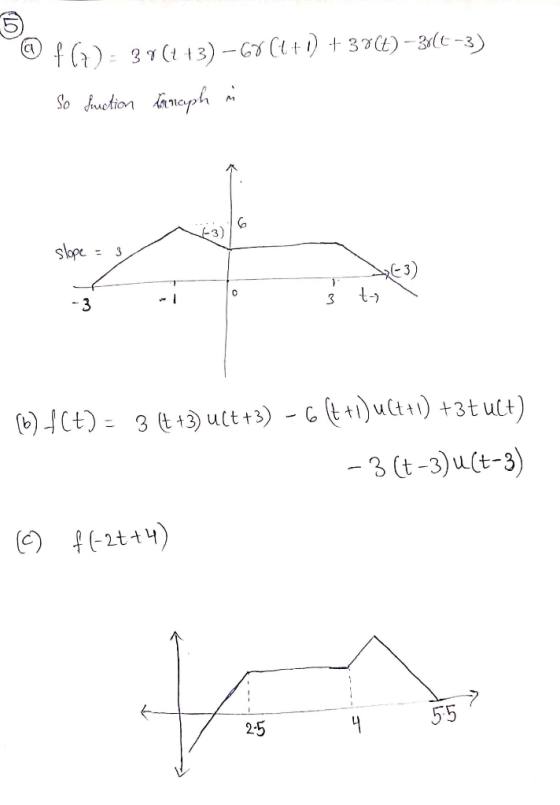
here f(-2t+4) requires decimation and changing with respect to y axis and shifting it to 4 units right side
Add Answer to:
Sketch the voltage waveform for the time domain function: 10 - 3r(+3) - 6r(r+1)+3r() -3r(1-3) Where...
Write the time domain function r(t) of the graph below as the sum of two rectangular...
 Write the time domain function r(t) of the graph below as the sum of two rectangular pulse functions, then compute the fourier transform X(w) in terms of sinc function. (Reminder: A rectangular pulse centered 50,427 at the origin with width 27 is defined as II(t) = 11, -T<t<+T and it has the fourier transform II(t) sincwr)) 1 0 Amplitude -1 -2 0 2 3 8 9 10 11 5 6 7 Time-
Question 8: 1. Redraw the circuit shown below with the s domain equivalent models, where V1(t)...
 Question 8: 1. Redraw the circuit shown below with the s domain equivalent models, where V1(t) is a step function from 0 to 1V at t-0 2. Find transfer function in the s domain H( 3. Write the s-domain equation for Vout(s) if V1(s) is a 1V step function. 4. Write the equation of r of the circuit in terms of R's and C 5. Write the equation for the step response in the time domain. 6. You can either...
PART B: 04 Sketch graph for sin waveform and cosine waveform for AC voltage and AC...
 PART B: 04 Sketch graph for sin waveform and cosine waveform for AC voltage and AC current. (4 marks) (b) Obtain the energy stored in each capacitor in Figure Q4(b) under DC conditions. (6 marks) (c) Determine the current through a 200 uF capacitor whose voltage is shown in Figure Q4(c). Sketch graph for current, I versus time, t. (10 marks) 2 mF Η Λ 2 ΚΩ 5 ΚΩ ΛΜ 6 mA 3 ΚΩ ΑΛΛ 4 ΚΩ 4 mE Figure...
1. (a) Evaluate the Fourier coefficients a, an, ba for the function defined as f)-2 cos() for-π/2...
 1. (a) Evaluate the Fourier coefficients a, an, ba for the function defined as f)-2 cos() for-π/2 s sn2 and zero else over the period of 2T, do NOT use MATLAB or a calculator for integrations. All the steps should be shown. Write a few terms of the Fourier series expansion Plot 2 or 3 cycles of the Fourier series using MATLAB and verify whether the plot matches the given waveform Find Co and Cn and plot the amplitude spectrum...
citor i Voltage and current as a function -10 of time. b. Find and plot the...
 citor i Voltage and current as a function -10 of time. b. Find and plot the instantaneous power pl) on the capacitor. c. Find and plot the instantaneous energy wit stored on the capacitor. ce of V. d plot The voltage across a capacitor with capacitance of 50 aF is given by 6.8 nce of i) V. and f time. -20, 0sI<S 40-300, 5SI<10 6.10 (1) -10r+200, 10 sI<20 0, otherwise ance 000) This waveform is shown in Figure P6.8....
I'm absolutely stuck on this, please show work and explain. + 1+ Vo R & Vo...
 I'm absolutely stuck on this, please show work and explain.
+ 1+ Vo R & Vo R FIG I: RC CIRCUIT FIG 2: RL CIRCUIT A. View the RC circuit in Fig. 1. 1) Assume an input sinusoidal voltage with frequency f=50kHz, R=4.7kN and C= 0.01°F (#103). Compute the phase difference between Vo and Vi. 2) Plot the amplitude for the voltage ratio vs. frequency. 3) Determine the characteristic frequency (fc). 4) Assume a step function input voltage (Vi) applied...
I'm absolutely stuck on this, please show work and explain.
+ 1+ Vo R & Vo R FIG I: RC CIRCUIT FIG 2: RL CIRCUIT A. View the RC circuit in Fig. 1. 1) Assume an input sinusoidal voltage with frequency f=50kHz, R=4.7kN and C= 0.01°F (#103). Compute the phase difference between Vo and Vi. 2) Plot the amplitude for the voltage ratio vs. frequency. 3) Determine the characteristic frequency (fc). 4) Assume a step function input voltage (Vi) applied...
Write the time domain function z(t) of the graph below as the sum of two rectangular...
 Write the time domain function z(t) of the graph below as the sum of two rectangular pulse functions, then compute the fourier transform X(w) in terms of sinc function. (Reminder: A rectangular pulse centered fo.lt21 at the origin with width 27 is defined as II(t) = 11.-T <t< + and it has the fourier transform II(t) sinc(wr)) 3 2 Amplitude 0 0 1 2 3 4 5 6 7 8 9 10 11 Time
A waveform is described by the function 3 sin(22t 52 10). where t is in seconds...
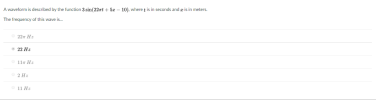 A waveform is described by the function 3 sin(22t 52 10). where t is in seconds and The frequency of this wave is... is in meters. 22 Hz 11π Hz 2 H 11H之
Help fill in table The CH2 waveform vr(t) is shown in red. 3. Now, double the...
 Help fill in table
The CH2 waveform vr(t) is shown in red. 3. Now, double the function generator frequency (to f=1250Hz about 1250Hz) to display exactly two complete cycles in 8 horizontal divisions. Do not change the amplitude of e(t). Again, both waveforms should be centered vertically on the scope grid. Adjust the vertical POSITION knobs if necessary. Carefully sketch and label both waveforms on the grid. Use the same settings (VOLTS/DIV AND SEC/DIV from part A4.) as with the...
Help fill in table
The CH2 waveform vr(t) is shown in red. 3. Now, double the function generator frequency (to f=1250Hz about 1250Hz) to display exactly two complete cycles in 8 horizontal divisions. Do not change the amplitude of e(t). Again, both waveforms should be centered vertically on the scope grid. Adjust the vertical POSITION knobs if necessary. Carefully sketch and label both waveforms on the grid. Use the same settings (VOLTS/DIV AND SEC/DIV from part A4.) as with the...
Question 1 (10 points) Determine the domain of the following function and sketch a contour plot...
 Question 1 (10 points) Determine the domain of the following function and sketch a contour plot (to be included in your work). f(x, y) = 1 – 4x° +y? — 2y all real numbers D = { (x, y) : 4х2 + (у — 1)? <1} o o oo D = {(x, y) : 4x° + (у — 1)? > 1}
 Write the time domain function r(t) of the graph below as the sum of two rectangular pulse functions, then compute the fourier transform X(w) in terms of sinc function. (Reminder: A rectangular pulse centered 50,427 at the origin with width 27 is defined as II(t) = 11, -T<t<+T and it has the fourier transform II(t) sincwr)) 1 0 Amplitude -1 -2 0 2 3 8 9 10 11 5 6 7 Time-
 Question 8: 1. Redraw the circuit shown below with the s domain equivalent models, where V1(t) is a step function from 0 to 1V at t-0 2. Find transfer function in the s domain H( 3. Write the s-domain equation for Vout(s) if V1(s) is a 1V step function. 4. Write the equation of r of the circuit in terms of R's and C 5. Write the equation for the step response in the time domain. 6. You can either...
 PART B: 04 Sketch graph for sin waveform and cosine waveform for AC voltage and AC current. (4 marks) (b) Obtain the energy stored in each capacitor in Figure Q4(b) under DC conditions. (6 marks) (c) Determine the current through a 200 uF capacitor whose voltage is shown in Figure Q4(c). Sketch graph for current, I versus time, t. (10 marks) 2 mF Η Λ 2 ΚΩ 5 ΚΩ ΛΜ 6 mA 3 ΚΩ ΑΛΛ 4 ΚΩ 4 mE Figure...
 1. (a) Evaluate the Fourier coefficients a, an, ba for the function defined as f)-2 cos() for-π/2 s sn2 and zero else over the period of 2T, do NOT use MATLAB or a calculator for integrations. All the steps should be shown. Write a few terms of the Fourier series expansion Plot 2 or 3 cycles of the Fourier series using MATLAB and verify whether the plot matches the given waveform Find Co and Cn and plot the amplitude spectrum...
 citor i Voltage and current as a function -10 of time. b. Find and plot the instantaneous power pl) on the capacitor. c. Find and plot the instantaneous energy wit stored on the capacitor. ce of V. d plot The voltage across a capacitor with capacitance of 50 aF is given by 6.8 nce of i) V. and f time. -20, 0sI<S 40-300, 5SI<10 6.10 (1) -10r+200, 10 sI<20 0, otherwise ance 000) This waveform is shown in Figure P6.8....
 I'm absolutely stuck on this, please show work and explain.
+ 1+ Vo R & Vo R FIG I: RC CIRCUIT FIG 2: RL CIRCUIT A. View the RC circuit in Fig. 1. 1) Assume an input sinusoidal voltage with frequency f=50kHz, R=4.7kN and C= 0.01°F (#103). Compute the phase difference between Vo and Vi. 2) Plot the amplitude for the voltage ratio vs. frequency. 3) Determine the characteristic frequency (fc). 4) Assume a step function input voltage (Vi) applied...
I'm absolutely stuck on this, please show work and explain.
+ 1+ Vo R & Vo R FIG I: RC CIRCUIT FIG 2: RL CIRCUIT A. View the RC circuit in Fig. 1. 1) Assume an input sinusoidal voltage with frequency f=50kHz, R=4.7kN and C= 0.01°F (#103). Compute the phase difference between Vo and Vi. 2) Plot the amplitude for the voltage ratio vs. frequency. 3) Determine the characteristic frequency (fc). 4) Assume a step function input voltage (Vi) applied...
 Write the time domain function z(t) of the graph below as the sum of two rectangular pulse functions, then compute the fourier transform X(w) in terms of sinc function. (Reminder: A rectangular pulse centered fo.lt21 at the origin with width 27 is defined as II(t) = 11.-T <t< + and it has the fourier transform II(t) sinc(wr)) 3 2 Amplitude 0 0 1 2 3 4 5 6 7 8 9 10 11 Time
 A waveform is described by the function 3 sin(22t 52 10). where t is in seconds and The frequency of this wave is... is in meters. 22 Hz 11π Hz 2 H 11H之
 Help fill in table
The CH2 waveform vr(t) is shown in red. 3. Now, double the function generator frequency (to f=1250Hz about 1250Hz) to display exactly two complete cycles in 8 horizontal divisions. Do not change the amplitude of e(t). Again, both waveforms should be centered vertically on the scope grid. Adjust the vertical POSITION knobs if necessary. Carefully sketch and label both waveforms on the grid. Use the same settings (VOLTS/DIV AND SEC/DIV from part A4.) as with the...
Help fill in table
The CH2 waveform vr(t) is shown in red. 3. Now, double the function generator frequency (to f=1250Hz about 1250Hz) to display exactly two complete cycles in 8 horizontal divisions. Do not change the amplitude of e(t). Again, both waveforms should be centered vertically on the scope grid. Adjust the vertical POSITION knobs if necessary. Carefully sketch and label both waveforms on the grid. Use the same settings (VOLTS/DIV AND SEC/DIV from part A4.) as with the...
 Question 1 (10 points) Determine the domain of the following function and sketch a contour plot (to be included in your work). f(x, y) = 1 – 4x° +y? — 2y all real numbers D = { (x, y) : 4х2 + (у — 1)? <1} o o oo D = {(x, y) : 4x° + (у — 1)? > 1}
Most questions answered within 3 hours.
-
Where is the error in this code sequence?
String s1 = "Hello";
String s2 = "ello";...
asked 11 months ago -
Financial data for Joel de Paris, Inc., for last year
follow:
Joel de Paris, Inc.
Balance...
asked 11 months ago -
Consider this reaction:
Al2(SO4)3 (aq)+ BaCl3
(aq) Al2Cl6 (aq)- +
3BaSO4(s) . What is the...
asked 11 months ago -
Suppose that Savneet is considering increasing her
recent random sample from 20 car rentals to 40...
asked 11 months ago -
Trucks arrive at an unloading terminal at an average rate of 120
per hour.
Trucks arrive...
asked 11 months ago -
Why are methanol and ethanol completely soluble in water while
octanol is not very little soluble....
asked 11 months ago -
A facilities manager at a university reads in a research report
that the mean amount of...
asked 11 months ago -
When the CuSO4 is rehydrated by adding water to the anhydrous
compound, is this an endothermic...
asked 11 months ago -
A ray of sunlight is passing from diamond into crown glass; the
angle of incidence is...
asked 11 months ago -
A block of mass 0.249 kg is placed on top of a light, vertical
spring of...
asked 11 months ago -
how do the kidneys compensate in the presences of acidosis
a) trigger hyperventilate
b) reserve acid...
asked 11 months ago -
Question 501 pts
The rental rate of capital to the firm increases. Which of the
following...
asked 11 months ago