
Homework Answers
Answer: 7.899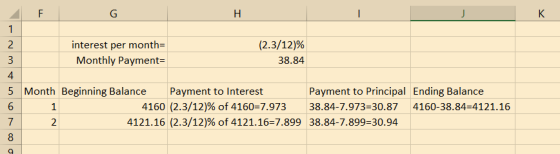
- The per month interest rate will be ( 2.3/12 )% =r (say)
- The beginning balance for the first month is going to be the amount owed at the beginning = amount borrowed=4160.
- Payment to interest is calculated by calculating the interest on the corresponding month's beginning balance= r*beginning balance.
- Payment to principal is the amount that is paid in the month over and above the payment towards interest= monthly payment - payment to interest for the month.
- the ending balance of the loan account will be the beginning balance of the next month because that is what is the new amount owed= Beginning balance- monthly payment.
Add Answer to:
Kyle used the Quantitative Reasoning Procees to create a plan to pay off his gtudent loang...
Suppose that under the Plan of Repayment one should pay off the debt in a number...
 Suppose that under the Plan of Repayment one should pay off the debt in a number of equal end-of-month instaliments principal and interest). This is the customary way to pay off loans on automobiles, house mortgages, etc. A friend of yours has financed $15.000 on the purchase of a new automobile, and the annual interest rate is 6% (0.5% per month) a. Monthly payments over a 48-month loan period will be how much? b. How much interest and principal wil...
Suppose that under the Plan of Repayment one should pay off the debt in a number...
 Suppose that under the Plan of Repayment one should pay off the debt in a number of equal end-of-month installments (principal and interest). This is the customary way to pay of loans on automobiles, house mortgages, etc. A friend of yours has financed $15,000 on the purchase of a new automobile, and the annual interest rate is 12% (1% per month). a. Monthly payments over a 60-month loan period will be how much? D. how much interest and principal will...
Quantitative Reasoning | Module 10: Homework133 Allegra is starting a small record label and has secured...
 Quantitative Reasoning | Module 10: Homework133 Allegra is starting a small record label and has secured start-up funding in the form of an interest only loan for s90,000, which hasan APR of 9.9% compounded monthly. Since the loan is interest only, she will not pay off any of the balance of the loan until it comes to term at the end of eight years. Instead, she will simply pay the monthly interest owed on the loan amount of $90,000. 4....
You just borrowed $300,000 to buy a house. You plan to pay off your loan by...
You just borrowed $300,000 to buy a house. You plan to pay off your loan by making equal monthly payments over the next 20 years. Suppose the interest rate your bank charges you is an APR of 6%, compounded semi-annually. What is the principal payback for the last month in Year 20? $2126.07 $2136.57 $1250 $1500 $1879.22
George Costanza has just taken out an $18,718.00, 60-month car loan from his local bank with...
George Costanza has just taken out an $18,718.00, 60-month car loan from his local bank with a 7.20% interest rate compounded monthly. At the end of the second year, George plans on making a $3,167.00 payment directly to the loan’s principal and then to keep on making his regular monthly payments. How many months remain on the loan after the extra payment is made? (Do not round)
Question 12 4 pts Bill just financed a used car through his credit union. His loan...
 Question 12 4 pts Bill just financed a used car through his credit union. His loan of $14,572 has an interest rate of 5.00% and requires payments of $275 a month for 60 months. Assuming that all payments are paid on time, his last payment will pay off the loan in full. What type of loan does Bill have? Amortizing Pure discount Lump sum Interest-only
2. Amortization. Tanner has just begun paying off his student loans of $30,000 which he has...
 2. Amortization. Tanner has just begun paying off his student loans of $30,000 which he has decided to pay off over the next 15 years at an annual rate of 5%, compounded monthly, making monthly payments. Use an amortization table and present value tools to advise Tanner on the following: Answer Point Value Points Earned 2.a. What will Tanner's monthly payment be? Work: 2.b. How much of Tanner's first monthly payment will be applied to pay down the principle on...
Problem #3: Mort is to pay off a loan of $80,000 with equal payments at the...
 Problem #3: Mort is to pay off a loan of $80,000 with equal payments at the end of every month over 10 years (i.e., 120 months). The ANNUAL effective rate is 4.5%. Mort decides that he can actually manage to pay double the monthly payment each month. How many MONTHS will it take him to pay off the loan? (Include the final month where the last payment will be smaller than all the rest.) Problem #3: Answer in integer number...
1. You want to buy a $249,000 home. You plan to pay 5% as a down...
1. You want to buy a $249,000 home. You plan to pay 5% as a down payment, and take out a 30 year loan for the rest. a) How much is the loan amount going to be? $ b) What will your monthly payments be if the interest rate is 6%? $ c) What will your monthly payments be if the interest rate is 7%? $ 2. You can afford a $1150 per month mortgage payment. You've found a 30...
2-13 interest Idle P J. R. Smith plans to borrow $200,000 through a 30-year mortgage from his bank to buy a home....
 2-13 interest Idle P J. R. Smith plans to borrow $200,000 through a 30-year mortgage from his bank to buy a home. If the bank charges him an interest rate of 7 percent, find the (a) Monthly mortgage payment (b) Amortization schedule for the first 3 months: balance after each payment: principal and interest portions of each payment. (c) For the first 221 payments, what is the total interest paid and the total principal. (d) How much would J. R....
 Suppose that under the Plan of Repayment one should pay off the debt in a number of equal end-of-month instaliments principal and interest). This is the customary way to pay off loans on automobiles, house mortgages, etc. A friend of yours has financed $15.000 on the purchase of a new automobile, and the annual interest rate is 6% (0.5% per month) a. Monthly payments over a 48-month loan period will be how much? b. How much interest and principal wil...
 Suppose that under the Plan of Repayment one should pay off the debt in a number of equal end-of-month installments (principal and interest). This is the customary way to pay of loans on automobiles, house mortgages, etc. A friend of yours has financed $15,000 on the purchase of a new automobile, and the annual interest rate is 12% (1% per month). a. Monthly payments over a 60-month loan period will be how much? D. how much interest and principal will...
 Quantitative Reasoning | Module 10: Homework133 Allegra is starting a small record label and has secured start-up funding in the form of an interest only loan for s90,000, which hasan APR of 9.9% compounded monthly. Since the loan is interest only, she will not pay off any of the balance of the loan until it comes to term at the end of eight years. Instead, she will simply pay the monthly interest owed on the loan amount of $90,000. 4....
 Question 12 4 pts Bill just financed a used car through his credit union. His loan of $14,572 has an interest rate of 5.00% and requires payments of $275 a month for 60 months. Assuming that all payments are paid on time, his last payment will pay off the loan in full. What type of loan does Bill have? Amortizing Pure discount Lump sum Interest-only
 2. Amortization. Tanner has just begun paying off his student loans of $30,000 which he has decided to pay off over the next 15 years at an annual rate of 5%, compounded monthly, making monthly payments. Use an amortization table and present value tools to advise Tanner on the following: Answer Point Value Points Earned 2.a. What will Tanner's monthly payment be? Work: 2.b. How much of Tanner's first monthly payment will be applied to pay down the principle on...
 Problem #3: Mort is to pay off a loan of $80,000 with equal payments at the end of every month over 10 years (i.e., 120 months). The ANNUAL effective rate is 4.5%. Mort decides that he can actually manage to pay double the monthly payment each month. How many MONTHS will it take him to pay off the loan? (Include the final month where the last payment will be smaller than all the rest.) Problem #3: Answer in integer number...
 2-13 interest Idle P J. R. Smith plans to borrow $200,000 through a 30-year mortgage from his bank to buy a home. If the bank charges him an interest rate of 7 percent, find the (a) Monthly mortgage payment (b) Amortization schedule for the first 3 months: balance after each payment: principal and interest portions of each payment. (c) For the first 221 payments, what is the total interest paid and the total principal. (d) How much would J. R....
Most questions answered within 3 hours.
-
Where is the error in this code sequence?
String s1 = "Hello";
String s2 = "ello";...
asked 10 months ago -
Financial data for Joel de Paris, Inc., for last year
follow:
Joel de Paris, Inc.
Balance...
asked 10 months ago -
Consider this reaction:
Al2(SO4)3 (aq)+ BaCl3
(aq) Al2Cl6 (aq)- +
3BaSO4(s) . What is the...
asked 10 months ago -
Suppose that Savneet is considering increasing her
recent random sample from 20 car rentals to 40...
asked 10 months ago -
Trucks arrive at an unloading terminal at an average rate of 120
per hour.
Trucks arrive...
asked 10 months ago -
Why are methanol and ethanol completely soluble in water while
octanol is not very little soluble....
asked 10 months ago -
A facilities manager at a university reads in a research report
that the mean amount of...
asked 10 months ago -
When the CuSO4 is rehydrated by adding water to the anhydrous
compound, is this an endothermic...
asked 10 months ago -
A ray of sunlight is passing from diamond into crown glass; the
angle of incidence is...
asked 10 months ago -
A block of mass 0.249 kg is placed on top of a light, vertical
spring of...
asked 10 months ago -
how do the kidneys compensate in the presences of acidosis
a) trigger hyperventilate
b) reserve acid...
asked 10 months ago -
Question 501 pts
The rental rate of capital to the firm increases. Which of the
following...
asked 10 months ago