
Homework Answers
Add Answer to:
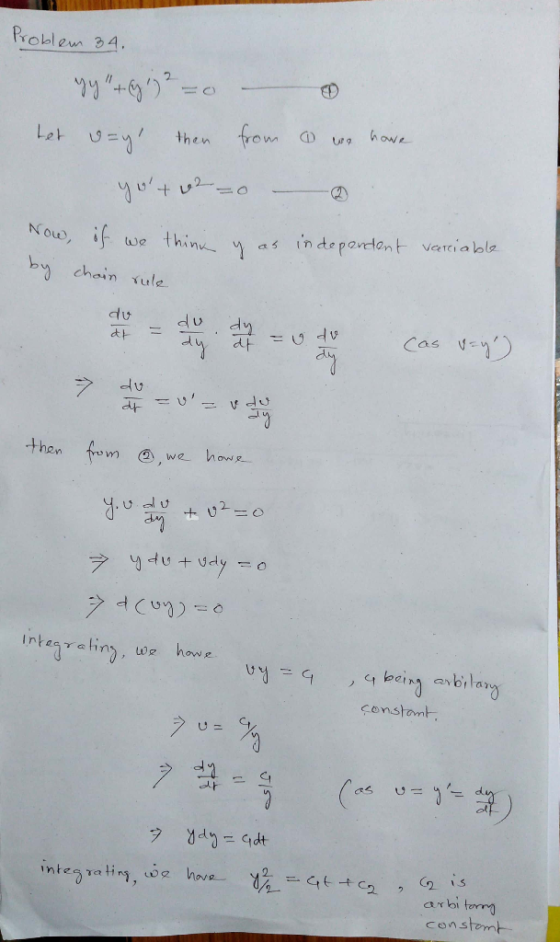
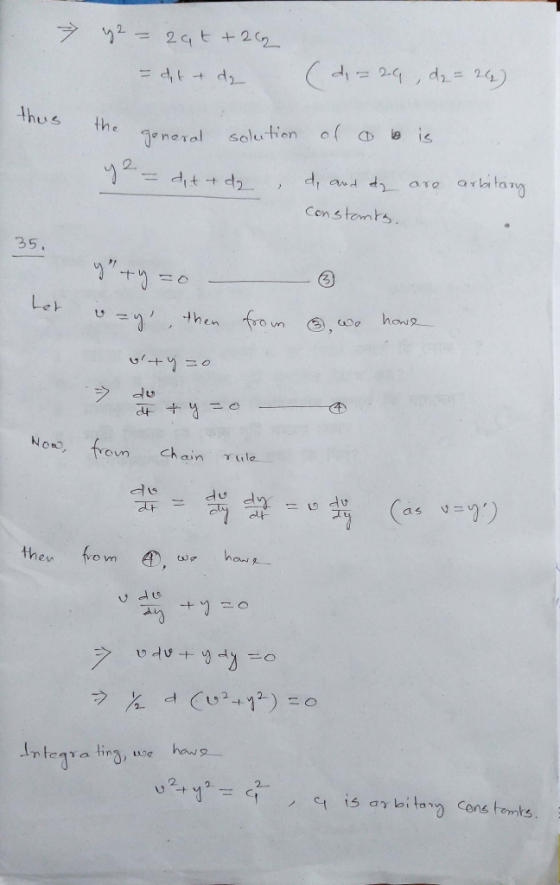
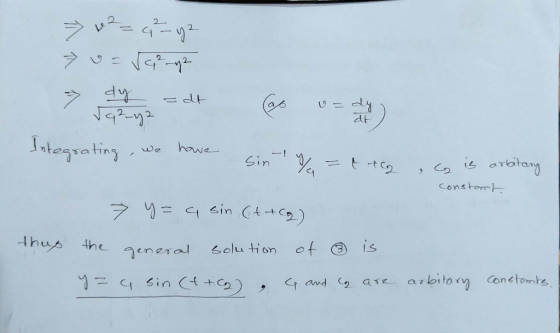
problem 34
Equations with the Independent Variable Missing. If a second order differential equation has the...
Question 3 (1 mark) Attempt 1 Consider the following second order differential equation: 2 6 d2y...
 Question 3 (1 mark) Attempt 1 Consider the following second order differential equation: 2 6 d2y +4 dr2 If we let u y and v y' then as an AUTONOMOUS first order system, the second order differential equation is correctly expressed as: dy d.r -y 1+112, with y(1) 9 and y'(1)5 d.r du 6 А dt1, to)1, dtv, u(to)=9, -1+11r2+2u-4v2, v(to)=5. du 6 B dry )9, ar=1+112+y-4(y), v(1)5 du d.r dt du C 1, (1) 0, =v, u(1)=9, -1+11r2+u-4v2, v(1)=5...
please show all steps 4. Some equations that are not separable can be made separable by...
 please show all steps
4. Some equations that are not separable can be made separable by an appropriate substitution. Differential equations of the form y = f (!) are called Euler-homogeneous. These can be solved by letting v = y/t or y = ut. Using the product rule, dy du di = v + tai so that the differential equation becomes du v+t du f(0) - 0 dt t Use this technique to solve dy 2y+ + +4 - Leave...
please show all steps
4. Some equations that are not separable can be made separable by an appropriate substitution. Differential equations of the form y = f (!) are called Euler-homogeneous. These can be solved by letting v = y/t or y = ut. Using the product rule, dy du di = v + tai so that the differential equation becomes du v+t du f(0) - 0 dt t Use this technique to solve dy 2y+ + +4 - Leave...
Reduce a second order non linear differential equations with time as an independent variable to a...
Reduce a second order non linear differential equations with time as an independent variable to a system of first order differential equations then using those first order differential equations develop a matlab program to solve an initial value problem.
problem form Elementary Differential Equations cla problem form Elementary Differential Equations class (I) Any graphing calculator...
 problem form Elementary Differential Equations cla
ss
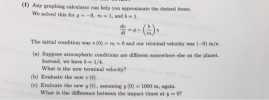
(I) Any graphing calculator can We solved this for g-9, m 1, and b 1 help you approximate the desired items. dv -() dt The initial condition was v (0) 0 and our terminal velocity was (-9) m/s. (a) Suppose atmospheric conditions are different somewhere else on the planet. Instead, we have b 1/4. What is the new terminal velocity? (b) Evaluate the new v (t) (e) Evaluate...
problem form Elementary Differential Equations cla
problem form Elementary Differential Equations class
(I) Any graphing calculator can We solved this for g-9, m 1, and b 1 help you approximate the desired items. dv -() dt The initial condition was v (0) 0 and our terminal velocity was (-9) m/s. (a) Suppose atmospheric conditions are different somewhere else on the planet. Instead, we have b 1/4. What is the new terminal velocity? (b) Evaluate the new v (t) (e) Evaluate...
7. Design an Op Amp circuit that solves the following first order differential equation for v(t):...
 7. Design an Op Amp circuit that solves the following first order differential equation for v(t): dv dt 8. Design an Op Amp circuit that solves the following second order differential equations for y(t): 습+10 y(t) = cos(21t) · dt?
Problem 4. The higher order differential equation and initial conditions are shown as follows: = dy...
 Problem 4. The higher order differential equation and initial conditions are shown as follows: = dy dy +y?, y(0) = 1, y'(0) = -1, "(0) = 2 dt3 dt (a) [5pts. Transform the above initial value problem into an equivalent first order differential system, including initial conditions. (b) [2pts.] Express the system and the initial condition in (a) in vector form. (c) [4pts.] Using the second order Runge Kutta method as follows Ū* = Ūi + hĚ(ti, Ūi) h =...
(1 point) It can be helpful to classify a differential equation, so that we can predict...
 (1 point) It can be helpful to classify a differential equation, so that we can predict the techniques that might help us to find a function which solves the equation. Two classifications are the order of the equation -- (what is the highest number of derivatives involved) and whether or not the equation is linear Linearity is important because the structure of the the family of solutions to a linear equation is fairly simple. Linear equations can usually be solved...
Differential Equations with MATLAB/Plotting first order differential equations in Matlab/ Differential Equations MATLAB/IVP Matlab/IVP I'd really...
 Differential Equations with MATLAB/Plotting first order
differential equations in Matlab/ Differential Equations MATLAB/IVP
Matlab/IVP
I'd really appreciate if I can get some help plotting these 3
first order differential equations as well as their comments.
PLEASE! ANYTHING HELPS, I am very stuck :(
EZplot and ODE 45 were mentioned in class and the instructions
in class were not clear at all.
Given the first order differential equation with initial condition. dy/dt = y t, y(0)=-1 Complete problems 1-3 in one...
Differential Equations with MATLAB/Plotting first order
differential equations in Matlab/ Differential Equations MATLAB/IVP
Matlab/IVP
I'd really appreciate if I can get some help plotting these 3
first order differential equations as well as their comments.
PLEASE! ANYTHING HELPS, I am very stuck :(
EZplot and ODE 45 were mentioned in class and the instructions
in class were not clear at all.
Given the first order differential equation with initial condition. dy/dt = y t, y(0)=-1 Complete problems 1-3 in one...
(1 point) General Solution of a First Order Linear Differential Equation A first order linear differential...
 (1 point) General Solution of a First Order Linear Differential Equation A first order linear differential equation is one that can be put in the form dy + P(2)y= Q(1) dz where P and Q are continuous functions on a given interval. This form is called the standard form and is readily solved by multiplying both sides of the equation by an integrating factor, I(2) = el P(z) da In this problem, we want to find the general solution of...
State the order of the following ordinary differential equations and classify them as linear or non-linear....
 State the order of the following ordinary differential equations and classify them as linear or non-linear. (2t-e2t) day +64 dy dt4 dt = - ye-66 + 2sin(5t) The order of the differential equation is and it is ---Select--- d²f dp2 = pln(-6p) + 2e5p The order of the differential equation is and it is ---Select--- day sinh( ) – In(6) dy dx = 2cos(5y) – y dx2 The order of the differential equation is and it is ---Select---
 Question 3 (1 mark) Attempt 1 Consider the following second order differential equation: 2 6 d2y +4 dr2 If we let u y and v y' then as an AUTONOMOUS first order system, the second order differential equation is correctly expressed as: dy d.r -y 1+112, with y(1) 9 and y'(1)5 d.r du 6 А dt1, to)1, dtv, u(to)=9, -1+11r2+2u-4v2, v(to)=5. du 6 B dry )9, ar=1+112+y-4(y), v(1)5 du d.r dt du C 1, (1) 0, =v, u(1)=9, -1+11r2+u-4v2, v(1)=5...
 please show all steps
4. Some equations that are not separable can be made separable by an appropriate substitution. Differential equations of the form y = f (!) are called Euler-homogeneous. These can be solved by letting v = y/t or y = ut. Using the product rule, dy du di = v + tai so that the differential equation becomes du v+t du f(0) - 0 dt t Use this technique to solve dy 2y+ + +4 - Leave...
please show all steps
4. Some equations that are not separable can be made separable by an appropriate substitution. Differential equations of the form y = f (!) are called Euler-homogeneous. These can be solved by letting v = y/t or y = ut. Using the product rule, dy du di = v + tai so that the differential equation becomes du v+t du f(0) - 0 dt t Use this technique to solve dy 2y+ + +4 - Leave...
 problem form Elementary Differential Equations cla
ss
(I) Any graphing calculator can We solved this for g-9, m 1, and b 1 help you approximate the desired items. dv -() dt The initial condition was v (0) 0 and our terminal velocity was (-9) m/s. (a) Suppose atmospheric conditions are different somewhere else on the planet. Instead, we have b 1/4. What is the new terminal velocity? (b) Evaluate the new v (t) (e) Evaluate...
problem form Elementary Differential Equations cla
problem form Elementary Differential Equations class
(I) Any graphing calculator can We solved this for g-9, m 1, and b 1 help you approximate the desired items. dv -() dt The initial condition was v (0) 0 and our terminal velocity was (-9) m/s. (a) Suppose atmospheric conditions are different somewhere else on the planet. Instead, we have b 1/4. What is the new terminal velocity? (b) Evaluate the new v (t) (e) Evaluate...
 7. Design an Op Amp circuit that solves the following first order differential equation for v(t): dv dt 8. Design an Op Amp circuit that solves the following second order differential equations for y(t): 습+10 y(t) = cos(21t) · dt?
 Problem 4. The higher order differential equation and initial conditions are shown as follows: = dy dy +y?, y(0) = 1, y'(0) = -1, "(0) = 2 dt3 dt (a) [5pts. Transform the above initial value problem into an equivalent first order differential system, including initial conditions. (b) [2pts.] Express the system and the initial condition in (a) in vector form. (c) [4pts.] Using the second order Runge Kutta method as follows Ū* = Ūi + hĚ(ti, Ūi) h =...
 (1 point) It can be helpful to classify a differential equation, so that we can predict the techniques that might help us to find a function which solves the equation. Two classifications are the order of the equation -- (what is the highest number of derivatives involved) and whether or not the equation is linear Linearity is important because the structure of the the family of solutions to a linear equation is fairly simple. Linear equations can usually be solved...
 Differential Equations with MATLAB/Plotting first order
differential equations in Matlab/ Differential Equations MATLAB/IVP
Matlab/IVP
I'd really appreciate if I can get some help plotting these 3
first order differential equations as well as their comments.
PLEASE! ANYTHING HELPS, I am very stuck :(
EZplot and ODE 45 were mentioned in class and the instructions
in class were not clear at all.
Given the first order differential equation with initial condition. dy/dt = y t, y(0)=-1 Complete problems 1-3 in one...
Differential Equations with MATLAB/Plotting first order
differential equations in Matlab/ Differential Equations MATLAB/IVP
Matlab/IVP
I'd really appreciate if I can get some help plotting these 3
first order differential equations as well as their comments.
PLEASE! ANYTHING HELPS, I am very stuck :(
EZplot and ODE 45 were mentioned in class and the instructions
in class were not clear at all.
Given the first order differential equation with initial condition. dy/dt = y t, y(0)=-1 Complete problems 1-3 in one...
 (1 point) General Solution of a First Order Linear Differential Equation A first order linear differential equation is one that can be put in the form dy + P(2)y= Q(1) dz where P and Q are continuous functions on a given interval. This form is called the standard form and is readily solved by multiplying both sides of the equation by an integrating factor, I(2) = el P(z) da In this problem, we want to find the general solution of...
 State the order of the following ordinary differential equations and classify them as linear or non-linear. (2t-e2t) day +64 dy dt4 dt = - ye-66 + 2sin(5t) The order of the differential equation is and it is ---Select--- d²f dp2 = pln(-6p) + 2e5p The order of the differential equation is and it is ---Select--- day sinh( ) – In(6) dy dx = 2cos(5y) – y dx2 The order of the differential equation is and it is ---Select---
Most questions answered within 3 hours.
-
Where is the error in this code sequence?
String s1 = "Hello";
String s2 = "ello";...
asked 11 months ago -
Financial data for Joel de Paris, Inc., for last year
follow:
Joel de Paris, Inc.
Balance...
asked 11 months ago -
Consider this reaction:
Al2(SO4)3 (aq)+ BaCl3
(aq) Al2Cl6 (aq)- +
3BaSO4(s) . What is the...
asked 11 months ago -
Suppose that Savneet is considering increasing her
recent random sample from 20 car rentals to 40...
asked 11 months ago -
Trucks arrive at an unloading terminal at an average rate of 120
per hour.
Trucks arrive...
asked 11 months ago -
Why are methanol and ethanol completely soluble in water while
octanol is not very little soluble....
asked 11 months ago -
A facilities manager at a university reads in a research report
that the mean amount of...
asked 11 months ago -
When the CuSO4 is rehydrated by adding water to the anhydrous
compound, is this an endothermic...
asked 11 months ago -
A ray of sunlight is passing from diamond into crown glass; the
angle of incidence is...
asked 11 months ago -
A block of mass 0.249 kg is placed on top of a light, vertical
spring of...
asked 11 months ago -
how do the kidneys compensate in the presences of acidosis
a) trigger hyperventilate
b) reserve acid...
asked 11 months ago -
Question 501 pts
The rental rate of capital to the firm increases. Which of the
following...
asked 11 months ago