Consider a sample with data values of 19, 20, 5 ,8 , and 18 . Compute...
Consider a sample with data values of 19, 20, 5 ,8 , and 18 .
Compute the variance.
(to 1 decimal)
Compute the standard deviation.
(to 2 decimals)
Homework Answers
Solution :
n = 5
 =
=  = (19 + 20 + 5 + 8+18) / 5 = 70 / 5 = 14
s2 =  (x
- )2 / n -
1
(x
- )2 / n -
1
= (19 - 14)2 + (20 - 14)2 + (5 - 14)2 + (8 - 14)2 + (18 - 14)2 / 5 - 1
= 194 / 4
= 48.5
variance = 48.5
standard deviation =  variance =
48.5 = 6.96
variance =
48.5 = 6.96
Add Answer to:
Consider a sample with data values of 19, 20, 5 ,8 , and 18
.
Compute...
Consider a sample with data values of 8, 10, 7, 19, and 16. Compute the variance....
Consider a sample with data values of 8, 10, 7, 19, and 16. Compute the variance. (to 1 decimal) Compute the standard deviation. (to 2 decimals)
Consider the following sample data values. 3 17 1 19 13 8 18 11 a) Calculate...
 Consider the following sample data values. 3 17 1 19 13 8 18 11 a) Calculate the range b) Calculate the sample variance. c) Calculate the sample standard deviation. a) The range is 18 b) The sample variance is (Round to two decimal places as needed.)
5) Consider a sample with data values of 12, 17, 10, 16, and 20. Compute mean,...
 5) Consider a sample with data values of 12, 17, 10, 16, and 20. Compute mean, median, range variance, and standard deviation 6) Consider a sample with data values of 12, 17, 10, 16, and 20. Compute the z-scores for the ataset.
2 eBook Consider a sample with data values of 10, 20, 12, 17, and 16. Compute...
 2 eBook Consider a sample with data values of 10, 20, 12, 17, and 16. Compute the 3-score for each of the five observations (to 2 decimals). Enter negative values as negative numbers, Observed value -score 10 20 lllll 12 17 16 The Graduate Management Admission Test (GMAT) is a standardized exam used by many universities as part of the assessment for admission to graduate study in Exercise (3.43 : Not Answered At score is 547 (Magoosh website, January 5,...
Consider a sample with data values of 26, 24, 23, 16, 32, 33, 28, and 24....
Consider a sample with data values of 26, 24, 23, 16, 32, 33, 28, and 24. Compute the range, interquartile range, variance, and standard deviation (to a maximum of 2 decimals, if decimals are necessary. Use Excel's =quartile.exc function).
Consider a sample with data values of 27, 24, 23, 19, 32, 36, 29, and 24....
 Consider a sample with data values of 27, 24, 23, 19, 32, 36,
29, and 24. Compute the 20th, 25th, 65th, and 75th
percentiles
eBook Consider a sample with data values of 27, 24, 23, 19, 32, 36, 29, and 24. Compute the 20th, 25th, 65th, and 75th percentiles (to 1 decimal, if decimals are necessary). 20th percentile 25th percentile 65th percentile 75th percentile
Consider a sample with data values of 27, 24, 23, 19, 32, 36,
29, and 24. Compute the 20th, 25th, 65th, and 75th
percentiles
eBook Consider a sample with data values of 27, 24, 23, 19, 32, 36, 29, and 24. Compute the 20th, 25th, 65th, and 75th percentiles (to 1 decimal, if decimals are necessary). 20th percentile 25th percentile 65th percentile 75th percentile
Consider a sample with data values of 10, 20, 12, 17, and 16. Compute the z-score...
Consider a sample with data values of 10, 20, 12, 17, and 16. Compute the z-score for each of the five observations. If required enter negative values as negative numbers (to 2 decimals). Observed value z-score 10 ______ 20 ______ 12 _______ 17________ 16________
Consider a sample with data values 53, 55, 70, 58, and 64. Use Excel to compute...
Consider a sample with data values 53, 55, 70, 58, and 64. Use Excel to compute the following quantities. (a) Compute the mean. (b) Compute the median. (c) Compute the range. (d) Compute the variance. (e) Compute the standard deviation. (f) Compute the z-score for each of the five observations
Consider a sample with data values of 24, 28, 26, 15, 30, 34, 25, and 28....
Consider a sample with data values of 24, 28, 26, 15, 30, 34, 25, and 28. Compute the range. Compute the interquartile range. Compute the sample variance. (Round your answer to two decimal places.) Compute the sample standard deviation. (Round your answer to two decimal places.)
Data 4. The following data is from a random sample: 5, 1, 3, 3, 8. Compute...
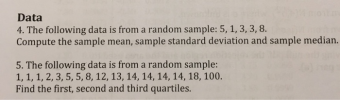 Data 4. The following data is from a random sample: 5, 1, 3, 3, 8. Compute the sample mean, sample standard deviation and sample median. 5. The following data is from a random sample: 1, 1, 1, 2, 3, 5, 5, 8, 12, 13, 14, 14, 14, 14, 18, 100. Find the first, second and third quartiles.
 Consider the following sample data values. 3 17 1 19 13 8 18 11 a) Calculate the range b) Calculate the sample variance. c) Calculate the sample standard deviation. a) The range is 18 b) The sample variance is (Round to two decimal places as needed.)
 5) Consider a sample with data values of 12, 17, 10, 16, and 20. Compute mean, median, range variance, and standard deviation 6) Consider a sample with data values of 12, 17, 10, 16, and 20. Compute the z-scores for the ataset.
 2 eBook Consider a sample with data values of 10, 20, 12, 17, and 16. Compute the 3-score for each of the five observations (to 2 decimals). Enter negative values as negative numbers, Observed value -score 10 20 lllll 12 17 16 The Graduate Management Admission Test (GMAT) is a standardized exam used by many universities as part of the assessment for admission to graduate study in Exercise (3.43 : Not Answered At score is 547 (Magoosh website, January 5,...
 Consider a sample with data values of 27, 24, 23, 19, 32, 36,
29, and 24. Compute the 20th, 25th, 65th, and 75th
percentiles
eBook Consider a sample with data values of 27, 24, 23, 19, 32, 36, 29, and 24. Compute the 20th, 25th, 65th, and 75th percentiles (to 1 decimal, if decimals are necessary). 20th percentile 25th percentile 65th percentile 75th percentile
Consider a sample with data values of 27, 24, 23, 19, 32, 36,
29, and 24. Compute the 20th, 25th, 65th, and 75th
percentiles
eBook Consider a sample with data values of 27, 24, 23, 19, 32, 36, 29, and 24. Compute the 20th, 25th, 65th, and 75th percentiles (to 1 decimal, if decimals are necessary). 20th percentile 25th percentile 65th percentile 75th percentile
 Data 4. The following data is from a random sample: 5, 1, 3, 3, 8. Compute the sample mean, sample standard deviation and sample median. 5. The following data is from a random sample: 1, 1, 1, 2, 3, 5, 5, 8, 12, 13, 14, 14, 14, 14, 18, 100. Find the first, second and third quartiles.
Most questions answered within 3 hours.
-
Where is the error in this code sequence?
String s1 = "Hello";
String s2 = "ello";...
asked 10 months ago -
Financial data for Joel de Paris, Inc., for last year
follow:
Joel de Paris, Inc.
Balance...
asked 10 months ago -
Consider this reaction:
Al2(SO4)3 (aq)+ BaCl3
(aq) Al2Cl6 (aq)- +
3BaSO4(s) . What is the...
asked 10 months ago -
Suppose that Savneet is considering increasing her
recent random sample from 20 car rentals to 40...
asked 10 months ago -
Trucks arrive at an unloading terminal at an average rate of 120
per hour.
Trucks arrive...
asked 10 months ago -
Why are methanol and ethanol completely soluble in water while
octanol is not very little soluble....
asked 10 months ago -
A facilities manager at a university reads in a research report
that the mean amount of...
asked 10 months ago -
When the CuSO4 is rehydrated by adding water to the anhydrous
compound, is this an endothermic...
asked 10 months ago -
A ray of sunlight is passing from diamond into crown glass; the
angle of incidence is...
asked 10 months ago -
A block of mass 0.249 kg is placed on top of a light, vertical
spring of...
asked 10 months ago -
how do the kidneys compensate in the presences of acidosis
a) trigger hyperventilate
b) reserve acid...
asked 10 months ago -
Question 501 pts
The rental rate of capital to the firm increases. Which of the
following...
asked 10 months ago