Explain the high rate of eletrophilic aromatic substitution observed in arylamines and state the synthetic strategy...
Homework Answers
Arylamines are potentially very reactive towards electrophilic aromatic substitution. This is because -NH2, -NHR2 and -NR2 are very strong activators and are ortho, para-directing.
However the basicity of the amino group means it is unsuitable for reactions with acids (e.g. H2SO4 or AlCl3) such as nitration, sulfonation and Friedel-Crafts alkylation or acylation. Polysubstitution can also be a problem. For example, bromination is very rapid, even in the absence of a catalyst, leading to bromination in all available ortho- and para- positions. To avoid these problems, it is customary to "protect" aryl amines by converting them to their N-acyl derivatives i.e. amides. The protecting group (an amide) can later be removed by either acid or base hydrolysis.
The amide is a less powerful activating group than the simple amino group, -NH2 since resonance within the N-acetyl group of the amide (see below) competes with delocalisation of the N lone pair into the ring.
In conclusion, the sequence should be protect the arylamines, substitute it and then deprotect it.
Add Answer to:
Explain the high rate of eletrophilic aromatic substitution
observed in arylamines and state the synthetic strategy...
(a) Devise a synthetic strategy to produce the following product starting from benzene: NH2 [M (b) Explain the mechanis...
 (a) Devise a synthetic strategy to produce the following product starting from benzene: NH2 [M (b) Explain the mechanism of the electrophilic aromatic substitutions from part (a) and using Wheland diagrams, explain the regioselectivity of the reactions [M (c) Why is pyrrole aromatic, but not basic?
7. Explain with the use of appropriate resonance structures, the regioselectivity of the electrophilic aromatic substitution...
 7. Explain with the use of appropriate resonance structures, the regioselectivity of the electrophilic aromatic substitution reaction - i.e. why is electrophilic aromatic substitution of acetanilide less favoured at the 3-position than at the 2- or the 4-positions.
Which one of the following compounds undergoes electrophilic aromatic substitution at the fastest rate? B
 Which one of the following compounds undergoes electrophilic
aromatic substitution at the fastest rate?
B
Which one of the following compounds undergoes electrophilic
aromatic substitution at the fastest rate?
B
Electrophilic aromatic substitution reactions. Will someone please solve and explain every step? Aromatic Compound Reagent AlCl3...
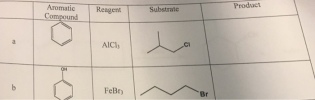 Electrophilic aromatic substitution reactions. Will someone
please solve and explain every step?
Aromatic Compound Reagent AlCl3 FeBr3 Substrate Product
Electrophilic aromatic substitution reactions. Will someone
please solve and explain every step?
Aromatic Compound Reagent AlCl3 FeBr3 Substrate Product
Aromatic heterocycles also undergo electrophilic aromatic substitution reactions. When furan is treated with an electrophile, the...
 Aromatic heterocycles also undergo electrophilic aromatic
substitution reactions. When furan is treated with an electrophile,
the electrophile is installed only at the C-2 position. Explain why
this reaction occurs only at the C-2 position, rather than the C-3
positions.(explain in words and resonance structures)
Question 2 (10 pts). Aromatic heterocycles can undergo EAS reactions. When furan (below) is treated with an electrophile, an EAS reaction occurs in which the electrophile is installed only at carbon 2, not carbon 3. Explain...
Aromatic heterocycles also undergo electrophilic aromatic
substitution reactions. When furan is treated with an electrophile,
the electrophile is installed only at the C-2 position. Explain why
this reaction occurs only at the C-2 position, rather than the C-3
positions.(explain in words and resonance structures)
Question 2 (10 pts). Aromatic heterocycles can undergo EAS reactions. When furan (below) is treated with an electrophile, an EAS reaction occurs in which the electrophile is installed only at carbon 2, not carbon 3. Explain...
Rank the following compounds in order of increasing reactivity for electrophilic aromatic substitution. Explain your reasoning.
 Rank the following compounds in order of increasing reactivity
for electrophilic aromatic substitution. Explain your
reasoning.
Rank the following compounds in order of increasing reactivity
for electrophilic aromatic substitution. Explain your
reasoning.
a. Which of the following two nucleophilic aRomatic substitution Reactions would you expect to proceed at...
 a. Which of the following two nucleophilic aRomatic substitution Reactions would you expect to proceed at Faster Rate. Explain in detail the Reasoning which led нь урик (one/31e + NaOH ol + NaBr O 00+ 001 09 --> + & Na Bir ol + NaO A
Please explain:) 3. Aromatic or no? Label each of the following compounds as aromatic, non-aromatic, or...
 Please explain:)
3. Aromatic or no? Label each of the following compounds as aromatic, non-aromatic, or anti- aromatic, and explain each answer briefly. 4. Design a multi-step synthesis for the following transformation. For EAS reactions, you may make a mixture of ortho and para products and then simply state "separate" to give you the desired isomer. CH3 CH3 OH CH3 toluene NO2 NO2
Please explain:)
3. Aromatic or no? Label each of the following compounds as aromatic, non-aromatic, or anti- aromatic, and explain each answer briefly. 4. Design a multi-step synthesis for the following transformation. For EAS reactions, you may make a mixture of ortho and para products and then simply state "separate" to give you the desired isomer. CH3 CH3 OH CH3 toluene NO2 NO2
Benzene will engage in electrophile aromatic substitution reactions. Which of the following statemtns is NOT TRUE...
 Benzene will engage in electrophile aromatic substitution
reactions. Which of the following statemtns is NOT TRUE about the
mechanism for this reaction? please help I dont know what to
put!
3. Benzene will engage in electrophilic aromatic substitution reactions. Which of the following statements is not true about the mechanism for this reaction? A. Formation of a carbocation intermediate is the rate-determining step. B. The carbocation intermediate has an sp3-hybridized carbon in the ring. C. Benzene is an electrophile. D....
Benzene will engage in electrophile aromatic substitution
reactions. Which of the following statemtns is NOT TRUE about the
mechanism for this reaction? please help I dont know what to
put!
3. Benzene will engage in electrophilic aromatic substitution reactions. Which of the following statements is not true about the mechanism for this reaction? A. Formation of a carbocation intermediate is the rate-determining step. B. The carbocation intermediate has an sp3-hybridized carbon in the ring. C. Benzene is an electrophile. D....
250 ChemActivity 29 Electrophilic Aromatic Substitution no ChemActivity 29 Part A: Electrophilic Aromatic Substitution (What products...
 250 ChemActivity 29 Electrophilic Aromatic Substitution no ChemActivity 29 Part A: Electrophilic Aromatic Substitution (What products are formed when a strong electrophile is added to benzene?) Model 1: (review) Electrophilic Addition of HCI Rani o g cyclohexene carbocation intermediate Run 2 U X benzene This product carbocation intermediate DOES NOT Critical Thinking Questions 1 For Rxn I (above) draw curved arrows showing the mechanism of electrophilic addition of HCl. Include an appropriate carbocation intermediate in the box above. Figure 1:...
 (a) Devise a synthetic strategy to produce the following product starting from benzene: NH2 [M (b) Explain the mechanism of the electrophilic aromatic substitutions from part (a) and using Wheland diagrams, explain the regioselectivity of the reactions [M (c) Why is pyrrole aromatic, but not basic?
 7. Explain with the use of appropriate resonance structures, the regioselectivity of the electrophilic aromatic substitution reaction - i.e. why is electrophilic aromatic substitution of acetanilide less favoured at the 3-position than at the 2- or the 4-positions.
 Which one of the following compounds undergoes electrophilic
aromatic substitution at the fastest rate?
B
Which one of the following compounds undergoes electrophilic
aromatic substitution at the fastest rate?
B
 Electrophilic aromatic substitution reactions. Will someone
please solve and explain every step?
Aromatic Compound Reagent AlCl3 FeBr3 Substrate Product
Electrophilic aromatic substitution reactions. Will someone
please solve and explain every step?
Aromatic Compound Reagent AlCl3 FeBr3 Substrate Product
 Aromatic heterocycles also undergo electrophilic aromatic
substitution reactions. When furan is treated with an electrophile,
the electrophile is installed only at the C-2 position. Explain why
this reaction occurs only at the C-2 position, rather than the C-3
positions.(explain in words and resonance structures)
Question 2 (10 pts). Aromatic heterocycles can undergo EAS reactions. When furan (below) is treated with an electrophile, an EAS reaction occurs in which the electrophile is installed only at carbon 2, not carbon 3. Explain...
Aromatic heterocycles also undergo electrophilic aromatic
substitution reactions. When furan is treated with an electrophile,
the electrophile is installed only at the C-2 position. Explain why
this reaction occurs only at the C-2 position, rather than the C-3
positions.(explain in words and resonance structures)
Question 2 (10 pts). Aromatic heterocycles can undergo EAS reactions. When furan (below) is treated with an electrophile, an EAS reaction occurs in which the electrophile is installed only at carbon 2, not carbon 3. Explain...
 Rank the following compounds in order of increasing reactivity
for electrophilic aromatic substitution. Explain your
reasoning.
Rank the following compounds in order of increasing reactivity
for electrophilic aromatic substitution. Explain your
reasoning.
 a. Which of the following two nucleophilic aRomatic substitution Reactions would you expect to proceed at Faster Rate. Explain in detail the Reasoning which led нь урик (one/31e + NaOH ol + NaBr O 00+ 001 09 --> + & Na Bir ol + NaO A
 Please explain:)
3. Aromatic or no? Label each of the following compounds as aromatic, non-aromatic, or anti- aromatic, and explain each answer briefly. 4. Design a multi-step synthesis for the following transformation. For EAS reactions, you may make a mixture of ortho and para products and then simply state "separate" to give you the desired isomer. CH3 CH3 OH CH3 toluene NO2 NO2
Please explain:)
3. Aromatic or no? Label each of the following compounds as aromatic, non-aromatic, or anti- aromatic, and explain each answer briefly. 4. Design a multi-step synthesis for the following transformation. For EAS reactions, you may make a mixture of ortho and para products and then simply state "separate" to give you the desired isomer. CH3 CH3 OH CH3 toluene NO2 NO2
 Benzene will engage in electrophile aromatic substitution
reactions. Which of the following statemtns is NOT TRUE about the
mechanism for this reaction? please help I dont know what to
put!
3. Benzene will engage in electrophilic aromatic substitution reactions. Which of the following statements is not true about the mechanism for this reaction? A. Formation of a carbocation intermediate is the rate-determining step. B. The carbocation intermediate has an sp3-hybridized carbon in the ring. C. Benzene is an electrophile. D....
Benzene will engage in electrophile aromatic substitution
reactions. Which of the following statemtns is NOT TRUE about the
mechanism for this reaction? please help I dont know what to
put!
3. Benzene will engage in electrophilic aromatic substitution reactions. Which of the following statements is not true about the mechanism for this reaction? A. Formation of a carbocation intermediate is the rate-determining step. B. The carbocation intermediate has an sp3-hybridized carbon in the ring. C. Benzene is an electrophile. D....
 250 ChemActivity 29 Electrophilic Aromatic Substitution no ChemActivity 29 Part A: Electrophilic Aromatic Substitution (What products are formed when a strong electrophile is added to benzene?) Model 1: (review) Electrophilic Addition of HCI Rani o g cyclohexene carbocation intermediate Run 2 U X benzene This product carbocation intermediate DOES NOT Critical Thinking Questions 1 For Rxn I (above) draw curved arrows showing the mechanism of electrophilic addition of HCl. Include an appropriate carbocation intermediate in the box above. Figure 1:...
Most questions answered within 3 hours.
-
Where is the error in this code sequence?
String s1 = "Hello";
String s2 = "ello";...
asked 11 months ago -
Financial data for Joel de Paris, Inc., for last year
follow:
Joel de Paris, Inc.
Balance...
asked 11 months ago -
Consider this reaction:
Al2(SO4)3 (aq)+ BaCl3
(aq) Al2Cl6 (aq)- +
3BaSO4(s) . What is the...
asked 11 months ago -
Suppose that Savneet is considering increasing her
recent random sample from 20 car rentals to 40...
asked 11 months ago -
Trucks arrive at an unloading terminal at an average rate of 120
per hour.
Trucks arrive...
asked 11 months ago -
Why are methanol and ethanol completely soluble in water while
octanol is not very little soluble....
asked 11 months ago -
A facilities manager at a university reads in a research report
that the mean amount of...
asked 11 months ago -
When the CuSO4 is rehydrated by adding water to the anhydrous
compound, is this an endothermic...
asked 11 months ago -
A ray of sunlight is passing from diamond into crown glass; the
angle of incidence is...
asked 11 months ago -
A block of mass 0.249 kg is placed on top of a light, vertical
spring of...
asked 11 months ago -
how do the kidneys compensate in the presences of acidosis
a) trigger hyperventilate
b) reserve acid...
asked 11 months ago -
Question 501 pts
The rental rate of capital to the firm increases. Which of the
following...
asked 11 months ago