

Homework Answers
Add Answer to:
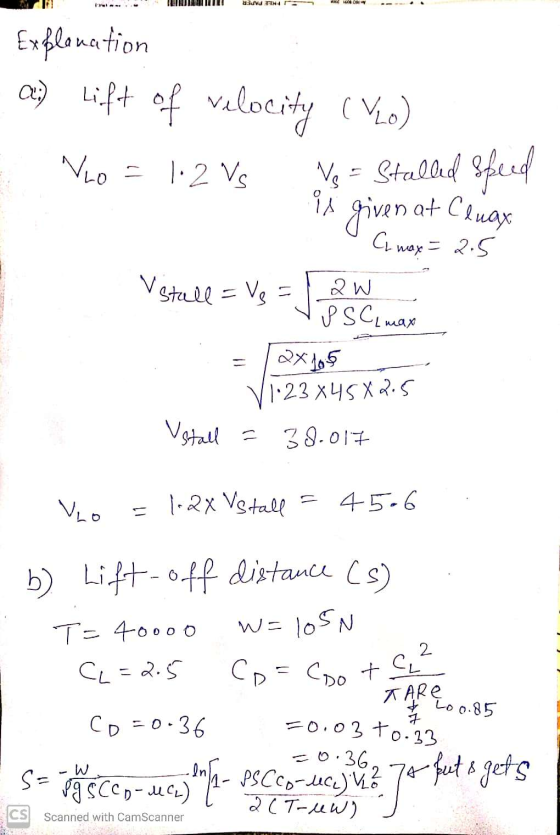
A Twin Engine Air craft has following Characters: Wing Area: 45 m² Gross Weight = 100000N...
Q7. Consider the twin-jet airplane described as follow: wing area = 47 m2, aspect ratio =...
 Q7. Consider the twin-jet airplane described as follow: wing area = 47 m2, aspect ratio = 6.5, Oswald efficiency factor = 0.87, weight = 103,047N, and zero-lift drag coefficient = 0.032. The airplane is equipped with two jet engines with 40,298 N of static thrust each at sea level. The thrust-specific fuel consumption is 1.0 N of fuel per newton of thrust per hour, the fuel capacity is 1900 gal, and the maximum gross weight is 136,960 N. Calculate the...
Consider a large jet airplane which has the following characteristics: Maximum gross weight = 130000 N...
 Consider a large jet airplane which has the following characteristics: Maximum gross weight = 130000 N General • Fuel weight = 50000 N Wing 2 Wing area = 50 m Wing aspect ratio (AR) = 6.5 Wing span efficiency factor (e) = 0.87 Aerodynamics . = MARE • Zero-lift drag coefficient = 0.032 Drag Cp = Cpo + kc where k = kı + kz kı = 0 and k3 Lift CLmax = 1.4 during flight Two turbojet engines. (thrust...
The figure shows a jet engine suspended beneath the wing of an airplane. The weight W...
 The figure shows a jet engine suspended beneath the wing of an airplane. The weight W of the engine is 13600 N and acts as shown in the figure. In flight the engine produces a thrust 7 of 61000 N that is parallel to the ground. The rotational axis in the figure is perpendicular to the plane of the paper. With respect to this axis, find the magnitude of the torque due to (a) the weight and (b) the thrust....
A business jet has a wing area of 88.3 square meters, an aspect ratio of 8.2,...
A business jet has a wing area of 88.3 square meters, an aspect ratio of 8.2, an Oswald efficiency factor of .89, a zero-lift drag coefficient of .026, a mass of 19,000 kg, and a maximum static thrust at sea level for each engine of 61,600 N (A) Calculate the maximum rate of climb at sea level. (B) Calculate the maximum rate of climb at an altitude of 13 km. (C) Estimate its absolute ceiling assuming the maximum rate of...
The large airplane has a span of 50 meters, an elliptic wing of aspect ratio 6,...
 The large airplane has a span of 50 meters, an elliptic wing of aspect ratio 6, a mass of 60,000 kg and is flying at sea level density (1.2 kg/m^3) at 100 m/s. Assume that it has a NACA 0009 (symmetric) airfoil, i. Calculate the actual lift coefficient for the wing ii. Calculate the geometric angle of attack. iii. What is the downwash angle? iv. What is the downwash velocity at the wing? v. What is the strength (circulation) of...
Question 5 (14 marks) The following are the characteristics of a single-engine light aircraft 9.8 m...
 Question 5 (14 marks) The following are the characteristics of a single-engine light aircraft 9.8 m Wing span Wing area 15.2 m2 Height of wing 1.20 m All up weight 19.2 kN Power plant: 150 kW (sea-level) Propeller efficiency: 85% Maximum lift coefficient: 1.32 Parasite drag coefficient: 0.022 Oswald's efficiency factor: 0.88 Using the above data calculate the: a. stalling speed in km/h, (39.53 m/s, 142.3 km/h) aspect ratio, induced drag coefficient and hence total drag at Lift-off Stalling Speed...
Ex.3 /35 A Cessna 172 has a cruise speed V-226 km/h and weight W-1,000Kg. The wing area is S-16mt...
 Ex.3 /35 A Cessna 172 has a cruise speed V-226 km/h and weight W-1,000Kg. The wing area is S-16mt with a wing span b-1lm Assuming the wing rectangular, what is the Reynolds number at an altitude z-1,000m. A model of this airplane, scaled by a factor of 2, is tested in a wind tunnel at sea level. What should be the velocity in the wind tunnel to have dynamics similarity (neglect Mach number effects). What will be the lift measured...
Consider a turbofan powered airplane with the following characteristics: Available thrust: 16 256 N at sea...
Consider a turbofan powered airplane with the following characteristics: Available thrust: 16 256 N at sea level/per engine. Weight: 88 251 N. Planform area: 29.24 m2 . Number of engines: 2 Span: 16.25 m Span efficiency factor: 0.81 Parasite drag coefficient: 0.02 Maximum lift coefficient: 2.0 Specific fuel consumption: 0.6/h How far will this airplane glide if the engines stop at 10 000 m altitude?
80 m 845 m2 7.53 Wing Span Wing Planform Area Wing Aspect Ratio Sweep angle at...
 80 m 845 m2 7.53 Wing Span Wing Planform Area Wing Aspect Ratio Sweep angle at quarter chord (0.25c) Taper ratio 33.5 0.3 A380 1500 m² Component Wetted Area Fuselage Wing 1700 m Horizontal tail Vertical tail Engines (4) 290 m² (each) 400 m² 280 m² Cruise Mach Number 0.85 Cruising Altitude 12.5 km Wing Loading 16500 N/m2) Temperature Geo potential Altitude above Sea Level -- (m) Acceleration of Gravity (m/s) Absolute Pressure -p- (104 N/m2) Density .p. (101 kg/m3)...
80 m 845 m2 7.53 Wing Span Wing Planform Area Wing Aspect Ratio Sweep angle at...
 80 m 845 m2 7.53 Wing Span Wing Planform Area Wing Aspect Ratio Sweep angle at quarter chord (0.25c) Taper ratio 33.5 0.3 A380 1500 m² Component Wetted Area Fuselage Wing 1700 m Horizontal tail Vertical tail Engines (4) 290 m² (each) 400 m² 280 m² Cruise Mach Number 0.85 Cruising Altitude 12.5 km Wing Loading 16500 N/m2) Temperature Geo potential Altitude above Sea Level -- (m) Acceleration of Gravity (m/s) Absolute Pressure -p- (104 N/m2) Density .p. (101 kg/m3)...
 Q7. Consider the twin-jet airplane described as follow: wing area = 47 m2, aspect ratio = 6.5, Oswald efficiency factor = 0.87, weight = 103,047N, and zero-lift drag coefficient = 0.032. The airplane is equipped with two jet engines with 40,298 N of static thrust each at sea level. The thrust-specific fuel consumption is 1.0 N of fuel per newton of thrust per hour, the fuel capacity is 1900 gal, and the maximum gross weight is 136,960 N. Calculate the...
 Consider a large jet airplane which has the following characteristics: Maximum gross weight = 130000 N General • Fuel weight = 50000 N Wing 2 Wing area = 50 m Wing aspect ratio (AR) = 6.5 Wing span efficiency factor (e) = 0.87 Aerodynamics . = MARE • Zero-lift drag coefficient = 0.032 Drag Cp = Cpo + kc where k = kı + kz kı = 0 and k3 Lift CLmax = 1.4 during flight Two turbojet engines. (thrust...
 The figure shows a jet engine suspended beneath the wing of an airplane. The weight W of the engine is 13600 N and acts as shown in the figure. In flight the engine produces a thrust 7 of 61000 N that is parallel to the ground. The rotational axis in the figure is perpendicular to the plane of the paper. With respect to this axis, find the magnitude of the torque due to (a) the weight and (b) the thrust....
 The large airplane has a span of 50 meters, an elliptic wing of aspect ratio 6, a mass of 60,000 kg and is flying at sea level density (1.2 kg/m^3) at 100 m/s. Assume that it has a NACA 0009 (symmetric) airfoil, i. Calculate the actual lift coefficient for the wing ii. Calculate the geometric angle of attack. iii. What is the downwash angle? iv. What is the downwash velocity at the wing? v. What is the strength (circulation) of...
 Question 5 (14 marks) The following are the characteristics of a single-engine light aircraft 9.8 m Wing span Wing area 15.2 m2 Height of wing 1.20 m All up weight 19.2 kN Power plant: 150 kW (sea-level) Propeller efficiency: 85% Maximum lift coefficient: 1.32 Parasite drag coefficient: 0.022 Oswald's efficiency factor: 0.88 Using the above data calculate the: a. stalling speed in km/h, (39.53 m/s, 142.3 km/h) aspect ratio, induced drag coefficient and hence total drag at Lift-off Stalling Speed...
 Ex.3 /35 A Cessna 172 has a cruise speed V-226 km/h and weight W-1,000Kg. The wing area is S-16mt with a wing span b-1lm Assuming the wing rectangular, what is the Reynolds number at an altitude z-1,000m. A model of this airplane, scaled by a factor of 2, is tested in a wind tunnel at sea level. What should be the velocity in the wind tunnel to have dynamics similarity (neglect Mach number effects). What will be the lift measured...
 80 m 845 m2 7.53 Wing Span Wing Planform Area Wing Aspect Ratio Sweep angle at quarter chord (0.25c) Taper ratio 33.5 0.3 A380 1500 m² Component Wetted Area Fuselage Wing 1700 m Horizontal tail Vertical tail Engines (4) 290 m² (each) 400 m² 280 m² Cruise Mach Number 0.85 Cruising Altitude 12.5 km Wing Loading 16500 N/m2) Temperature Geo potential Altitude above Sea Level -- (m) Acceleration of Gravity (m/s) Absolute Pressure -p- (104 N/m2) Density .p. (101 kg/m3)...
 80 m 845 m2 7.53 Wing Span Wing Planform Area Wing Aspect Ratio Sweep angle at quarter chord (0.25c) Taper ratio 33.5 0.3 A380 1500 m² Component Wetted Area Fuselage Wing 1700 m Horizontal tail Vertical tail Engines (4) 290 m² (each) 400 m² 280 m² Cruise Mach Number 0.85 Cruising Altitude 12.5 km Wing Loading 16500 N/m2) Temperature Geo potential Altitude above Sea Level -- (m) Acceleration of Gravity (m/s) Absolute Pressure -p- (104 N/m2) Density .p. (101 kg/m3)...
Most questions answered within 3 hours.
-
Where is the error in this code sequence?
String s1 = "Hello";
String s2 = "ello";...
asked 10 months ago -
Financial data for Joel de Paris, Inc., for last year
follow:
Joel de Paris, Inc.
Balance...
asked 10 months ago -
Consider this reaction:
Al2(SO4)3 (aq)+ BaCl3
(aq) Al2Cl6 (aq)- +
3BaSO4(s) . What is the...
asked 10 months ago -
Suppose that Savneet is considering increasing her
recent random sample from 20 car rentals to 40...
asked 10 months ago -
Trucks arrive at an unloading terminal at an average rate of 120
per hour.
Trucks arrive...
asked 10 months ago -
Why are methanol and ethanol completely soluble in water while
octanol is not very little soluble....
asked 10 months ago -
A facilities manager at a university reads in a research report
that the mean amount of...
asked 10 months ago -
When the CuSO4 is rehydrated by adding water to the anhydrous
compound, is this an endothermic...
asked 10 months ago -
A ray of sunlight is passing from diamond into crown glass; the
angle of incidence is...
asked 10 months ago -
A block of mass 0.249 kg is placed on top of a light, vertical
spring of...
asked 10 months ago -
how do the kidneys compensate in the presences of acidosis
a) trigger hyperventilate
b) reserve acid...
asked 10 months ago -
Question 501 pts
The rental rate of capital to the firm increases. Which of the
following...
asked 10 months ago