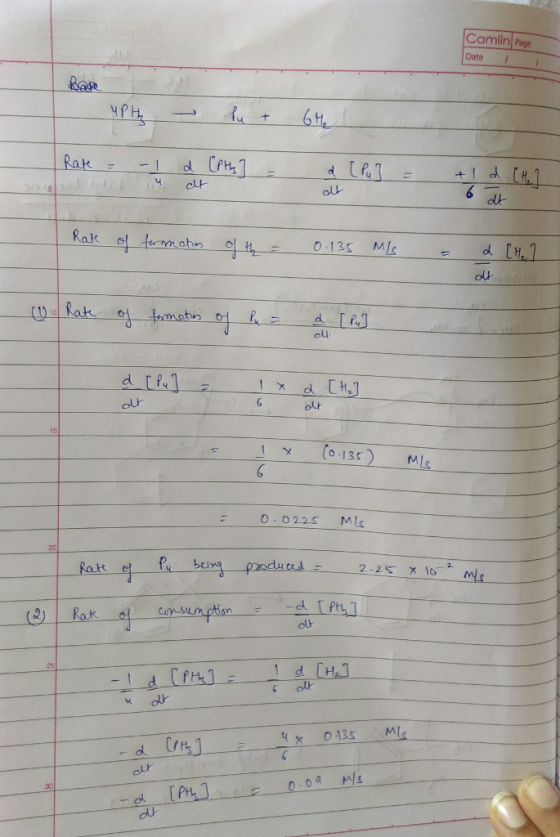
Consider the reaction 4PH3(g) → P4(g) + 6H2(g) At a particular point during the reaction, molecular...
Consider the reaction
4PH3(g)
→
P4(g)
+
6H2(g)
At a particular point during the reaction, molecular
hydrogen is being formed at the rate of 0.135
M/s.
(a) At what rate is P4 being
produced?
M/s
(b) At what rate is PH3 being
consumed?
Homework Answers
Add Answer to:
Consider the reaction
4PH3(g)
→
P4(g)
+
6H2(g)
At a particular point during the reaction, molecular...
Consider the reaction 4PH3(g) →P4(g) + 6H2(g) At a particular point during the reaction, molecular hydrogen...
Consider the reaction 4PH3(g) →P4(g) + 6H2(g) At a particular point during the reaction, molecular hydrogen is being formed at the rate of 0.173 M/s. (a) At what rate is P4 being produced? (answer in M/s) (b) At what rate is PH3 being consumed? (answer in M/s)
Be sure to answer all parts. Consider the reaction 4PH3(g) →P4(g) + 6H2(g) At a particular...
Be sure to answer all parts. Consider the reaction 4PH3(g) →P4(g) + 6H2(g) At a particular point during the reaction, molecular hydrogen is being formed at the rate of 0.143 M/s. (a) At what rate is P4 being produced? M/s (b) At what rate is PH3 being consumed? M/s
2) Consider the reaction 4PH3(g) → P4(g) + 6H2(g) Suppose that, at a particular moment during...
2) Consider the reaction 4PH3(g) → P4(g) + 6H2(g) Suppose that, at a particular moment during the reaction, molecular hydrogen is being formed at rate of 0.227 M/s. (a) At what rate is P4 changing? ______ M/s (b) At what rate is PH3 changing? _______ M/sF 4. Consider the reaction: N2(g) + 3H2(g) → 2NH3(g) Suppose that a particular moment during the reaction, molecular hydrogen is reacting at a rate of −0.0220 M/s. At what rate is ammonia being formed?...
2. Consider the reaction 4PH3(g) → P4(g) + 6H2(g) Suppose that, at a particular moment during...
2. Consider the reaction 4PH3(g) → P4(g) + 6H2(g) Suppose that, at a particular moment during the reaction, molecular hydrogen is being formed at rate of 0.234 M/s. (a) At what rate is P4 changing? _______ M/s (b) At what rate is PH3 changing? ________ M/sF
Be sure to answer all parts. Consider the reaction 4PH3(g) → P4(g) + 6H2(g) Suppose that,...
Be sure to answer all parts. Consider the reaction 4PH3(g) → P4(g) + 6H2(g) Suppose that, at a particular moment during the reaction, molecular hydrogen is being formed at rate of 0.226 M/s. (a) At what rate is P4 changing? M/s (b) At what rate is PH3 changing? M/sF
Consider the reaction 4PH3(g) ---> P4(g) + 6H2(g) If in a certain experiment, over a specific...
Consider the reaction 4PH3(g) ---> P4(g) + 6H2(g) If in a certain experiment, over a specific time period, 0.0048 mole of PH3 is consumed in a 2.0 L container per second of a reaction. What is the rate of reaction?
the decomposition of phosphine forms phosphorus and hydrogen in the following reaction: 4PH3(g)--> P4(g)+6H2(g) A. express...
the decomposition of phosphine forms phosphorus and hydrogen in the following reaction: 4PH3(g)--> P4(g)+6H2(g) A. express the rate with respect to each of the reactants and oroducts. B. if the instantaneous rate with respect to PH3 is 0.34 M s^-1, what is the instantaneous rate of the reaction? use rate laws not calculus please.
For the reaction shown here 4PH3(g) —> 6H2(g) + P4(g) the equilibrium comcentrations were found to...
For the reaction shown here 4PH3(g) —> 6H2(g) + P4(g) the equilibrium comcentrations were found to be [PH3] = 0.250 [H2] = 0.600 [P4] = 0.750 What is the equilibrium comstant for this reactiln?
5. Phosphine (PH3) decomposes into phosphorus and molecular hydrogen: 4PH3(9) - P4(9) + 6H2(9) Experiments show...
 5. Phosphine (PH3) decomposes into phosphorus and molecular hydrogen: 4PH3(9) - P4(9) + 6H2(9) Experiments show that this is a first-order reaction, with a rate constant of 0.0173 s at 650°C. Identify each of the following statements about this reaction as true or false. (Use the drop-down menu and select "True" or "False" for each. You must get all 4 correct.) The rate constant would be smaller than 0.0173 sat 550°C. The reaction PH3 - PH2 + H might be...
The reaction: P4 (s) + 6H2(g) +4PH3 (g) tells us that 7.0 moles of H2reacts with...
 The reaction: P4 (s) + 6H2(g) +4PH3 (g) tells us that 7.0 moles of H2reacts with how many moles of Phosphorous, P4? 1.00 3.00 1.17 6.00 7.00
 5. Phosphine (PH3) decomposes into phosphorus and molecular hydrogen: 4PH3(9) - P4(9) + 6H2(9) Experiments show that this is a first-order reaction, with a rate constant of 0.0173 s at 650°C. Identify each of the following statements about this reaction as true or false. (Use the drop-down menu and select "True" or "False" for each. You must get all 4 correct.) The rate constant would be smaller than 0.0173 sat 550°C. The reaction PH3 - PH2 + H might be...
 The reaction: P4 (s) + 6H2(g) +4PH3 (g) tells us that 7.0 moles of H2reacts with how many moles of Phosphorous, P4? 1.00 3.00 1.17 6.00 7.00
Most questions answered within 3 hours.
-
Where is the error in this code sequence?
String s1 = "Hello";
String s2 = "ello";...
asked 10 months ago -
Financial data for Joel de Paris, Inc., for last year
follow:
Joel de Paris, Inc.
Balance...
asked 10 months ago -
Consider this reaction:
Al2(SO4)3 (aq)+ BaCl3
(aq) Al2Cl6 (aq)- +
3BaSO4(s) . What is the...
asked 10 months ago -
Suppose that Savneet is considering increasing her
recent random sample from 20 car rentals to 40...
asked 10 months ago -
Trucks arrive at an unloading terminal at an average rate of 120
per hour.
Trucks arrive...
asked 10 months ago -
Why are methanol and ethanol completely soluble in water while
octanol is not very little soluble....
asked 10 months ago -
A facilities manager at a university reads in a research report
that the mean amount of...
asked 10 months ago -
When the CuSO4 is rehydrated by adding water to the anhydrous
compound, is this an endothermic...
asked 10 months ago -
A ray of sunlight is passing from diamond into crown glass; the
angle of incidence is...
asked 10 months ago -
A block of mass 0.249 kg is placed on top of a light, vertical
spring of...
asked 10 months ago -
how do the kidneys compensate in the presences of acidosis
a) trigger hyperventilate
b) reserve acid...
asked 10 months ago -
Question 501 pts
The rental rate of capital to the firm increases. Which of the
following...
asked 10 months ago