
Homework Answers
ANSWER :-
#13:-
Different greenhouse gases last in the atmosphere for different
duration, and they also absorb different amounts of heat.
The “global warming potential” of a GHG indicates the amount of
warming a gas causes over a given period of time (normally 100
years).
GWP is an index, with CO2 having the index value of 1, and the GWP
for all other GHGs is the number of times more warming they cause
compared to CO2. Example:- 1kg of methane causes 25 times more
warming over a 100 year period compared to 1kg of CO2, and so
methane as a GWP of 25.
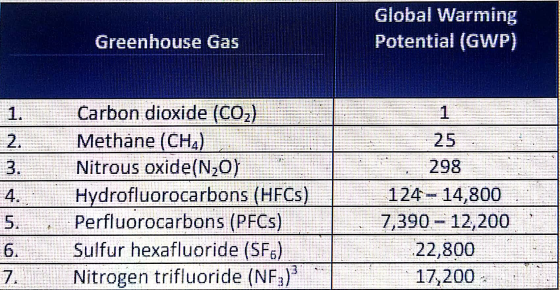
From the table given above
GWP of methane - 25
GWP of N2O - 298
64 kg of methane = 64 x 25 = 1600 kg of CO2
800g of Nitrous oxide = 0.8 x 298 = 238.4 kg of CO2
So, total CO2 emission = 1600 + 238.4 = 1838.4 kg
#14:-
It is not scientifically possible to assign individual weather
events to the current climate change, however, it can be
statistically proven that global warming will increase the
probability of extreme weather events.
The direct consequences of man-made climate
change include:
- rising maximum temperatures
- rising minimum temperatures
- rising sea levels
- higher ocean temperatures
- an increase in heavy precipitation (heavy rain and hail)
- shrinking glaciers
- thawing permafrost
The indirect consequences of climate change, which directly affect us humans and our environment, include:
- an increase in hunger and water crises, especially in developing countries
- health risks through rising air temperatures and heatwaves
- economic implications of dealing with secondary damage related to climate change
- increasing spread of pests and pathogens
- loss of biodiversity due to limited adaptability and adaptability speed of flora and fauna
- ocean acidification due to increased HCO3 concentrations in the water as a consequence of increased CO₂ concentrations
the need for adaptation in all areas (e.g. agriculture,
forestry, energy, infrastructure, tourism, etc.)
As the global climate is a highly interconnected system that is
influenced by many different factors, the consequences usually
result in positive or negative feedback effects. This refers to
developments that are self-enhancing due to the occurrence of
certain conditions.
A common example is the ice-albedo feedback, which refers to the
melting of the polar caps. According to this, extensive ice
surfaces have a cooling effect on the global climate, as a high
proportion of radiation is reflected. As a result of the
global rise in the average temperature, however, these ice
surfaces begin to melt, the ice surfaces shrink and the amount of
reflected radiation is reduced. At the same time, the area of land
or ocean that has a significantly lower albedo will increase,
reflecting less radiation and thus intensifying the actual cause of
glacier melt.
Furthermore, scientists can calculate the so-called tipping points
of individual subsystems of the global climate. The higher
the global rise in temperature, the more the climate system is
affected, so that at a certain point, despite significant
efforts, a reversal in the process is no longer possible. Where
exactly these tipping points can be found, however, is currently
still unclear and can only be calculated with a great degree of
uncertainty. Such tipping points are expected for the melting of
the polar caps and for the stability of important ocean
currents
Global warming is an aspect of climate change, referring to
the long-term rise of the planet's temperatures. It is caused by
increased concentrations of greenhouse gases in the atmosphere,
mainly from human activities such as burning fossil fuels, and
farming.
So all of the above can be reasons of climate change in the long
term.
#15 :-
The Eight Millennium Development Goals are:
- eradication of extreme poverty and hunger.
- achieving universal primary education.
- promoting gender equality and empower women.
- reducing child mortality.
- improving maternal health.
- to combat HIV/AIDS, malaria, and other diseases.
- ensuring environmental sustainability.
-
developing a global partnership for development.
#16:-
3 measures used for biomass production are :-
biomass produced, energy stored and carbon stored.
Biomass is the plant material derived from the reaction between CO2 in the air, water and sunlight, via photosynthesis, to produce carbohydrates that form the building blocks of biomass. Typically photosynthesis converts less than 1% of the available sunlight to stored, chemical energy. The solar energy driving photosynthesis is stored in the chemical bonds of the structural components of biomass. If biomass is processed efficiently, either chemically or biologically, by extracting the energy stored in the chemical bonds and the subsequent ‘energy’ product combined with oxygen, the carbon is oxidised to produce CO2 and water. The process is cyclical, as the CO2 is then available to produce new biomass.
Add Answer to:
13 # A rice puddy produces 64.0kg methane and Goog of Nro. What is the total...
QUESTION 3 The textbook discusses 3 types of environmental degradation affecting the environment. Below, please match...
 QUESTION 3 The textbook discusses 3 types of environmental degradation affecting the environment. Below, please match each type of degradation discussed to the type of consequence suggested in the textbook. (Answer based on what the book says, not based on your personal opinion.) Air pollution A., is killinig humans 8,..isklin the earth Land poliution Water pollution address chiticar Watel Air Pollution Air pollution occurs when the release of materials to the atmosphere cannot be safelv disposed of by natural processes....
 QUESTION 3 The textbook discusses 3 types of environmental degradation affecting the environment. Below, please match each type of degradation discussed to the type of consequence suggested in the textbook. (Answer based on what the book says, not based on your personal opinion.) Air pollution A., is killinig humans 8,..isklin the earth Land poliution Water pollution address chiticar Watel Air Pollution Air pollution occurs when the release of materials to the atmosphere cannot be safelv disposed of by natural processes....
Most questions answered within 3 hours.
-
Where is the error in this code sequence?
String s1 = "Hello";
String s2 = "ello";...
asked 11 months ago -
Financial data for Joel de Paris, Inc., for last year
follow:
Joel de Paris, Inc.
Balance...
asked 11 months ago -
Consider this reaction:
Al2(SO4)3 (aq)+ BaCl3
(aq) Al2Cl6 (aq)- +
3BaSO4(s) . What is the...
asked 11 months ago -
Suppose that Savneet is considering increasing her
recent random sample from 20 car rentals to 40...
asked 11 months ago -
Trucks arrive at an unloading terminal at an average rate of 120
per hour.
Trucks arrive...
asked 11 months ago -
Why are methanol and ethanol completely soluble in water while
octanol is not very little soluble....
asked 11 months ago -
A facilities manager at a university reads in a research report
that the mean amount of...
asked 11 months ago -
When the CuSO4 is rehydrated by adding water to the anhydrous
compound, is this an endothermic...
asked 11 months ago -
A ray of sunlight is passing from diamond into crown glass; the
angle of incidence is...
asked 11 months ago -
A block of mass 0.249 kg is placed on top of a light, vertical
spring of...
asked 11 months ago -
how do the kidneys compensate in the presences of acidosis
a) trigger hyperventilate
b) reserve acid...
asked 11 months ago -
Question 501 pts
The rental rate of capital to the firm increases. Which of the
following...
asked 11 months ago