

Homework Answers


Add Answer to:
7.9 Using the second organization of the symbol table described in the text (a stack of...
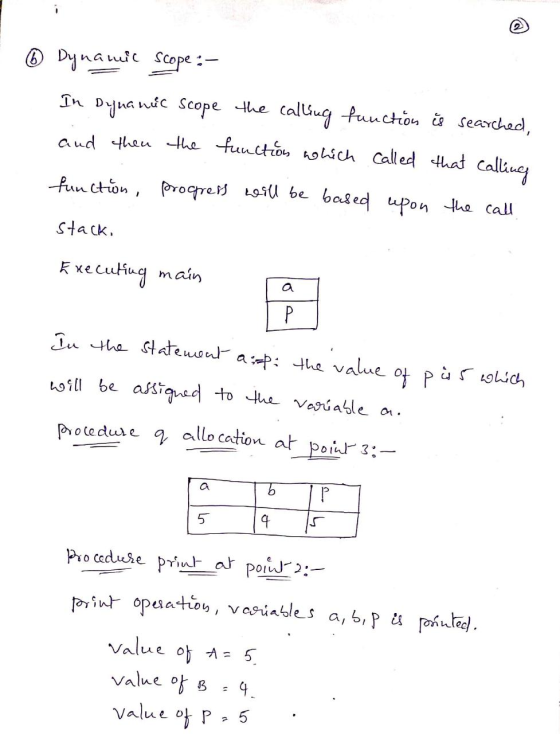
Assignment: Show the symbol table for the following C programs at the printf lines (a) using lexi...
Assignment: Show the symbol table for the following C programs at the printf lines (a) using lexical scope and (b) using dynamic scope. What does the program print using each kind of scope rule? Program 1: const int b = 10; int foo() { int a = b + 10; return a; } int bar() { int b = 4; return foo(); } int main() { printf(“foo = %d\n”,foo()); printf(“bar = %d\n”,bar()); return 0; } Program 2: int a; void...
Given the following Ada program: procedure Main is X, Y: Integer; procedure Sub1 is Y, Z:...
 Given the following Ada program: procedure Main is X, Y: Integer; procedure Sub1 is Y, Z: Integer; begin -- of Sub1 point 1 Sub2; end; -- of Sub1 procedure Sub2 is X: Integer; procedure sub3 (B: Integer) is W: Integer; begin -- of Sub3 point 2 end; -- of Sub3 begin -- of Sub2 point 3 Sub3 (X); end; -- of Sub2 begin -- of Main point 4 Sub1; end; -- of Main For each of the four marked points,...
Will rate, thank you. Consider the following pseudocode, assuming nested subroutines, lexical scope, and that local...
 Will rate, thank you.
Consider the following pseudocode, assuming nested subroutines, lexical scope, and that local variables (including formal parameters) are stored in the stack. procedure main() g: integer procedure B(a: integer) x: integer procedure A(n: integer) g := n procedure R(m: integer) write_integer (x) x := x/2 -- integer division if x > 1 R(m + 1) else A (m) --body of B x := a * a R(1) --body of main B(3) write_integer(g) (a) What does this program...
Will rate, thank you.
Consider the following pseudocode, assuming nested subroutines, lexical scope, and that local variables (including formal parameters) are stored in the stack. procedure main() g: integer procedure B(a: integer) x: integer procedure A(n: integer) g := n procedure R(m: integer) write_integer (x) x := x/2 -- integer division if x > 1 R(m + 1) else A (m) --body of B x := a * a R(1) --body of main B(3) write_integer(g) (a) What does this program...
C++ Carefully review Program 19-2 in your textbook, MathStack. This is a static stack, meaning that the size of the stack is set at the beginning of the program (see line 11): MathStack stack(5). I wo...
 C++
Carefully review Program 19-2 in your textbook,
MathStack. This is a static stack, meaning that the size
of the stack is set at the beginning of the program (see line 11):
MathStack stack(5).
I would like you to modify this program as follows:
1. Implement it as a dynamic stack (do not use a static
stack as it is designed in the book). Use a linked list to
implement this. There's code in the book.
2. Add functionality for...
C++
Carefully review Program 19-2 in your textbook,
MathStack. This is a static stack, meaning that the size
of the stack is set at the beginning of the program (see line 11):
MathStack stack(5).
I would like you to modify this program as follows:
1. Implement it as a dynamic stack (do not use a static
stack as it is designed in the book). Use a linked list to
implement this. There's code in the book.
2. Add functionality for...
**TStack.py below** # CMPT 145: Linear ADTs # Defines the Stack ADT # # A stack (also called a pushdown or LIFO stack)...
 **TStack.py below**
# CMPT 145: Linear ADTs
# Defines the Stack ADT
#
# A stack (also called a pushdown or LIFO stack) is a compound
# data structure in which the data values are ordered according
# to the LIFO (last-in first-out) protocol.
#
# Implementation:
# This implementation was designed to point out when ADT operations are
# used incorrectly.
def create():
"""
Purpose
creates an empty stack
Return
an empty stack
"""
return '__Stack__',list()
def is_empty(stack):
"""...
**TStack.py below**
# CMPT 145: Linear ADTs
# Defines the Stack ADT
#
# A stack (also called a pushdown or LIFO stack) is a compound
# data structure in which the data values are ordered according
# to the LIFO (last-in first-out) protocol.
#
# Implementation:
# This implementation was designed to point out when ADT operations are
# used incorrectly.
def create():
"""
Purpose
creates an empty stack
Return
an empty stack
"""
return '__Stack__',list()
def is_empty(stack):
"""...
Derive a class called Stack from the linked list described in Assignment 2 (list of Dates)....
Derive a class called Stack from the linked list described in Assignment 2 (list of Dates). This means the Stack class will inherit all the properties (data and functions) of the linked list. But, since a stack only allows pushing and popping at the front of the list only, you will need to prevent the operations at the back. To do this, derive the Stack class in such a way that the base class (LinkedList) functions become private in the...
The first project involves modifying the attached lexical analyzer and the compilation listing ge...
The first project involves modifying the attached lexical analyzer and the compilation listing generator code. You need to make the following modifications to the lexical analyzer, scanner.l: 1. A second type of comment should be added that begins with // and ends with the end of line. As with the existing comment, no token should be returned. 2. The definition for the identifiers should be modified so that underscores can be included, however, consecutive underscores, leading and trailing underscores should...
Purpose This assignment is an exercise in implementing the Stack ADT using a dynamically-allocated array, as...
Purpose This assignment is an exercise in implementing the Stack ADT using a dynamically-allocated array, as well as techniques for managing dynamically-allocated storage in C++. Assignment In this assignment, you will write a class called Stack that will encapsulate a dynamically-allocated array of elements of a generic data type. A driver program is provided for this assignment to test your implementation. You don't have to write the tests. Program You will need to write a single template class for this...
Stacks and Java 1. Using Java design and implement a stack on an array. Implement the...
Stacks and Java 1. Using Java design and implement a stack on an array. Implement the following operations: push, pop, top, size, isEmpty. Make sure that your program checks whether the stack is full in the push operation, and whether the stack is empty in the pop operation. None of the built-in classes/methods/functions of Java can be used and must be user implemented. Practical application 1: Arithmetic operations. (a) Design an algorithm that takes a string, which represents an arithmetic...
Using Python, Can someone please assist in the following: These are the hints: Summary This week's lab is to create a simple multiplication table using nested loops and if statements. Prompt the...
 Using Python, Can someone please assist in the following:
These are the hints:
Summary This week's lab is to create a simple multiplication table using nested loops and if statements. Prompt the user for the size of the multiplication table (from 2x2 to 10x10). Use a validation loop to display a warning if the number is less than 2 or greater than 10 and prompt the user to enter the data again until they enter a valid number Put a...
Using Python, Can someone please assist in the following:
These are the hints:
Summary This week's lab is to create a simple multiplication table using nested loops and if statements. Prompt the user for the size of the multiplication table (from 2x2 to 10x10). Use a validation loop to display a warning if the number is less than 2 or greater than 10 and prompt the user to enter the data again until they enter a valid number Put a...
 Given the following Ada program: procedure Main is X, Y: Integer; procedure Sub1 is Y, Z: Integer; begin -- of Sub1 point 1 Sub2; end; -- of Sub1 procedure Sub2 is X: Integer; procedure sub3 (B: Integer) is W: Integer; begin -- of Sub3 point 2 end; -- of Sub3 begin -- of Sub2 point 3 Sub3 (X); end; -- of Sub2 begin -- of Main point 4 Sub1; end; -- of Main For each of the four marked points,...
 Will rate, thank you.
Consider the following pseudocode, assuming nested subroutines, lexical scope, and that local variables (including formal parameters) are stored in the stack. procedure main() g: integer procedure B(a: integer) x: integer procedure A(n: integer) g := n procedure R(m: integer) write_integer (x) x := x/2 -- integer division if x > 1 R(m + 1) else A (m) --body of B x := a * a R(1) --body of main B(3) write_integer(g) (a) What does this program...
Will rate, thank you.
Consider the following pseudocode, assuming nested subroutines, lexical scope, and that local variables (including formal parameters) are stored in the stack. procedure main() g: integer procedure B(a: integer) x: integer procedure A(n: integer) g := n procedure R(m: integer) write_integer (x) x := x/2 -- integer division if x > 1 R(m + 1) else A (m) --body of B x := a * a R(1) --body of main B(3) write_integer(g) (a) What does this program...
 C++
Carefully review Program 19-2 in your textbook,
MathStack. This is a static stack, meaning that the size
of the stack is set at the beginning of the program (see line 11):
MathStack stack(5).
I would like you to modify this program as follows:
1. Implement it as a dynamic stack (do not use a static
stack as it is designed in the book). Use a linked list to
implement this. There's code in the book.
2. Add functionality for...
C++
Carefully review Program 19-2 in your textbook,
MathStack. This is a static stack, meaning that the size
of the stack is set at the beginning of the program (see line 11):
MathStack stack(5).
I would like you to modify this program as follows:
1. Implement it as a dynamic stack (do not use a static
stack as it is designed in the book). Use a linked list to
implement this. There's code in the book.
2. Add functionality for...
 **TStack.py below**
# CMPT 145: Linear ADTs
# Defines the Stack ADT
#
# A stack (also called a pushdown or LIFO stack) is a compound
# data structure in which the data values are ordered according
# to the LIFO (last-in first-out) protocol.
#
# Implementation:
# This implementation was designed to point out when ADT operations are
# used incorrectly.
def create():
"""
Purpose
creates an empty stack
Return
an empty stack
"""
return '__Stack__',list()
def is_empty(stack):
"""...
**TStack.py below**
# CMPT 145: Linear ADTs
# Defines the Stack ADT
#
# A stack (also called a pushdown or LIFO stack) is a compound
# data structure in which the data values are ordered according
# to the LIFO (last-in first-out) protocol.
#
# Implementation:
# This implementation was designed to point out when ADT operations are
# used incorrectly.
def create():
"""
Purpose
creates an empty stack
Return
an empty stack
"""
return '__Stack__',list()
def is_empty(stack):
"""...
 Using Python, Can someone please assist in the following:
These are the hints:
Summary This week's lab is to create a simple multiplication table using nested loops and if statements. Prompt the user for the size of the multiplication table (from 2x2 to 10x10). Use a validation loop to display a warning if the number is less than 2 or greater than 10 and prompt the user to enter the data again until they enter a valid number Put a...
Using Python, Can someone please assist in the following:
These are the hints:
Summary This week's lab is to create a simple multiplication table using nested loops and if statements. Prompt the user for the size of the multiplication table (from 2x2 to 10x10). Use a validation loop to display a warning if the number is less than 2 or greater than 10 and prompt the user to enter the data again until they enter a valid number Put a...
Most questions answered within 3 hours.
-
Where is the error in this code sequence?
String s1 = "Hello";
String s2 = "ello";...
asked 10 months ago -
Financial data for Joel de Paris, Inc., for last year
follow:
Joel de Paris, Inc.
Balance...
asked 10 months ago -
Consider this reaction:
Al2(SO4)3 (aq)+ BaCl3
(aq) Al2Cl6 (aq)- +
3BaSO4(s) . What is the...
asked 10 months ago -
Suppose that Savneet is considering increasing her
recent random sample from 20 car rentals to 40...
asked 10 months ago -
Trucks arrive at an unloading terminal at an average rate of 120
per hour.
Trucks arrive...
asked 10 months ago -
Why are methanol and ethanol completely soluble in water while
octanol is not very little soluble....
asked 10 months ago -
A facilities manager at a university reads in a research report
that the mean amount of...
asked 10 months ago -
When the CuSO4 is rehydrated by adding water to the anhydrous
compound, is this an endothermic...
asked 10 months ago -
A ray of sunlight is passing from diamond into crown glass; the
angle of incidence is...
asked 10 months ago -
A block of mass 0.249 kg is placed on top of a light, vertical
spring of...
asked 10 months ago -
how do the kidneys compensate in the presences of acidosis
a) trigger hyperventilate
b) reserve acid...
asked 10 months ago -
Question 501 pts
The rental rate of capital to the firm increases. Which of the
following...
asked 10 months ago