

Homework Answers
Question 9:
Response A is explained below: The economy will self-correct and the negative out-put gap from those shocks will disappear eventually, however long it may take.
This response is based on the classical view, which assumes economy to be self-correcting. According to classical economist, the economy is self-regulating which means it has the capability to achieve the natural level of GDP, at which all the resources in the economy are fully employed. The self-regulating mechanism is explained below:
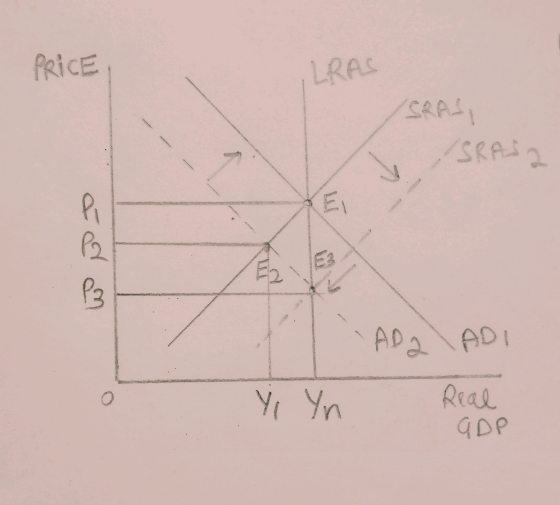
Refer to the below figure: X-axis shows the real GDP; Y-axis shows the price level. Initially the economy is at its long-run equilibrium at point E1, where the vertical long-run aggregate supply curve (LRAS), short-run aggregate supply curve (SRAS1) and the initial demand curve (AD1) intersect each other. Here, the equilibrium level of Real GDP is equal the full employment level of output given as Yn and the equilibrium price level is P1.
If rumors are to be believed, then a fall in consumer sentiments caused due to trade wars and a downfall in the financial market would negatively affect the aggregate spending in the economy. Lower consumer confidence, higher savings and lower investment spending would lead to a fall in the aggregate demand. This would shift the aggregate demand curve leftwards from AD1 to AD2. The economy would move to short-run equilibrium at point E2 where prices will fall from P1 to P2. In response to lower prices and lower demand, the firms would have to cut down production in order to avoid further losses. This would induce firms to lay-off employees taht would cause unemployment rates to rise. The aggregate output would fall below the potential level to Y1 which would create a short-run recessionary gap equivalent to “Y1 – Yn”
Unlike in the short-run, where wages and resource price are rigid due to wage contracts, in the long run all prices become flexible. With a fall in price level, labor wages and other input prices experience a downward trend. Due to low cost of production, firms would respond by employing more labor and increasing production levels. This causes the short-run aggregate supply curve to shift rightwards from SRAS1 to SRAS2. The short-run aggregate supply curve keeps on shifting until it intersects both the aggregate demand curve and the long-run aggregate supply curve. Thus, with the self-correcting nature of the economy, it moves to the new long-run equilibrium at point E3, where LRAS, AD2 and SRAS2 intersect. Here :
o Real GDP stabilizes back to potential level Yn which clsoes negative out-put gap
o Employment rises and Unemployment rate equalizes to natural rate of unemployment
o Price level falls further to P3.
Add Answer to:
Question 9 (13.5 points) You've taken a job as a chief macroeconomic advisor in a $100...
Here is major macro economic indicators of the economy from 2009 to 2016. 2009 2016 4.3%...
 Here is major macro economic indicators of the economy from 2009 to 2016. 2009 2016 4.3% 0.2% Real GDP growth rate Unemployment rate inflation Tax revenues (% of GDP) National Debt to GDP ratio 10% 1.2% 19% 127% 23% -0.8% 27% 180% Government spending over that past decade has remained stable around 20% of GDP. Which of the following policies do you think is best for reversing the current situation? Consider the implications on economic activities of all choices and...
Here is major macro economic indicators of the economy from 2009 to 2016. 2009 2016 43%...
 Here is major macro economic indicators of the economy from 2009 to 2016. 2009 2016 43% -0.2% Real GDP growth rate Unemployment rate inflation Tax revenues (% of GDP) National Debt to GDP ratio 10% 1.2% 19% 127% 23% -0.8% 27% 180% Government spending over that past decade has remained stable around 20% of GDP. Which of the following policies do you think is best for reversing the current situation? Consider the implications on economic activities of all choices and...
During the Great Depression, real GDP decreased, unemployment rose, and the inflation rate was negative. Which...
During the Great Depression, real GDP decreased, unemployment rose, and the inflation rate was negative. Which would have been the appropriate federal government policy combination to improve economic performance? a.) increase government spending, decrease taxes, decrease the quantity of money b.) increase government spending, decrease taxes, increase the quantity of money c.) decrease government spending, increase taxes, decrease the quantity of money d.) keep government spending and taxes stable, increase the quantity of money
Suppose as the chief economic advisor, the minister of finance calls you to his office and...
Suppose as the chief economic advisor, the minister of finance calls you to his office and says the following " Unemployment is too high, we need to lower it by increasing both output and income. Right now the equilibrium level of income /output is $900 billion dollars, but perhaps an acceptable unemployment rate could be achieved if aggregate output increase to $1100. billion. Note however that the MPC is .75 and taxes must remain at the present level. So adjusting...
connect Question 10 of 19 10.00 points Everything else equal, which of the following will have...
 connect Question 10 of 19 10.00 points Everything else equal, which of the following will have a bigger effect on aggregate demand and GDP $100 million reduction in taxes or a $100 million increase in government spending? The increase in gove spending which OOP and income direct we hav e t he decrease in taxes, which must go through consumption to alect GOP The increase in government spending which has shorter lags will have a bigger effect than the decrease...
Inflationary pressure in the AS-AD model can be shown as a leftward shift of the AD...
Inflationary pressure in the AS-AD model can be shown as a leftward shift of the AD curve when the economy is already producing at its potential GDP. supply shock that shifts the AS to the right. rightward shift of the AD curve when the economy is already producing at its potential GDP. Typically, if consumer and business confidence is high then ________ and if consumer and business confidence is low then ________. AD shifts to the left; AD shifts to...
1. In the beginning of 2017, the U.S. government predicted that economic growth would rise by...
1. In the beginning of 2017, the U.S. government predicted that economic growth would rise by 2019 and that the government's deficit would also increase. The government, therefore, was predicting that in 2019 the cyclical deficit would _______ and the structural deficit would _______. A. increase; increase B. decrease; increase C. increase; decrease D. decrease; decrease E. decrease; unchanged 2. Denmark's government budget was in surplus in 2014, and in deficit in the following year, 2015. We can conclude the...
An increase in aggregate demand (AD) can cause
Question 6 An increase in aggregate demand (AD) can cause an increase in cyclical unemployment. a recession in the economy. an expansion in the economy. Question 9 Which of the following would cause a negative demand shock (shift to the left) in aggregate demand? decreased availability of business capital increased government spending production costs falling Question 10For aggregate demand and aggregate supply to be an economic model, the equilibrium aggregate price level and equilibrium aggregate real GDP should only consider long run curves. be considered in individual markets. intersect.
ce Level Long Run Aegregate Supply 110 LRAS 1 105 100 95 13 5 14.5 15.5...
 ce Level Long Run Aegregate Supply 110 LRAS 1 105 100 95 13 5 14.5 15.5 165 Real GDP or Output amlbon of 2009 dollars Refer to the economic model pictured above: Decrease in price levels from 105 to 100 will cause Real GDP to O remain constant in the long run increase to 16.5 trillion in the long run O decrease to 13.5 trillion in the long run O increase to 15.5 trillion in the long run Price Level...
EXERCISE 1:TRUE OR FALSE 1. If the dollar appreciates relative to foreign currencies, we would expect...
 EXERCISE 1:TRUE OR FALSE 1. If the dollar appreciates relative to foreign currencies, we would expect a country's net exports to fall. If government decreases its purchases by $20 billion and the MPC is 0.8, equilibrium GDP will decrease by $100 billion. When a private closed economy is at equilibrium, then (GDP-C) is equal to planned investment. If planned investment is larger than saving, then real GDP will increase as the economy adjusts toward equilibrium. 5. Positive net exports increase...
 Here is major macro economic indicators of the economy from 2009 to 2016. 2009 2016 4.3% 0.2% Real GDP growth rate Unemployment rate inflation Tax revenues (% of GDP) National Debt to GDP ratio 10% 1.2% 19% 127% 23% -0.8% 27% 180% Government spending over that past decade has remained stable around 20% of GDP. Which of the following policies do you think is best for reversing the current situation? Consider the implications on economic activities of all choices and...
 Here is major macro economic indicators of the economy from 2009 to 2016. 2009 2016 43% -0.2% Real GDP growth rate Unemployment rate inflation Tax revenues (% of GDP) National Debt to GDP ratio 10% 1.2% 19% 127% 23% -0.8% 27% 180% Government spending over that past decade has remained stable around 20% of GDP. Which of the following policies do you think is best for reversing the current situation? Consider the implications on economic activities of all choices and...
 connect Question 10 of 19 10.00 points Everything else equal, which of the following will have a bigger effect on aggregate demand and GDP $100 million reduction in taxes or a $100 million increase in government spending? The increase in gove spending which OOP and income direct we hav e t he decrease in taxes, which must go through consumption to alect GOP The increase in government spending which has shorter lags will have a bigger effect than the decrease...
 ce Level Long Run Aegregate Supply 110 LRAS 1 105 100 95 13 5 14.5 15.5 165 Real GDP or Output amlbon of 2009 dollars Refer to the economic model pictured above: Decrease in price levels from 105 to 100 will cause Real GDP to O remain constant in the long run increase to 16.5 trillion in the long run O decrease to 13.5 trillion in the long run O increase to 15.5 trillion in the long run Price Level...
 EXERCISE 1:TRUE OR FALSE 1. If the dollar appreciates relative to foreign currencies, we would expect a country's net exports to fall. If government decreases its purchases by $20 billion and the MPC is 0.8, equilibrium GDP will decrease by $100 billion. When a private closed economy is at equilibrium, then (GDP-C) is equal to planned investment. If planned investment is larger than saving, then real GDP will increase as the economy adjusts toward equilibrium. 5. Positive net exports increase...
Most questions answered within 3 hours.
-
Where is the error in this code sequence?
String s1 = "Hello";
String s2 = "ello";...
asked 11 months ago -
Financial data for Joel de Paris, Inc., for last year
follow:
Joel de Paris, Inc.
Balance...
asked 11 months ago -
Consider this reaction:
Al2(SO4)3 (aq)+ BaCl3
(aq) Al2Cl6 (aq)- +
3BaSO4(s) . What is the...
asked 11 months ago -
Suppose that Savneet is considering increasing her
recent random sample from 20 car rentals to 40...
asked 11 months ago -
Trucks arrive at an unloading terminal at an average rate of 120
per hour.
Trucks arrive...
asked 11 months ago -
Why are methanol and ethanol completely soluble in water while
octanol is not very little soluble....
asked 11 months ago -
A facilities manager at a university reads in a research report
that the mean amount of...
asked 11 months ago -
When the CuSO4 is rehydrated by adding water to the anhydrous
compound, is this an endothermic...
asked 11 months ago -
A ray of sunlight is passing from diamond into crown glass; the
angle of incidence is...
asked 11 months ago -
A block of mass 0.249 kg is placed on top of a light, vertical
spring of...
asked 11 months ago -
how do the kidneys compensate in the presences of acidosis
a) trigger hyperventilate
b) reserve acid...
asked 11 months ago -
Question 501 pts
The rental rate of capital to the firm increases. Which of the
following...
asked 11 months ago