
op-amp & capacitor
please solve this problem
6. 76 Given the network in Fig. \(\mathrm{P} 6.76 .\)
(a) Determine the equation for the closed-loop gain \(|\mathrm{G}|=\left|\frac{v_{0}}{v_{i}}\right|\)
(b) Sketch the magnitude of the closed-loop gain as a function of frequency if \(R_{1}=1 \mathrm{k} \Omega, R_{2}=10 \mathrm{k} \Omega\), and \(C=2 \mu \mathrm{F}\).
Homework Answers


Add Answer to:
op-amp & capacitorplease solve this problem6.76 Given the network in Fig. P6.76. (a) Determine...
(b) If the op-amp is realized by the circuit shown in Fig. 4( find the low-frequency gain and estimate the dominant pol...
 (b) If the op-amp is realized by the circuit shown in Fig. 4( find the low-frequency gain and estimate the dominant pole pi as a function of the appropriate small-signal parameters and capacitor values. The unity-gain buffer has very high input resistance and very low output resistance. Assume that the voltage gain of the 2nd stage is very large and make any appro priate approximations. Then find the expression for the unity-gain frequency assuming that it is well within the...
If both questions can be answeredthanks!Find the Equivalent Resistance Four resistors are connected as...
 Find the Equivalent ResistanceFour resistors are connected as shown in figure (a), below. (Let R=3.00 Ω.)The original network of resistors is reduced to a single equivalent resistance.(a) Find the equivalent resistance between points \(a\) and \(\mathrm{c}\).solutionConceptualize Imagine charges flowing into and through this combination from the left. All charges must pass from a to \(b\) through the first two resistors, but the charges split at \(b\) into Categorize Because of the simple nature of the combination of resistors in the...
Find closed loop gain and i0 he circuit 8.28. For Fig. 8.58, using ideal op-amp model,...
 Find closed loop gain and i0
he circuit 8.28. For Fig. 8.58, using ideal op-amp model, cal- at choice Vinl to culate the closed-loop gain . Also find io when us 1.2V. 12 0 V2 + io 20 kQ + 2.5 k2 Vo 10 k Figure 8.58
he circuit 8.28. For Fig. 8.58, using ideal op-amp model, cal- at choice Vinl to culate the closed-loop gain . Also find io when us 1.2V. 12 0 V2 + io 20 kQ...
Find closed loop gain and i0
he circuit 8.28. For Fig. 8.58, using ideal op-amp model, cal- at choice Vinl to culate the closed-loop gain . Also find io when us 1.2V. 12 0 V2 + io 20 kQ + 2.5 k2 Vo 10 k Figure 8.58
he circuit 8.28. For Fig. 8.58, using ideal op-amp model, cal- at choice Vinl to culate the closed-loop gain . Also find io when us 1.2V. 12 0 V2 + io 20 kQ...
ELEC324/624 2018 Page 4 i) (2 marks) The open-loop frequency response of the LM748 op-amp is...
 ELEC324/624 2018 Page 4 i) (2 marks) The open-loop frequency response of the LM748 op-amp is shown in the figure be for two different values of the external compensating capacitor, Ci.If provides unity-gain compensation, determine the capacitance the op-amp for a closed-loop gain of 3 dB. C-30 pF required to compensat Open Loop Frequency Response 120 100 80 40 20 -20 FREQUENCY(Hx) j) (2 marks) Describe how delay in the loop of any feedback control system can seriously compromise the...
JU Oct 2017 5 Minute Test Your Understanding Quiz A compensated Op-Amp has an open-loop gain...
 JU Oct 2017 5 Minute Test Your Understanding Quiz A compensated Op-Amp has an open-loop gain of 10' and a dominant pole of 8 Hz. The Op-Amp is used in a closed-loop single stage amplifier which has a low-frequency gain of 50. What is the -3 dB bandwidth of the closed-loop amplifier? Note: I know of at least two ways to solve this problem
2.152 An op-amp is connected in the inverting config- uration with R2 = 20 ks2 and...
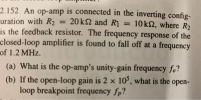 2.152 An op-amp is connected in the inverting config- uration with R2 = 20 ks2 and Ri = 10ks, where R2 is the feedback resistor. The frequency response of the closed-loop amplifier is found to fall off at a frequency of 1.2 MHz (a) What is the op-amp's unity-gain frequency fo? (b) If the open-loop gain is 2 x 10%, what is the open- loop breakpoint frequency fp?
Find the specifications for the 741C op amp online. Record the values for each of the...
 Find the specifications for the 741C op amp online. Record the values for each of the characteristic parameters listed below. Also, discuss the significance of each parameter. A. Input Impedence . Output Impedence Maximum Gain Output Voltage Swing Short Circuit Output Current . . 1b. Explain how the voltage buffer "isolates" the input from the output, and explain why this might be useful. 1C. What is the fall-off frequency (approximate bandwidth) of a 741 op amp circuit designed with a...
For the circuit shown in Fig. 4.3, the op-amp is ideal and is operating in its...
 For the circuit shown in Fig. 4.3, the op-amp is ideal and is operating in its linear region. (a) Determine the transfer function H (s) = Vo(s)/Vi(s). (b) Sketch and clearly label the Bode Magnitude-Phase plot of H(jo) (Your provided two graph papers. Use the first for the magnitude plot and the second for the phase plot). (c) What filter is represented by H(s)? Explain. 400 k 2 210 S2 50 nF 160 k92 내 mto 105 2 50 nF...
I want right answer Problem Design and draw a first-order op amp-RC high-pass filter with 3-dB...
 I want right answer
Problem Design and draw a first-order op amp-RC high-pass filter with 3-dB frequency of 10' Hz, a high-frequency input resistance of 100 k, and a high frequency-gain magnitude of 2
I want right answer
Problem Design and draw a first-order op amp-RC high-pass filter with 3-dB frequency of 10' Hz, a high-frequency input resistance of 100 k, and a high frequency-gain magnitude of 2
Determine the equivalent resistance R and the equivalent capacitance C
 In Circuit \(\mathrm{A}\) in Figure 3, each resistor has a resistance of \(1 \mathrm{k} \Omega\) and each capacitor has a capacitance of \(2 \mu \mathrm{F}\). Circuit A can be simplified to the equivalent Circuit B in Figure 3 .(a) Determine the equivalent resistance R and the equivalent capacitance C. Write your final answers in the blank spaces below Circuit B in Figure 3 .For the remainder of this question, refer to Circuit \(\mathrm{B}\). In Circuit \(\mathrm{B}\), the capacitor is allowed to charge...
 (b) If the op-amp is realized by the circuit shown in Fig. 4( find the low-frequency gain and estimate the dominant pole pi as a function of the appropriate small-signal parameters and capacitor values. The unity-gain buffer has very high input resistance and very low output resistance. Assume that the voltage gain of the 2nd stage is very large and make any appro priate approximations. Then find the expression for the unity-gain frequency assuming that it is well within the...
 Find closed loop gain and i0
he circuit 8.28. For Fig. 8.58, using ideal op-amp model, cal- at choice Vinl to culate the closed-loop gain . Also find io when us 1.2V. 12 0 V2 + io 20 kQ + 2.5 k2 Vo 10 k Figure 8.58
he circuit 8.28. For Fig. 8.58, using ideal op-amp model, cal- at choice Vinl to culate the closed-loop gain . Also find io when us 1.2V. 12 0 V2 + io 20 kQ...
Find closed loop gain and i0
he circuit 8.28. For Fig. 8.58, using ideal op-amp model, cal- at choice Vinl to culate the closed-loop gain . Also find io when us 1.2V. 12 0 V2 + io 20 kQ + 2.5 k2 Vo 10 k Figure 8.58
he circuit 8.28. For Fig. 8.58, using ideal op-amp model, cal- at choice Vinl to culate the closed-loop gain . Also find io when us 1.2V. 12 0 V2 + io 20 kQ...
 ELEC324/624 2018 Page 4 i) (2 marks) The open-loop frequency response of the LM748 op-amp is shown in the figure be for two different values of the external compensating capacitor, Ci.If provides unity-gain compensation, determine the capacitance the op-amp for a closed-loop gain of 3 dB. C-30 pF required to compensat Open Loop Frequency Response 120 100 80 40 20 -20 FREQUENCY(Hx) j) (2 marks) Describe how delay in the loop of any feedback control system can seriously compromise the...
 JU Oct 2017 5 Minute Test Your Understanding Quiz A compensated Op-Amp has an open-loop gain of 10' and a dominant pole of 8 Hz. The Op-Amp is used in a closed-loop single stage amplifier which has a low-frequency gain of 50. What is the -3 dB bandwidth of the closed-loop amplifier? Note: I know of at least two ways to solve this problem
 2.152 An op-amp is connected in the inverting config- uration with R2 = 20 ks2 and Ri = 10ks, where R2 is the feedback resistor. The frequency response of the closed-loop amplifier is found to fall off at a frequency of 1.2 MHz (a) What is the op-amp's unity-gain frequency fo? (b) If the open-loop gain is 2 x 10%, what is the open- loop breakpoint frequency fp?
 Find the specifications for the 741C op amp online. Record the values for each of the characteristic parameters listed below. Also, discuss the significance of each parameter. A. Input Impedence . Output Impedence Maximum Gain Output Voltage Swing Short Circuit Output Current . . 1b. Explain how the voltage buffer "isolates" the input from the output, and explain why this might be useful. 1C. What is the fall-off frequency (approximate bandwidth) of a 741 op amp circuit designed with a...
 For the circuit shown in Fig. 4.3, the op-amp is ideal and is operating in its linear region. (a) Determine the transfer function H (s) = Vo(s)/Vi(s). (b) Sketch and clearly label the Bode Magnitude-Phase plot of H(jo) (Your provided two graph papers. Use the first for the magnitude plot and the second for the phase plot). (c) What filter is represented by H(s)? Explain. 400 k 2 210 S2 50 nF 160 k92 내 mto 105 2 50 nF...
 I want right answer
Problem Design and draw a first-order op amp-RC high-pass filter with 3-dB frequency of 10' Hz, a high-frequency input resistance of 100 k, and a high frequency-gain magnitude of 2
I want right answer
Problem Design and draw a first-order op amp-RC high-pass filter with 3-dB frequency of 10' Hz, a high-frequency input resistance of 100 k, and a high frequency-gain magnitude of 2
 In Circuit \(\mathrm{A}\) in Figure 3, each resistor has a resistance of \(1 \mathrm{k} \Omega\) and each capacitor has a capacitance of \(2 \mu \mathrm{F}\). Circuit A can be simplified to the equivalent Circuit B in Figure 3 .(a) Determine the equivalent resistance R and the equivalent capacitance C. Write your final answers in the blank spaces below Circuit B in Figure 3 .For the remainder of this question, refer to Circuit \(\mathrm{B}\). In Circuit \(\mathrm{B}\), the capacitor is allowed to charge...
Most questions answered within 3 hours.
-
Where is the error in this code sequence?
String s1 = "Hello";
String s2 = "ello";...
asked 11 months ago -
Financial data for Joel de Paris, Inc., for last year
follow:
Joel de Paris, Inc.
Balance...
asked 11 months ago -
Consider this reaction:
Al2(SO4)3 (aq)+ BaCl3
(aq) Al2Cl6 (aq)- +
3BaSO4(s) . What is the...
asked 11 months ago -
Suppose that Savneet is considering increasing her
recent random sample from 20 car rentals to 40...
asked 11 months ago -
Trucks arrive at an unloading terminal at an average rate of 120
per hour.
Trucks arrive...
asked 11 months ago -
Why are methanol and ethanol completely soluble in water while
octanol is not very little soluble....
asked 11 months ago -
A facilities manager at a university reads in a research report
that the mean amount of...
asked 11 months ago -
When the CuSO4 is rehydrated by adding water to the anhydrous
compound, is this an endothermic...
asked 11 months ago -
A ray of sunlight is passing from diamond into crown glass; the
angle of incidence is...
asked 11 months ago -
A block of mass 0.249 kg is placed on top of a light, vertical
spring of...
asked 11 months ago -
how do the kidneys compensate in the presences of acidosis
a) trigger hyperventilate
b) reserve acid...
asked 11 months ago -
Question 501 pts
The rental rate of capital to the firm increases. Which of the
following...
asked 11 months ago