
Homework Answers
Add Answer to:
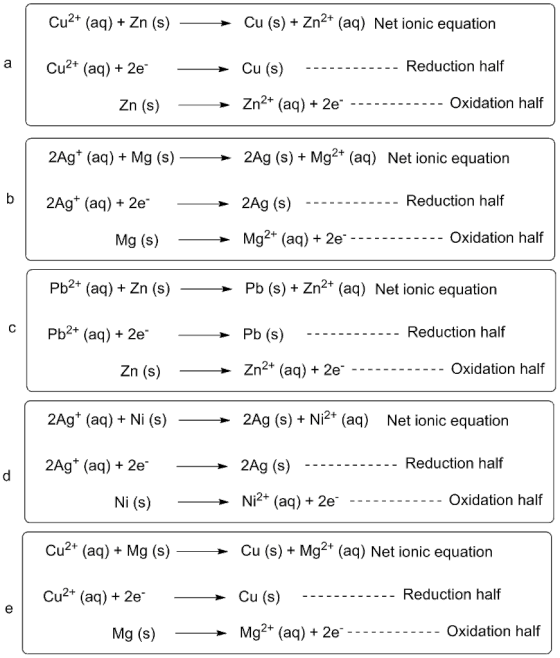
write the balanced net ionic equations for the cell reactions
for the following
QUESTIONS Write the...
Name QUESTIONS Write the balanced, net-ionic equations for the sell reactions for the following half-cell combinations...
 Name QUESTIONS Write the balanced, net-ionic equations for the sell reactions for the following half-cell combinations at standard conditions. Bc sure to. consider dircction of spontaneity I. a. Cu/Cu, Zn/Zn b. Ag/Ag , Mg/Mg d. Ni/Ni, Ag/Ag': e. Cu/Cu", Mg/Mg*
Write Balanced Ionic Equations and Balanced Net Ionic Equations for the following combinations (including states ex.(s)...
Write Balanced Ionic Equations and Balanced Net Ionic Equations for the following combinations (including states ex.(s) or (aq)): BaCl2 and AgNO3, KBr and AgNO3, K2CrO4 and AgNO3, NaOH and AgNO3, Na2CO3 and BaCl2, (NH4)2SO4 and BaCl2, Pb(NO3)2 and Na2CO3, Zn(NO3)2 and Na2CO3, FeCl3 and Na2CO3, Cu(NO3)2 and Na2CO3, K2CrO4 and Pb(NO3)2, NaOH and Pb(NO3)2, NaOH and FeCl3, NaCH3COO and FeCl3, MgCl2 and NaOH, Cu(NO3)2 and NaOH.
Write balanced molecular, ionic and net-ionic equations for 10 reactions (8 precipitate (P) and 2 neautralization)...
 Write balanced molecular, ionic and net-ionic equations for 10
reactions
(8 precipitate (P) and 2 neautralization)
Use the next few pages to write balanced MOLECULAR, IONIC, and NET-IONIC equations for 10 reactions that occurred during this laboratory experiment. There are more than 10 possible reactions. Choose precipitation reactions and 2 neutralization reactions. Make sure to include the physical states of all the products. Class (circle one): Precipitation or Neutralization Reaction 1. Molecular: Complete lonic: Net lonic: no I reaction/ no...
Write balanced molecular, ionic and net-ionic equations for 10
reactions
(8 precipitate (P) and 2 neautralization)
Use the next few pages to write balanced MOLECULAR, IONIC, and NET-IONIC equations for 10 reactions that occurred during this laboratory experiment. There are more than 10 possible reactions. Choose precipitation reactions and 2 neutralization reactions. Make sure to include the physical states of all the products. Class (circle one): Precipitation or Neutralization Reaction 1. Molecular: Complete lonic: Net lonic: no I reaction/ no...
Write half reactions and balanced net ionic equations for the principal net reactions in the following...
Write half reactions and balanced net ionic equations for the principal net reactions in the following experiments. Show any necessary calculations. [Note: you may need to consider several possible combinations of oxidants and reductants before you decide on the correct one.] a. Nitrogen dioxide is bubbled into a NaOH solution. b. A little potassium iodide is dissolved in a solution of KIO3 in 6M HCl.
Write balanced net ionic equations for ALL reactions involved in the confirmation tests for the following...
 Write balanced net ionic equations for ALL reactions involved in the confirmation tests for the following cations: 2. (a) Pb (starting with PbCl2(s) dissolving in hot water followed by the reaction with K;CrO4) +2rc Pb Cr 0 PbC121 2Cro tag (b) Ca (starting with reaction of Ca(OH)2 (s) with dilute HCI, followed by reaction with K C2O4): (c) Mg2 (starting with reaction of Mg(OH)2($) with dilute HCl, followed by NH3 and NaHPO4): (d) Zn2 (starting with a reaction of Zn(OH)...
plzzz help 2. Net lonic Equations - use the directions below to write net ionic equations for the 15 possible ele...
 plzzz help
2. Net lonic Equations - use the directions below to write net ionic equations for the 15 possible electrode combinations. Pay special attention to Step 7 to write net ionic equations for Redox reactions. Directions For Writing Molecular, lonic, And Net lonic Equations: 1. Molecular Equation: balance the molecular equation by predicting the products and changing the coefficients so that all atoms are balanced. Equations must be balanced to obey the Law of Conservation of Matter 2. lonic...
plzzz help
2. Net lonic Equations - use the directions below to write net ionic equations for the 15 possible electrode combinations. Pay special attention to Step 7 to write net ionic equations for Redox reactions. Directions For Writing Molecular, lonic, And Net lonic Equations: 1. Molecular Equation: balance the molecular equation by predicting the products and changing the coefficients so that all atoms are balanced. Equations must be balanced to obey the Law of Conservation of Matter 2. lonic...
write the molecular equations, ionic and net ionic equations for the following reactions 1. Al +...
write the molecular equations, ionic and net ionic equations for the following reactions 1. Al + HCl 2. Cu + HCl 3. Fe + HCl 4. Mg + HCl 5. Zn + HCl 6. Sn + HCl 7. Ca + HCl
4. Write net ionic equations for reactions a), b) and d) only in Q. 1 above. 5. a) If the followi...
 4. Write net ionic equations for reactions a), b) and d) only in Q. 1 above. 5. a) If the following reactions will take place, complete and balance it. If there is no reaction, state: a) AgNO3(ag) Cu(s) b) Cu(NOs)2 (aq) + Zn(s) c) Pb(NOs)2 (aq) + H2(g) d) AI(s) + HCI(aq) b) Balance the following half reactions in acidic solutions: i) VO2+ (aq) →V" (aq) 6. Balance the following reactions in basic solutions: a) Mno,(aq) + SO, (aq) MnO...
Data analysis: write the net ionic equations for any reactions that occurred between the metals and metal ions list occurred with N.R. Indicate any combinations where no reaction ed below (sect...
 Data analysis: write the net ionic equations for any reactions that occurred between the metals and metal ions list occurred with N.R. Indicate any combinations where no reaction ed below (section la). e Lead ion and zinc . Lead ion and copper Zinc ion and lead . Zinc ion and copper . Copper(II) ion and lead . Copper(II) ion and zinc 2. In your notebook, write the net ionic equations for the react tions that occurred between the metals and...
Write balanced net ionic equations for the following reactions. Supply H^+ and/ or H2O as needed ...
 Write balanced net ionic equations for the following reactions.
Supply H^+ and/ or H2O as needed to obtain balance.
2+ 3+ 2+ 2+ b Cro)+CuCr+ +Cu(s) Cr(s) Cu+ Cu(s) -+ NO3+ Zn(s) + NO2(g) + Mn2+ + Se042 T3Co(CNT(CN)64 2+
2+ 3+ 2+ 2+ b Cro)+CuCr+ +Cu(s) Cr(s) Cu+ Cu(s) -+ NO3+ Zn(s) + NO2(g) +
Mn2+ + Se042 T3Co(CNT(CN)64 2+
Write balanced net ionic equations for the following reactions.
Supply H^+ and/ or H2O as needed to obtain balance.
2+ 3+ 2+ 2+ b Cro)+CuCr+ +Cu(s) Cr(s) Cu+ Cu(s) -+ NO3+ Zn(s) + NO2(g) + Mn2+ + Se042 T3Co(CNT(CN)64 2+
2+ 3+ 2+ 2+ b Cro)+CuCr+ +Cu(s) Cr(s) Cu+ Cu(s) -+ NO3+ Zn(s) + NO2(g) +
Mn2+ + Se042 T3Co(CNT(CN)64 2+
 Name QUESTIONS Write the balanced, net-ionic equations for the sell reactions for the following half-cell combinations at standard conditions. Bc sure to. consider dircction of spontaneity I. a. Cu/Cu, Zn/Zn b. Ag/Ag , Mg/Mg d. Ni/Ni, Ag/Ag': e. Cu/Cu", Mg/Mg*
 Write balanced molecular, ionic and net-ionic equations for 10
reactions
(8 precipitate (P) and 2 neautralization)
Use the next few pages to write balanced MOLECULAR, IONIC, and NET-IONIC equations for 10 reactions that occurred during this laboratory experiment. There are more than 10 possible reactions. Choose precipitation reactions and 2 neutralization reactions. Make sure to include the physical states of all the products. Class (circle one): Precipitation or Neutralization Reaction 1. Molecular: Complete lonic: Net lonic: no I reaction/ no...
Write balanced molecular, ionic and net-ionic equations for 10
reactions
(8 precipitate (P) and 2 neautralization)
Use the next few pages to write balanced MOLECULAR, IONIC, and NET-IONIC equations for 10 reactions that occurred during this laboratory experiment. There are more than 10 possible reactions. Choose precipitation reactions and 2 neutralization reactions. Make sure to include the physical states of all the products. Class (circle one): Precipitation or Neutralization Reaction 1. Molecular: Complete lonic: Net lonic: no I reaction/ no...
 Write balanced net ionic equations for ALL reactions involved in the confirmation tests for the following cations: 2. (a) Pb (starting with PbCl2(s) dissolving in hot water followed by the reaction with K;CrO4) +2rc Pb Cr 0 PbC121 2Cro tag (b) Ca (starting with reaction of Ca(OH)2 (s) with dilute HCI, followed by reaction with K C2O4): (c) Mg2 (starting with reaction of Mg(OH)2($) with dilute HCl, followed by NH3 and NaHPO4): (d) Zn2 (starting with a reaction of Zn(OH)...
 plzzz help
2. Net lonic Equations - use the directions below to write net ionic equations for the 15 possible electrode combinations. Pay special attention to Step 7 to write net ionic equations for Redox reactions. Directions For Writing Molecular, lonic, And Net lonic Equations: 1. Molecular Equation: balance the molecular equation by predicting the products and changing the coefficients so that all atoms are balanced. Equations must be balanced to obey the Law of Conservation of Matter 2. lonic...
plzzz help
2. Net lonic Equations - use the directions below to write net ionic equations for the 15 possible electrode combinations. Pay special attention to Step 7 to write net ionic equations for Redox reactions. Directions For Writing Molecular, lonic, And Net lonic Equations: 1. Molecular Equation: balance the molecular equation by predicting the products and changing the coefficients so that all atoms are balanced. Equations must be balanced to obey the Law of Conservation of Matter 2. lonic...
 4. Write net ionic equations for reactions a), b) and d) only in Q. 1 above. 5. a) If the following reactions will take place, complete and balance it. If there is no reaction, state: a) AgNO3(ag) Cu(s) b) Cu(NOs)2 (aq) + Zn(s) c) Pb(NOs)2 (aq) + H2(g) d) AI(s) + HCI(aq) b) Balance the following half reactions in acidic solutions: i) VO2+ (aq) →V" (aq) 6. Balance the following reactions in basic solutions: a) Mno,(aq) + SO, (aq) MnO...
 Data analysis: write the net ionic equations for any reactions that occurred between the metals and metal ions list occurred with N.R. Indicate any combinations where no reaction ed below (section la). e Lead ion and zinc . Lead ion and copper Zinc ion and lead . Zinc ion and copper . Copper(II) ion and lead . Copper(II) ion and zinc 2. In your notebook, write the net ionic equations for the react tions that occurred between the metals and...
 Write balanced net ionic equations for the following reactions.
Supply H^+ and/ or H2O as needed to obtain balance.
2+ 3+ 2+ 2+ b Cro)+CuCr+ +Cu(s) Cr(s) Cu+ Cu(s) -+ NO3+ Zn(s) + NO2(g) + Mn2+ + Se042 T3Co(CNT(CN)64 2+
2+ 3+ 2+ 2+ b Cro)+CuCr+ +Cu(s) Cr(s) Cu+ Cu(s) -+ NO3+ Zn(s) + NO2(g) +
Mn2+ + Se042 T3Co(CNT(CN)64 2+
Write balanced net ionic equations for the following reactions.
Supply H^+ and/ or H2O as needed to obtain balance.
2+ 3+ 2+ 2+ b Cro)+CuCr+ +Cu(s) Cr(s) Cu+ Cu(s) -+ NO3+ Zn(s) + NO2(g) + Mn2+ + Se042 T3Co(CNT(CN)64 2+
2+ 3+ 2+ 2+ b Cro)+CuCr+ +Cu(s) Cr(s) Cu+ Cu(s) -+ NO3+ Zn(s) + NO2(g) +
Mn2+ + Se042 T3Co(CNT(CN)64 2+
Most questions answered within 3 hours.
-
Where is the error in this code sequence?
String s1 = "Hello";
String s2 = "ello";...
asked 11 months ago -
Financial data for Joel de Paris, Inc., for last year
follow:
Joel de Paris, Inc.
Balance...
asked 11 months ago -
Consider this reaction:
Al2(SO4)3 (aq)+ BaCl3
(aq) Al2Cl6 (aq)- +
3BaSO4(s) . What is the...
asked 11 months ago -
Suppose that Savneet is considering increasing her
recent random sample from 20 car rentals to 40...
asked 11 months ago -
Trucks arrive at an unloading terminal at an average rate of 120
per hour.
Trucks arrive...
asked 11 months ago -
Why are methanol and ethanol completely soluble in water while
octanol is not very little soluble....
asked 11 months ago -
A facilities manager at a university reads in a research report
that the mean amount of...
asked 11 months ago -
When the CuSO4 is rehydrated by adding water to the anhydrous
compound, is this an endothermic...
asked 11 months ago -
A ray of sunlight is passing from diamond into crown glass; the
angle of incidence is...
asked 11 months ago -
A block of mass 0.249 kg is placed on top of a light, vertical
spring of...
asked 11 months ago -
how do the kidneys compensate in the presences of acidosis
a) trigger hyperventilate
b) reserve acid...
asked 11 months ago -
Question 501 pts
The rental rate of capital to the firm increases. Which of the
following...
asked 11 months ago