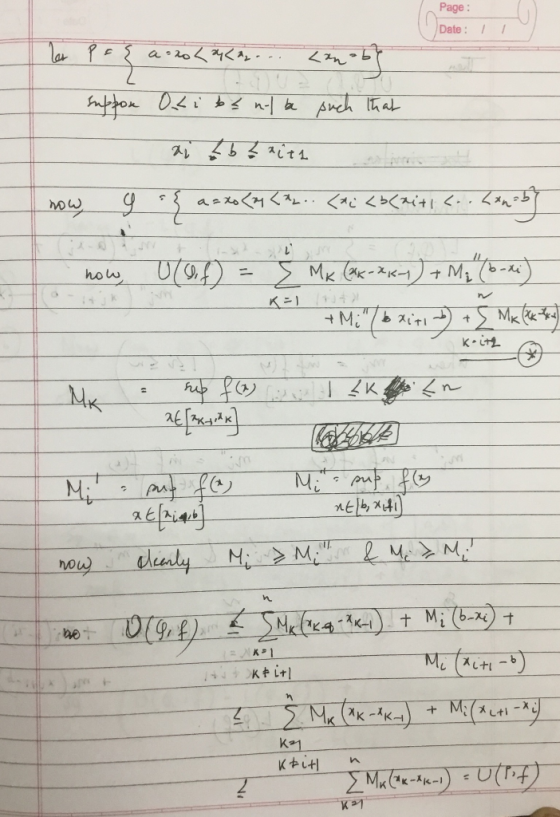
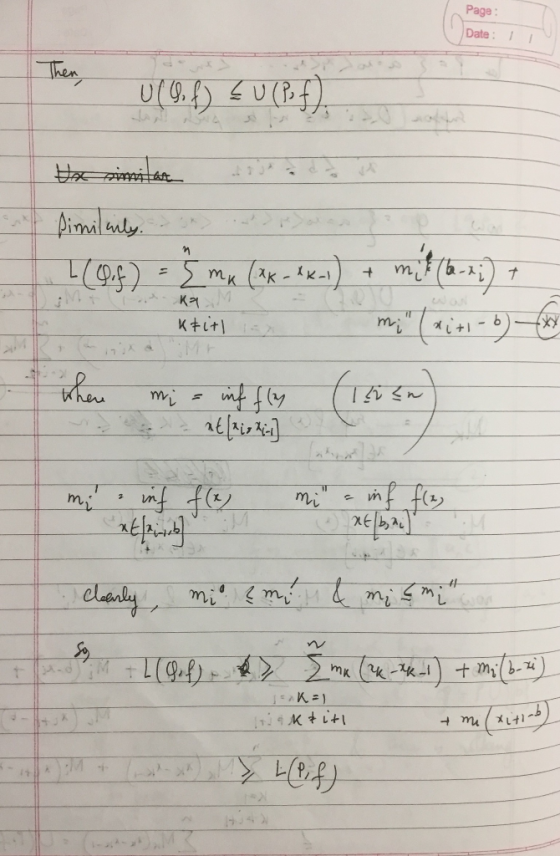
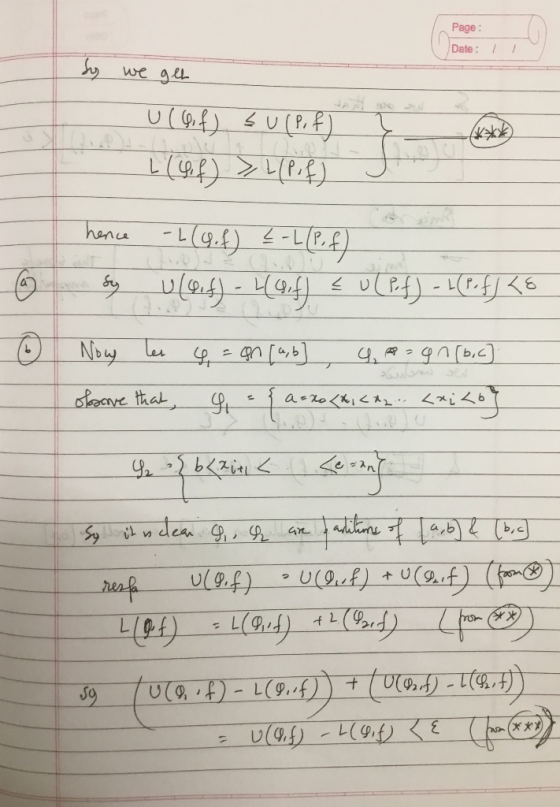
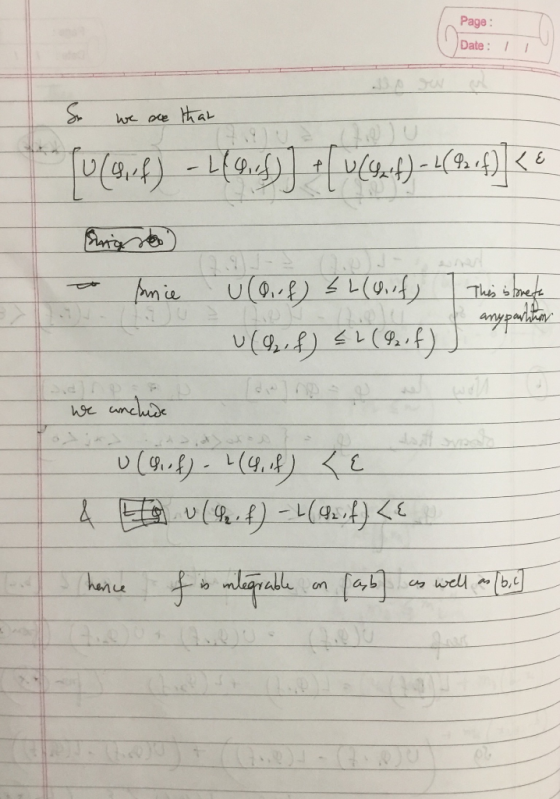
![Question 2. In this problem well prove that if a<b<c and f is integrable on [a, cl ther its also integrable on [a,b] and [b](http://img.homeworklib.com/questions/5045b970-8a3a-11eb-bbca-a18331a5322e.png?x-oss-process=image/resize,w_560)

Homework Answers

Add Answer to:
state any definitions or theorems used
Question 2. In this problem we'll prove that if a<b<c...
Please include a clearly worded explanation and state all theorems and definitions used. PROBLEM # 2...
 Please include a clearly
worded explanation and state all theorems and definitions used.
PROBLEM # 2 Let f : [a.b] R be Riemann integrable. a) Show that f is Riemann integrable. b) Show by induction that p(f) is Riemann integrable where p(v)- is any polynomial. c) Let f (laA) c, d and suppose that G : [c, d] → R is any continuous function. Show that the composition G(f) : [a,b] → R is Riemann integrable. (Hint: There are several...
Please include a clearly
worded explanation and state all theorems and definitions used.
PROBLEM # 2 Let f : [a.b] R be Riemann integrable. a) Show that f is Riemann integrable. b) Show by induction that p(f) is Riemann integrable where p(v)- is any polynomial. c) Let f (laA) c, d and suppose that G : [c, d] → R is any continuous function. Show that the composition G(f) : [a,b] → R is Riemann integrable. (Hint: There are several...
Suppose that f is bounded on a, b and that for any cE (a, b), f...
 Suppose that f is bounded on a, b and that for any cE (a, b), f is integrable on [c, b (a) Prove that for every e> 0, there exists CE (a, b) so that f(x)(c-a) < € for all x [a,b]. (b) For any > 0, find a partition P of [a, b so that U,P)-J f(r)dz < j and s f(r)dz L(f, P) < Hint: Do this by choosing c carefully and extending a partition of [c, b...
Problem 11.11 I have included a picture of the question (and the referenced problem 11.5), followed...
 Problem 11.11
I have included a picture of the question (and the referenced
problem 11.5), followed by definitions and theorems so you're able
to use this books particular language. The information I include
ranges from basic definitions to the fundamental theorems of
calculus.
Problem 11.11. Show, if f : [0,1] → R is bounded and the lower integral of f is positive, then there is an open interval on which f > 0. (Compare with problems 11.5 above and Problem...
Problem 11.11
I have included a picture of the question (and the referenced
problem 11.5), followed by definitions and theorems so you're able
to use this books particular language. The information I include
ranges from basic definitions to the fundamental theorems of
calculus.
Problem 11.11. Show, if f : [0,1] → R is bounded and the lower integral of f is positive, then there is an open interval on which f > 0. (Compare with problems 11.5 above and Problem...
Exercise 5.3.2. [Used in Exercise 5.5.6.] Let [a,b] C R be a non-degenerate closed bounded interv...
 Exercise 5.3.2. [Used in Exercise 5.5.6.] Let [a,b] C R be a non-degenerate closed bounded interval, and let f: la,b] R be a function. Suppose that f is integrable Prove that if If(x)l S M for all xe la, b], for some M E R, then Jx)ds M(b-a)
Exercise 5.3.2. [Used in Exercise 5.5.6.] Let [a,b] C R be a non-degenerate closed bounded interval, and let f: la,b] R be a function. Suppose that f is integrable Prove that if...
Exercise 5.3.2. [Used in Exercise 5.5.6.] Let [a,b] C R be a non-degenerate closed bounded interval, and let f: la,b] R be a function. Suppose that f is integrable Prove that if If(x)l S M for all xe la, b], for some M E R, then Jx)ds M(b-a)
Exercise 5.3.2. [Used in Exercise 5.5.6.] Let [a,b] C R be a non-degenerate closed bounded interval, and let f: la,b] R be a function. Suppose that f is integrable Prove that if...
Please all thank you Exercise 25: Let f 0,R be defined by f(x)-1/n, m, with m,nENand n is the minimal n such that m/n a) Show that L(f, P)0 for all partitions P of [0, 1] b) Let mE N. Show that t...
 Please all thank you
Exercise 25: Let f 0,R be defined by f(x)-1/n, m, with m,nENand n is the minimal n such that m/n a) Show that L(f, P)0 for all partitions P of [0, 1] b) Let mE N. Show that the cardinality of the set A bounded by m(m1)/2. e [0, 1]: f(x) > 1/m) is c) Given m E N construct a partition P such that U(f, Pm)2/m. d) Show that f is integrable and compute Jo...
Please all thank you
Exercise 25: Let f 0,R be defined by f(x)-1/n, m, with m,nENand n is the minimal n such that m/n a) Show that L(f, P)0 for all partitions P of [0, 1] b) Let mE N. Show that the cardinality of the set A bounded by m(m1)/2. e [0, 1]: f(x) > 1/m) is c) Given m E N construct a partition P such that U(f, Pm)2/m. d) Show that f is integrable and compute Jo...
1) Webber Chap. 11 Exercise 1 Prove that {a"b"c"} is not regular. Hint: Copy the proof...
 1) Webber Chap. 11 Exercise 1 Prove that {a"b"c"} is not regular. Hint: Copy the proof of Theorem 11.1-only minor alterations are needed. Theorem 11.1 The language {a"b"} is not regular. • Let M = (Q, {a,b}, 8, 9., F) be any DFA over the alphabet {a,b}; we'll show that L(M) + {a"b"} • Given as for input, M visits a sequence of states: - *(q,,ɛ), then 8*(q,,a), then 8*(9,,aa), and so on • Since Q is finite, M eventually...
Consider the application of the Pumping Lemma to prove that the language over Σ = {a,b,c}...
Consider the application of the Pumping Lemma to prove that the language over Σ = {a,b,c} shown below is not regular: L = {aibjck: i ≥ j ≥ k ≥ 0} First, we choose an input string w = apbpcp=xyz, 1|xy| p, |y|=k≥1, where p is the critical length. Next, create another string w´ L to produce a contradiction. Which of the following string will produce a contradiction? e) w´ = xz f) w´ = xyz g) w´ = xy2z h)...
Q 5. Let F be a field and consider the polynomial ring l (a) State the Division Algorithm for polynomials in Plrl. b) Let a e F. Prove that -a divides f(x) in Fix] if and only if (a)- (c) Prove t...
 Q 5. Let F be a field and consider the polynomial ring l (a) State the Division Algorithm for polynomials in Plrl. b) Let a e F. Prove that -a divides f(x) in Fix] if and only if (a)- (c) Prove that z-37 divides 42-1 in F43[z].
Q 5. Let F be a field and consider the polynomial ring l (a) State the Division Algorithm for polynomials in Plrl. b) Let a e F. Prove that -a divides f(x) in...
Q 5. Let F be a field and consider the polynomial ring l (a) State the Division Algorithm for polynomials in Plrl. b) Let a e F. Prove that -a divides f(x) in Fix] if and only if (a)- (c) Prove that z-37 divides 42-1 in F43[z].
Q 5. Let F be a field and consider the polynomial ring l (a) State the Division Algorithm for polynomials in Plrl. b) Let a e F. Prove that -a divides f(x) in...
2. More Rational Fun (a) Spend two to three minutes in deep meditation on Darboux's Theorem. Pay ...
 2. More Rational Fun (a) Spend two to three minutes in deep meditation on Darboux's Theorem. Pay special attention to the part in bold Darboux's Theorem on Integrability Let A C R" be bounded and let f:A-R be bounded as well. Suppose E is a bounding rectangle of A. Then f is integrable over A and f-1 iff, for every ε > 0, there is a δ > 0, such that for every partition P of E with size Pll...
Assume b.1 is proven. Please help prove b.2 (b) Let f: V V be any linear...
 Assume b.1 is proven. Please help prove b.2
(b) Let f: V V be any linear map of vector spaces over a field K. Recall that, for any polynomial p(X) = 0 ¢X€ K[X] and any vE v p(X) p(u) 2ef°(v). i-0 The kernel of p(X) is defined to be {v € V : p(X) - v = 0}. Ker(p(X)) (b.1) Show that Ker(p(X)) is a linear subspace of V. When p(X) = X - A where E K, explain...
Assume b.1 is proven. Please help prove b.2
(b) Let f: V V be any linear map of vector spaces over a field K. Recall that, for any polynomial p(X) = 0 ¢X€ K[X] and any vE v p(X) p(u) 2ef°(v). i-0 The kernel of p(X) is defined to be {v € V : p(X) - v = 0}. Ker(p(X)) (b.1) Show that Ker(p(X)) is a linear subspace of V. When p(X) = X - A where E K, explain...
 Please include a clearly
worded explanation and state all theorems and definitions used.
PROBLEM # 2 Let f : [a.b] R be Riemann integrable. a) Show that f is Riemann integrable. b) Show by induction that p(f) is Riemann integrable where p(v)- is any polynomial. c) Let f (laA) c, d and suppose that G : [c, d] → R is any continuous function. Show that the composition G(f) : [a,b] → R is Riemann integrable. (Hint: There are several...
Please include a clearly
worded explanation and state all theorems and definitions used.
PROBLEM # 2 Let f : [a.b] R be Riemann integrable. a) Show that f is Riemann integrable. b) Show by induction that p(f) is Riemann integrable where p(v)- is any polynomial. c) Let f (laA) c, d and suppose that G : [c, d] → R is any continuous function. Show that the composition G(f) : [a,b] → R is Riemann integrable. (Hint: There are several...
 Suppose that f is bounded on a, b and that for any cE (a, b), f is integrable on [c, b (a) Prove that for every e> 0, there exists CE (a, b) so that f(x)(c-a) < € for all x [a,b]. (b) For any > 0, find a partition P of [a, b so that U,P)-J f(r)dz < j and s f(r)dz L(f, P) < Hint: Do this by choosing c carefully and extending a partition of [c, b...
 Problem 11.11
I have included a picture of the question (and the referenced
problem 11.5), followed by definitions and theorems so you're able
to use this books particular language. The information I include
ranges from basic definitions to the fundamental theorems of
calculus.
Problem 11.11. Show, if f : [0,1] → R is bounded and the lower integral of f is positive, then there is an open interval on which f > 0. (Compare with problems 11.5 above and Problem...
Problem 11.11
I have included a picture of the question (and the referenced
problem 11.5), followed by definitions and theorems so you're able
to use this books particular language. The information I include
ranges from basic definitions to the fundamental theorems of
calculus.
Problem 11.11. Show, if f : [0,1] → R is bounded and the lower integral of f is positive, then there is an open interval on which f > 0. (Compare with problems 11.5 above and Problem...
 Exercise 5.3.2. [Used in Exercise 5.5.6.] Let [a,b] C R be a non-degenerate closed bounded interval, and let f: la,b] R be a function. Suppose that f is integrable Prove that if If(x)l S M for all xe la, b], for some M E R, then Jx)ds M(b-a)
Exercise 5.3.2. [Used in Exercise 5.5.6.] Let [a,b] C R be a non-degenerate closed bounded interval, and let f: la,b] R be a function. Suppose that f is integrable Prove that if...
Exercise 5.3.2. [Used in Exercise 5.5.6.] Let [a,b] C R be a non-degenerate closed bounded interval, and let f: la,b] R be a function. Suppose that f is integrable Prove that if If(x)l S M for all xe la, b], for some M E R, then Jx)ds M(b-a)
Exercise 5.3.2. [Used in Exercise 5.5.6.] Let [a,b] C R be a non-degenerate closed bounded interval, and let f: la,b] R be a function. Suppose that f is integrable Prove that if...
 Please all thank you
Exercise 25: Let f 0,R be defined by f(x)-1/n, m, with m,nENand n is the minimal n such that m/n a) Show that L(f, P)0 for all partitions P of [0, 1] b) Let mE N. Show that the cardinality of the set A bounded by m(m1)/2. e [0, 1]: f(x) > 1/m) is c) Given m E N construct a partition P such that U(f, Pm)2/m. d) Show that f is integrable and compute Jo...
Please all thank you
Exercise 25: Let f 0,R be defined by f(x)-1/n, m, with m,nENand n is the minimal n such that m/n a) Show that L(f, P)0 for all partitions P of [0, 1] b) Let mE N. Show that the cardinality of the set A bounded by m(m1)/2. e [0, 1]: f(x) > 1/m) is c) Given m E N construct a partition P such that U(f, Pm)2/m. d) Show that f is integrable and compute Jo...
 1) Webber Chap. 11 Exercise 1 Prove that {a"b"c"} is not regular. Hint: Copy the proof of Theorem 11.1-only minor alterations are needed. Theorem 11.1 The language {a"b"} is not regular. • Let M = (Q, {a,b}, 8, 9., F) be any DFA over the alphabet {a,b}; we'll show that L(M) + {a"b"} • Given as for input, M visits a sequence of states: - *(q,,ɛ), then 8*(q,,a), then 8*(9,,aa), and so on • Since Q is finite, M eventually...
 Q 5. Let F be a field and consider the polynomial ring l (a) State the Division Algorithm for polynomials in Plrl. b) Let a e F. Prove that -a divides f(x) in Fix] if and only if (a)- (c) Prove that z-37 divides 42-1 in F43[z].
Q 5. Let F be a field and consider the polynomial ring l (a) State the Division Algorithm for polynomials in Plrl. b) Let a e F. Prove that -a divides f(x) in...
Q 5. Let F be a field and consider the polynomial ring l (a) State the Division Algorithm for polynomials in Plrl. b) Let a e F. Prove that -a divides f(x) in Fix] if and only if (a)- (c) Prove that z-37 divides 42-1 in F43[z].
Q 5. Let F be a field and consider the polynomial ring l (a) State the Division Algorithm for polynomials in Plrl. b) Let a e F. Prove that -a divides f(x) in...
 2. More Rational Fun (a) Spend two to three minutes in deep meditation on Darboux's Theorem. Pay special attention to the part in bold Darboux's Theorem on Integrability Let A C R" be bounded and let f:A-R be bounded as well. Suppose E is a bounding rectangle of A. Then f is integrable over A and f-1 iff, for every ε > 0, there is a δ > 0, such that for every partition P of E with size Pll...
 Assume b.1 is proven. Please help prove b.2
(b) Let f: V V be any linear map of vector spaces over a field K. Recall that, for any polynomial p(X) = 0 ¢X€ K[X] and any vE v p(X) p(u) 2ef°(v). i-0 The kernel of p(X) is defined to be {v € V : p(X) - v = 0}. Ker(p(X)) (b.1) Show that Ker(p(X)) is a linear subspace of V. When p(X) = X - A where E K, explain...
Assume b.1 is proven. Please help prove b.2
(b) Let f: V V be any linear map of vector spaces over a field K. Recall that, for any polynomial p(X) = 0 ¢X€ K[X] and any vE v p(X) p(u) 2ef°(v). i-0 The kernel of p(X) is defined to be {v € V : p(X) - v = 0}. Ker(p(X)) (b.1) Show that Ker(p(X)) is a linear subspace of V. When p(X) = X - A where E K, explain...
Most questions answered within 3 hours.
-
Where is the error in this code sequence?
String s1 = "Hello";
String s2 = "ello";...
asked 10 months ago -
Financial data for Joel de Paris, Inc., for last year
follow:
Joel de Paris, Inc.
Balance...
asked 10 months ago -
Consider this reaction:
Al2(SO4)3 (aq)+ BaCl3
(aq) Al2Cl6 (aq)- +
3BaSO4(s) . What is the...
asked 10 months ago -
Suppose that Savneet is considering increasing her
recent random sample from 20 car rentals to 40...
asked 10 months ago -
Trucks arrive at an unloading terminal at an average rate of 120
per hour.
Trucks arrive...
asked 10 months ago -
Why are methanol and ethanol completely soluble in water while
octanol is not very little soluble....
asked 10 months ago -
A facilities manager at a university reads in a research report
that the mean amount of...
asked 10 months ago -
When the CuSO4 is rehydrated by adding water to the anhydrous
compound, is this an endothermic...
asked 10 months ago -
A ray of sunlight is passing from diamond into crown glass; the
angle of incidence is...
asked 10 months ago -
A block of mass 0.249 kg is placed on top of a light, vertical
spring of...
asked 10 months ago -
how do the kidneys compensate in the presences of acidosis
a) trigger hyperventilate
b) reserve acid...
asked 10 months ago -
Question 501 pts
The rental rate of capital to the firm increases. Which of the
following...
asked 10 months ago