
Prove:
$$ \int_{0}^{1} e^{x} \sqrt{2 x+1}\left(1+x+x^{2}\right)^{100} d x \leq \sqrt{\frac{\left(e^{2}-1\right)\left(3^{201}-1\right)}{402}} $$
You may not use any integral computation tools such as Wolfram Alpha for this question. HINT: Think about inner products.
Homework Answers
Please comment if you need any clarification.
If you find my answer helpful please put thumbs up.thank you

![let HX+X+ P (2* +1] derde 220 PE! P=3. 1=1 el MU! (s p200 dp foto 7+1 200+1 3 200 201 12 201 3 fuppur Inmit. 201 lower limit](http://img.homeworklib.com/questions/3d411a90-8a70-11eb-95d1-7b4a99249cbd.png?x-oss-process=image/resize,w_560)
Solve the integral substitute the value of picture below please i need some help i'm desperate please pleaseI hace a Lot homework
 \(\frac{\mathscr{L}}{\frac{\rho_{\infty} V_{\infty}^{2} c}{2}}=\int_{0}^{\frac{b}{2}}\left(\frac{\partial C_{l}}{\partial \alpha}\left(\alpha-\alpha_{C_{l}=0}\right)+\frac{\partial C_{l}}{\partial \alpha} \varphi(v)-\frac{\partial C_{l}}{\partial \alpha} \frac{\dot{p} v}{V_{\infty}}+\frac{\partial C_{l}}{\partial \beta} \beta \mathscr{U}_{b_{2}}(v)\right) v d v\)substitute this value in the integral and solve:
1-Given the function:
1-Given the function: \(y=\frac{x^{2}-3 x-4}{x^{2}-5 x+4}\), decide if \(f(x)=y\) is continuous or has a removable discontinuity, and find horizontal tond vertical asymptotes.2 A-Use the definition \(\lim _{h \rightarrow 0} \frac{f(x+h)-f(x)}{h}\) to prove that derivative of \(f(x)=\sqrt{4-x}\) is \(\frac{-1}{2 \sqrt{4-x}}\)2 B- Evaluate the limit \(\lim _{h \rightarrow 0} \frac{f(x+h) - f(x)}{h}\) for the given value of \(x\) and function \(f(x) .\)$$ f(x)=\sin x, \quad x=\frac{\pi}{4} $$3-Given the function: \(y=(x+4)^{3}(x-2)^{2}\), find y' and classify critical numbers very carefully using first derivative tess...
math
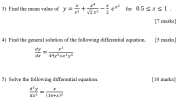 3) Find the mean value of \(y=\frac{x}{x^{2}}+\frac{x^{4}}{\sqrt{2} x^{2}}-\frac{x}{2} e^{x^{2}}\) for \(0.5 \leq x \leq 1\).4) Find the general solution of the following differential equation. $$ \frac{d y}{d x}=\frac{x^{2}}{49 y^{3}+x^{2} y^{3}} $$5) Solve the following differential equation. $$ \frac{d^{2} y}{d x^{2}}=\frac{x}{(16+x)^{2}} $$
Round your answers to two decimal places.
 Round your answers to two decimal places. a. Using the following equation:\(S_{\hat{y}},=s \sqrt{\frac{1}{n}+\frac{\left(x^{*}-\bar{x}\right)^{2}}{\sum\left(x_{i}-\bar{x}\right)^{2}}}\) Estimate the standard deviation of \(\hat{y}^{*}\) when \(x=3 .\)b. Using the following expression:\(\hat{y} * \pm t_{\alpha / 2} s_{\hat{y}}\)Develop a \(95 \%\) confidence interval for the expected value of \(y\) when \(x=3\). toc. Using the following equation:$$ s_{\text {pred }}=s \sqrt{1+\frac{1}{n}+\frac{\left(x^{*}-\bar{x}\right)^{2}}{\sum\left(x_{i}-\bar{x}\right)^{2}}} $$Estimate the standard deviation of an individual value of \(y\) when \(x=3\).d. Using the following expression:\(\hat{y}^{*} \pm t_{\alpha / 2} s_{\text {pred }}\)Develop a \(95 \%\) prediction...
Let X be a normal random variable with mean µ, variance^2 , pdf and mdf
 Let \(X\) be a normal random variable with mean \(\mu\), variance \(\sigma^{2}\), pdf$$ f(x)=\frac{1}{\sigma \sqrt{2 \pi}} e^{-\frac{(x-\mu)^{2}}{2 \sigma^{2}}} $$and mgf \(M(t)=e^{\mu t+\frac{1}{2} \sigma^{2} t^{2}}\)(a) Prove, by identifying the moment generating function of \(a+b X\), that \(a+b X \sim\) \(N\left(a+b \mu, b^{2} \sigma^{2}\right)\)(b) Prove, by identifying the pdf of \(a+b X\) (via the cdf), that \(a+b X \sim N(a+\) \(\left.b \mu, b^{2} \sigma^{2}\right)\)
My question relates to Example 2.4, Section 3 (The Harmonic Oscillator) in the textbook Introduction to...
My question relates to Example 2.4, Section 3 (The Harmonic Oscillator) in the textbook Introduction to Quantum Mechanics by DavidJ. Griffiths. My problem is with the normalization of of the following equation: |A|^2 \sqrt{\frac{m\omega}{\pi\hbar} (\frac{2m\omega}{\hbar})\int_{-infty}^\infty x^2 e^\frac{-m\omega x^2}{\hbar} dx. Integration by parts does not work because e^(-x^2) is not a n elementary function. I tried using the technique of improper integral - type 1 infinite integral - but I was not able to obtain the normalization factor of 1 given...
ZILLDIFFEQ9 11.1.016.
 Let \(\left\{\varphi_{n}(x)\right\}\) be an orthogonal set of functions on \([a, b]\) such that \(\psi_{0}(x)=1\) and \(\varphi_{1}(x)=x\), Show that \(\int_{a}^{b}(\alpha x+\beta) \varphi_{n}(x) d x=0\) for \(n=2,3, \ldots\) and any constants \(\alpha\) and \(\beta\),First we note that \(\alpha x+\beta=(\square) \Phi_{1}(x)+(\square \quad) \Psi_{0}(x)\).Using this together with the fact that \(\varphi_{0}\) and \(\varphi_{1}\) are orthogonal to \(\varphi_{n}\) for \(n>1\), we have the following.$$ \begin{aligned} \int_{a}^{b}(\alpha x+\beta) \varphi_{n}(x) d x &=\int_{a}^{b} a x \psi_{n}(x) d x+\int_{a}^{b} \beta \varphi_{n}(x) d x \\ &=\int_{a}^{b}\left(\square_{0}\right) \varphi_{1}(x) \varphi_{n}(x) d...
Find the Fourier integral representation of f(x) = e −|x| and hence show that
 (15 marks) Find the Fourier integral representation of \(f(x)=e^{-|x|}\) and hence show that$$ \int_{0}^{\infty} \frac{d t}{1+t^{2}}=\frac{\pi}{2} $$
Assess a subjective triangular probability distribution for the random variable, X, where X is defined as...
 Assess a subjective triangular probability distribution for the
random variable, X, where X is defined as the amount of snowfall
you think we will get in our next snowstorm in inches. Suppose that
you expect your commute to increase in minutes according to the
function . What is the expected increase in your
commute for the next snowstorm?
Estimate E[f(X)] by creating simple Monte Carlo
simulation in Excel.
Here are some equations for the triangular distribution that may
help you:...
Assess a subjective triangular probability distribution for the
random variable, X, where X is defined as the amount of snowfall
you think we will get in our next snowstorm in inches. Suppose that
you expect your commute to increase in minutes according to the
function . What is the expected increase in your
commute for the next snowstorm?
Estimate E[f(X)] by creating simple Monte Carlo
simulation in Excel.
Here are some equations for the triangular distribution that may
help you:...
Consider the heat conduction problem
 5. If \(f(x)=\left\{\begin{array}{cc}0 & -2<x<0 \\ x & 0<x<2\end{array} \quad\right.\)is periodio of period 4 , and whose Fourier series is given by \(\frac{a_{0}}{2}+\sum_{n=1}^{2}\left[a_{n} \cos \left(\frac{n \pi}{2} x\right)+b_{n} \sin \left(\frac{n \pi}{2} x\right)\right], \quad\) find \(a_{n}\)A. \(\frac{2}{n^{2} \pi^{2}}\)B. \(\frac{(-1)^{n}-1}{n^{2} \pi^{2}}\)C. \(\frac{4}{n^{2} \pi^{2}}\)D. \(\frac{2}{n \pi}\)\(\mathbf{E}_{1} \frac{2\left((-1)^{n}-1\right)}{n^{2} \pi^{2}}\)F. \(\frac{4}{n \pi}\)6. Let \(f(x)-2 x-l\) on \([0,2]\). The Fourier sine series for \(f(x)\) is \(\sum_{w}^{n} b_{n} \sin \left(\frac{n \pi}{2} x\right)\), What is \(b, ?\)A. \(\frac{4}{3 \pi}\)B. \(\frac{2}{\pi}\)C. \(\frac{4}{\pi}\)D. \(\frac{-4}{3 \pi}\)E. \(\frac{-2}{\pi}\)F. \(\frac{-4}{\pi}\)7. Let \(f(x)\) be periodic...
 Let \(\left\{\varphi_{n}(x)\right\}\) be an orthogonal set of functions on \([a, b]\) such that \(\psi_{0}(x)=1\) and \(\varphi_{1}(x)=x\), Show that \(\int_{a}^{b}(\alpha x+\beta) \varphi_{n}(x) d x=0\) for \(n=2,3, \ldots\) and any constants \(\alpha\) and \(\beta\),First we note that \(\alpha x+\beta=(\square) \Phi_{1}(x)+(\square \quad) \Psi_{0}(x)\).Using this together with the fact that \(\varphi_{0}\) and \(\varphi_{1}\) are orthogonal to \(\varphi_{n}\) for \(n>1\), we have the following.$$ \begin{aligned} \int_{a}^{b}(\alpha x+\beta) \varphi_{n}(x) d x &=\int_{a}^{b} a x \psi_{n}(x) d x+\int_{a}^{b} \beta \varphi_{n}(x) d x \\ &=\int_{a}^{b}\left(\square_{0}\right) \varphi_{1}(x) \varphi_{n}(x) d...
 Assess a subjective triangular probability distribution for the
random variable, X, where X is defined as the amount of snowfall
you think we will get in our next snowstorm in inches. Suppose that
you expect your commute to increase in minutes according to the
function . What is the expected increase in your
commute for the next snowstorm?
Estimate E[f(X)] by creating simple Monte Carlo
simulation in Excel.
Here are some equations for the triangular distribution that may
help you:...
Assess a subjective triangular probability distribution for the
random variable, X, where X is defined as the amount of snowfall
you think we will get in our next snowstorm in inches. Suppose that
you expect your commute to increase in minutes according to the
function . What is the expected increase in your
commute for the next snowstorm?
Estimate E[f(X)] by creating simple Monte Carlo
simulation in Excel.
Here are some equations for the triangular distribution that may
help you:...
Most questions answered within 3 hours.
-
Where is the error in this code sequence?
String s1 = "Hello";
String s2 = "ello";...
asked 11 months ago -
Financial data for Joel de Paris, Inc., for last year
follow:
Joel de Paris, Inc.
Balance...
asked 11 months ago -
Consider this reaction:
Al2(SO4)3 (aq)+ BaCl3
(aq) Al2Cl6 (aq)- +
3BaSO4(s) . What is the...
asked 11 months ago -
Suppose that Savneet is considering increasing her
recent random sample from 20 car rentals to 40...
asked 11 months ago -
Trucks arrive at an unloading terminal at an average rate of 120
per hour.
Trucks arrive...
asked 11 months ago -
Why are methanol and ethanol completely soluble in water while
octanol is not very little soluble....
asked 11 months ago -
A facilities manager at a university reads in a research report
that the mean amount of...
asked 11 months ago -
When the CuSO4 is rehydrated by adding water to the anhydrous
compound, is this an endothermic...
asked 11 months ago -
A ray of sunlight is passing from diamond into crown glass; the
angle of incidence is...
asked 11 months ago -
A block of mass 0.249 kg is placed on top of a light, vertical
spring of...
asked 11 months ago -
how do the kidneys compensate in the presences of acidosis
a) trigger hyperventilate
b) reserve acid...
asked 11 months ago -
Question 501 pts
The rental rate of capital to the firm increases. Which of the
following...
asked 11 months ago