
Homework Answers
 option
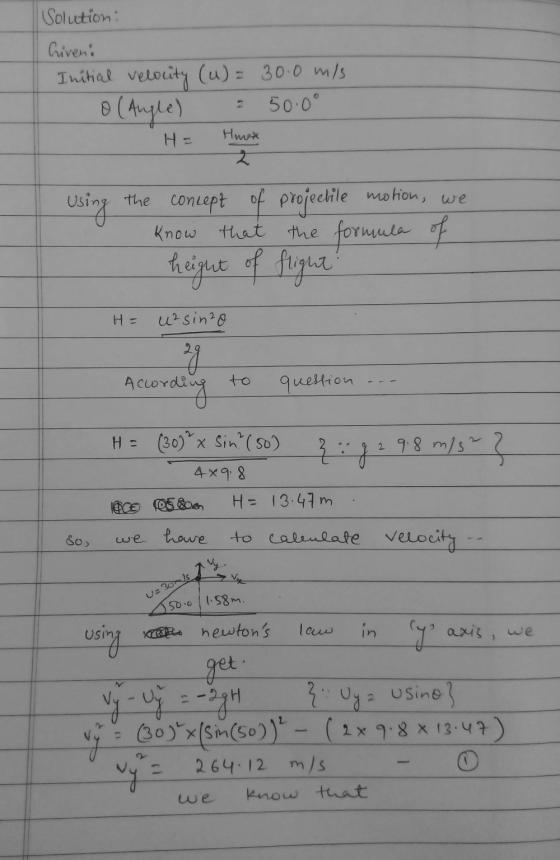
c is correct, The question is solved using the concept of
projectile motion by using the formula of height of flight.
option
c is correct, The question is solved using the concept of
projectile motion by using the formula of height of flight.
Add Answer to:
A high-quality potato cannon can fire a potato with a muzzle speed of 30.0 m/s. If...
A 21.0-kg cannonball is fired from a cannon with muzzle speed of 900 m/s at an...
 A 21.0-kg cannonball is fired from a cannon with muzzle speed of 900 m/s at an angle of 33.0° with the horizontal. A second ball is fired with the same initial speed at an angle of 90.0°. Let y = 0 at the cannon. (a) Use the isolated system model to find the maximum height reached by each ball hfirst ball hsecond ball (b) Use the isolated system model to find the total mechanical energy of the ball-Earth system at...
A 19.0-kg cannonball is fired from a cannon with muzzle speed of 1 050 m/s at...
A 19.0-kg cannonball is fired from a cannon with muzzle speed of 1 050 m/s at an angle of 36.0° with the horizontal. A second ball is fired with the same initial speed at an angle of 90.0°. Let y = 0 at the cannon. (a) Use the isolated system model to find the maximum height reached by each ball. hfirst ball = m hsecond ball = m (b) Use the isolated system model to find the total mechanical energy of the...
A firefighting crew uses a water cannon that shoots water at 30.0 m/s at a fixed...
 A firefighting crew uses a water cannon that shoots water at
30.0 m/s at a fixed angle of 50.0 ∘ above the horizontal. The
firefighters want to direct the water at a blaze that is 12.0 m
above ground level.
How far from the building should they position their cannon?
There are two possibilities (d1<d2); can you get them
both? (Hint: Start with a sketch showing the trajectory of the
water.)
KHomework 5 Ch 03 fall 2019 Item 10 A...
A firefighting crew uses a water cannon that shoots water at
30.0 m/s at a fixed angle of 50.0 ∘ above the horizontal. The
firefighters want to direct the water at a blaze that is 12.0 m
above ground level.
How far from the building should they position their cannon?
There are two possibilities (d1<d2); can you get them
both? (Hint: Start with a sketch showing the trajectory of the
water.)
KHomework 5 Ch 03 fall 2019 Item 10 A...
A firefighting crew uses a water cannon that shoots water at 30.0 m/s at a fixed...
 A firefighting crew uses a water cannon that shoots water at
30.0 m/s at a fixed angle of 52.0 ∘ above the horizontal. The
firefighters want to direct the water at a blaze that is 11.0 m
above ground level.
How far from the building should they position their cannon?
There are two possibilities (d1<d2); can you get them
both? (Hint: Start with a sketch showing the trajectory of the
water.)
<Homework 5 Ch 03 fall 2019 Item 10 A...
A firefighting crew uses a water cannon that shoots water at
30.0 m/s at a fixed angle of 52.0 ∘ above the horizontal. The
firefighters want to direct the water at a blaze that is 11.0 m
above ground level.
How far from the building should they position their cannon?
There are two possibilities (d1<d2); can you get them
both? (Hint: Start with a sketch showing the trajectory of the
water.)
<Homework 5 Ch 03 fall 2019 Item 10 A...
This lecture involves solving the following 2-D kinematic problem A cannon with a muzzle speed of 1,000 m/s i...
 This lecture involves solving the following 2-D kinematic problem A cannon with a muzzle speed of 1,000 m/s is used to start an avalanche on a mountain slope. The target is 3,000 m from the cannon horizontally and 800 m above the cannon. Determine the angle, above the horizontal, that the cannon should be fired. In the space provided below, write out the mathematical expression for the vertical displacement (y) based on the horizontal displacement (x), the angle (0), and...
A rock thrown with speed 7.00 m/s and launch angle 30.0 ∘ (above the horizontal) travels...
A rock thrown with speed 7.00 m/s and launch angle 30.0 ∘ (above the horizontal) travels a horizontal distance of d = 16.0 m before hitting the ground. From what height was the rock thrown? Use the value g = 9.800 m/ s 2 for the free-fall acceleration.Find the height y i from which the rock was launched.
Given that s(t) = - 4.9t2 + 125t represents the distance (m) of an object from...
 Given that s(t) = - 4.9t2 + 125t represents the distance (m) of an object from the ground, t seconds after it was thrown in the air, determine when the object reaches the ground. t= 27.5 s a. t = 20.5 s Ob. t= 25.5 s Oc. t= 26.7 s d. t= 22.5 s Oe. Of. t=23.55 Given that s(t) = -4.9t2 + 132t + 20 represents the distance in meters from the ground t seconds after an object is...
A rock thrown with speed 6.00 m/s and launch angle 30.0 ∘ (above the horizontal) travels...
A rock thrown with speed 6.00 m/s and launch angle 30.0 ∘ (above the horizontal) travels a horizontal distance of d = 16.5 m before hitting the ground. From what height was the rock thrown? Use the value g = 9.800 m/s2 for the free-fall acceleration. Find the height yi from which the rock was launched.
A rock thrown with speed 9.00 m/s and launch angle 30.0 ∘ (above the horizontal) travels...
A rock thrown with speed 9.00 m/s and launch angle 30.0 ∘ (above the horizontal) travels a horizontal distance of d = 20.0 m before hitting the ground. From what height was the rock thrown? Use the value g = 9.800 m/s2 for the free-fall acceleration
A cannon-ball is fired horizontally with a speed vo = 60.0 m/s above the edge of...
A cannon-ball is fired horizontally with a speed vo = 60.0 m/s above the edge of a cliff at point O a height h = 200 m directly above point B on the valley floor. Calculate the following: a. (4) The time t it takes the cannon ball to hit the valley floor at point C. b. (4) The horizontal range R . c. (6) The x- and y-components x v and y v , respectively, of the cannonball velocity...
 A 21.0-kg cannonball is fired from a cannon with muzzle speed of 900 m/s at an angle of 33.0° with the horizontal. A second ball is fired with the same initial speed at an angle of 90.0°. Let y = 0 at the cannon. (a) Use the isolated system model to find the maximum height reached by each ball hfirst ball hsecond ball (b) Use the isolated system model to find the total mechanical energy of the ball-Earth system at...
 A firefighting crew uses a water cannon that shoots water at
30.0 m/s at a fixed angle of 50.0 ∘ above the horizontal. The
firefighters want to direct the water at a blaze that is 12.0 m
above ground level.
How far from the building should they position their cannon?
There are two possibilities (d1<d2); can you get them
both? (Hint: Start with a sketch showing the trajectory of the
water.)
KHomework 5 Ch 03 fall 2019 Item 10 A...
A firefighting crew uses a water cannon that shoots water at
30.0 m/s at a fixed angle of 50.0 ∘ above the horizontal. The
firefighters want to direct the water at a blaze that is 12.0 m
above ground level.
How far from the building should they position their cannon?
There are two possibilities (d1<d2); can you get them
both? (Hint: Start with a sketch showing the trajectory of the
water.)
KHomework 5 Ch 03 fall 2019 Item 10 A...
 A firefighting crew uses a water cannon that shoots water at
30.0 m/s at a fixed angle of 52.0 ∘ above the horizontal. The
firefighters want to direct the water at a blaze that is 11.0 m
above ground level.
How far from the building should they position their cannon?
There are two possibilities (d1<d2); can you get them
both? (Hint: Start with a sketch showing the trajectory of the
water.)
<Homework 5 Ch 03 fall 2019 Item 10 A...
A firefighting crew uses a water cannon that shoots water at
30.0 m/s at a fixed angle of 52.0 ∘ above the horizontal. The
firefighters want to direct the water at a blaze that is 11.0 m
above ground level.
How far from the building should they position their cannon?
There are two possibilities (d1<d2); can you get them
both? (Hint: Start with a sketch showing the trajectory of the
water.)
<Homework 5 Ch 03 fall 2019 Item 10 A...
 This lecture involves solving the following 2-D kinematic problem A cannon with a muzzle speed of 1,000 m/s is used to start an avalanche on a mountain slope. The target is 3,000 m from the cannon horizontally and 800 m above the cannon. Determine the angle, above the horizontal, that the cannon should be fired. In the space provided below, write out the mathematical expression for the vertical displacement (y) based on the horizontal displacement (x), the angle (0), and...
 Given that s(t) = - 4.9t2 + 125t represents the distance (m) of an object from the ground, t seconds after it was thrown in the air, determine when the object reaches the ground. t= 27.5 s a. t = 20.5 s Ob. t= 25.5 s Oc. t= 26.7 s d. t= 22.5 s Oe. Of. t=23.55 Given that s(t) = -4.9t2 + 132t + 20 represents the distance in meters from the ground t seconds after an object is...
Most questions answered within 3 hours.
-
Where is the error in this code sequence?
String s1 = "Hello";
String s2 = "ello";...
asked 10 months ago -
Financial data for Joel de Paris, Inc., for last year
follow:
Joel de Paris, Inc.
Balance...
asked 10 months ago -
Consider this reaction:
Al2(SO4)3 (aq)+ BaCl3
(aq) Al2Cl6 (aq)- +
3BaSO4(s) . What is the...
asked 10 months ago -
Suppose that Savneet is considering increasing her
recent random sample from 20 car rentals to 40...
asked 10 months ago -
Trucks arrive at an unloading terminal at an average rate of 120
per hour.
Trucks arrive...
asked 10 months ago -
Why are methanol and ethanol completely soluble in water while
octanol is not very little soluble....
asked 10 months ago -
A facilities manager at a university reads in a research report
that the mean amount of...
asked 10 months ago -
When the CuSO4 is rehydrated by adding water to the anhydrous
compound, is this an endothermic...
asked 10 months ago -
A ray of sunlight is passing from diamond into crown glass; the
angle of incidence is...
asked 10 months ago -
A block of mass 0.249 kg is placed on top of a light, vertical
spring of...
asked 10 months ago -
how do the kidneys compensate in the presences of acidosis
a) trigger hyperventilate
b) reserve acid...
asked 10 months ago -
Question 501 pts
The rental rate of capital to the firm increases. Which of the
following...
asked 10 months ago