
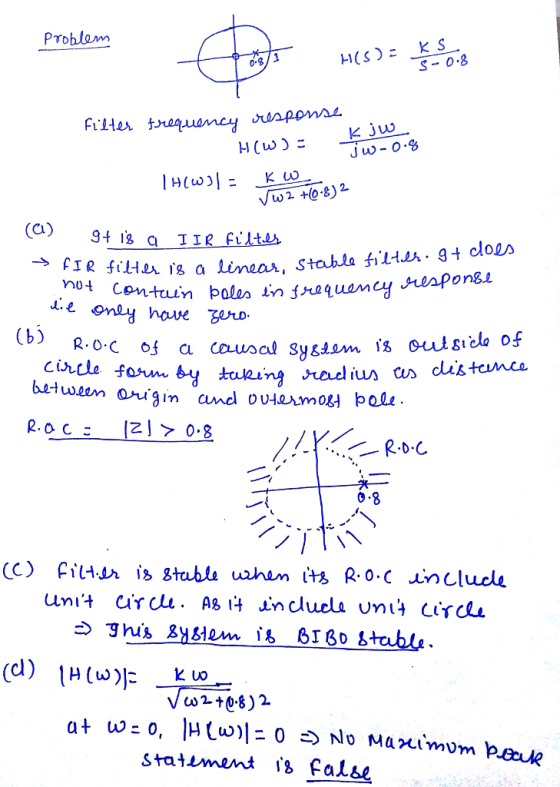
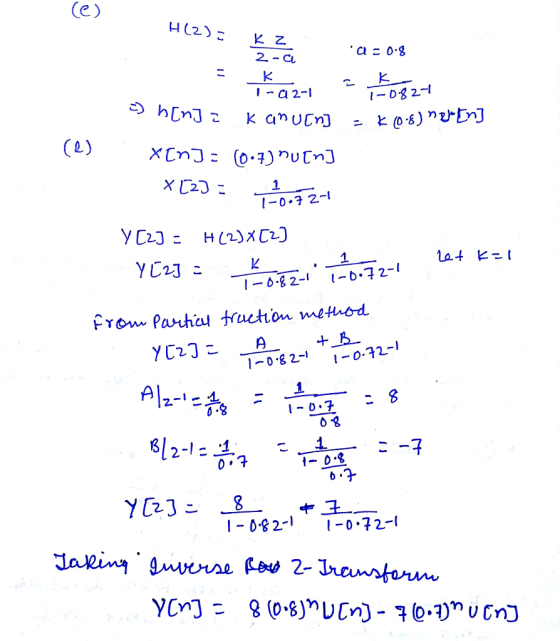
![Using the z-transform and indirect linear convolution, find the response of the filter to the signal: x[n]- 0.7u[n] l) Answer: y[n]](http://img.homeworklib.com/questions/6d9bca80-8a9a-11eb-a27d-adeb4676d047.png?x-oss-process=image/resize,w_560)
Homework Answers
Add Answer to:
Fill all Answer Blanks and show all calculations in a separate sheet of paper. Problem: Given...
Topics: Filter Design by Pole Zero Placement PROBLEM Problem #2 . a) Design a simple FIR...
 Topics: Filter Design by Pole Zero Placement PROBLEM Problem #2 . a) Design a simple FIR second order filter with real coefficients, causal, stable and with unity AC gain. Its steady state response is required to be zero when the input is: xIn]cos [(T/3)n] u[n] H(z) R.O.C: answer: b) Find the frequency response for the previous filter. H(0) c) Sketch the magnitude frequency response. T/3 t/3 d) Find the filter impulse response. h[n] e) Verify that the steady state step...
Problem #1. Topics: Z Transform Find the Z transform of: x[n]=-(0.9 )n-2u-n+5] X(Z) Problem #2. T...
 Problem #1. Topics: Z Transform Find the Z transform of: x[n]=-(0.9 )n-2u-n+5] X(Z) Problem #2. Topics: Filter Design, Effective Time Constant Design a causal 2nd order, normalized, stable Peak Filter centered at fo 1000Hz. Use only two conjugate poles and two zeros at the origin. The system is to be sampled at Fs- 8000Hz. The duration of the transient should be as close as possible to teft 7.5 ms. The transient is assumed to end when the largest pole elevated...
2. Consider a second IIR filter a. Determine the system function H(z), pole-zero location (patterns), and plot the pole-zero pattern. b. Determine the analytical expression for frequency response...
 2. Consider a second IIR filter a. Determine the system function H(z), pole-zero location (patterns), and plot the pole-zero pattern. b. Determine the analytical expression for frequency response, magnitude, and phase response. c. Choose b so that the maximum magnitude response is equal to 1. d. Plot the pole-zero pattern and the magnitude of the frequency response as a function of normal frequency.
2. Consider a second IIR filter a. Determine the system function H(z), pole-zero location (patterns), and plot...
2. Consider a second IIR filter a. Determine the system function H(z), pole-zero location (patterns), and plot the pole-zero pattern. b. Determine the analytical expression for frequency response, magnitude, and phase response. c. Choose b so that the maximum magnitude response is equal to 1. d. Plot the pole-zero pattern and the magnitude of the frequency response as a function of normal frequency.
2. Consider a second IIR filter a. Determine the system function H(z), pole-zero location (patterns), and plot...
Problem 4 Questions about the frequency response of an FIR filter: (a) Determine a formula for th...
 Please show all work
Problem 4 Questions about the frequency response of an FIR filter: (a) Determine a formula for the frequency response of an FIR filter defined by the pole-zero plot below: Pole-Zero Plot #1 0.5 -0.5 -1 1 -0.5 0 051 Real part (b) For the FIR filter in part (a), write a simplified version of the frequency response H(e'ω) and use it to prove that the maximum value of the frequency response magnitude will be at ω-tr/2....
Please show all work
Problem 4 Questions about the frequency response of an FIR filter: (a) Determine a formula for the frequency response of an FIR filter defined by the pole-zero plot below: Pole-Zero Plot #1 0.5 -0.5 -1 1 -0.5 0 051 Real part (b) For the FIR filter in part (a), write a simplified version of the frequency response H(e'ω) and use it to prove that the maximum value of the frequency response magnitude will be at ω-tr/2....
T/2, , and 370|2. 4.22 A four-point Hanning window (filter) has the z transform 1 -z...
 T/2, , and 370|2. 4.22 A four-point Hanning window (filter) has the z transform 1 -z 2>0. H(z) 1 1) (1- +2-2) a. Draw the pole/zero diagram for H(z), noting any pole/zero cancellations. b. Sketch the magnitude response H'(o). c. Show that H(z) is FIR by finding h(n) for all n. d. Find the dc gain of the filter.
T/2, , and 370|2. 4.22 A four-point Hanning window (filter) has the z transform 1 -z 2>0. H(z) 1 1) (1-...
T/2, , and 370|2. 4.22 A four-point Hanning window (filter) has the z transform 1 -z 2>0. H(z) 1 1) (1- +2-2) a. Draw the pole/zero diagram for H(z), noting any pole/zero cancellations. b. Sketch the magnitude response H'(o). c. Show that H(z) is FIR by finding h(n) for all n. d. Find the dc gain of the filter.
T/2, , and 370|2. 4.22 A four-point Hanning window (filter) has the z transform 1 -z 2>0. H(z) 1 1) (1-...
2. Circle the causal BIBO stable ROC below. a) 1.1<\리<1.2 b) Izk1/201zP1/2 d) 0.5<Izl<0.9 e) none...
 2. Circle the causal BIBO stable ROC below. a) 1.1<\리<1.2 b) Izk1/201zP1/2 d) 0.5<Izl<0.9 e) none above 3. A linear time-invariant IIR system is always BIBO stable a) True b) False 4. If a fiter has z-transform H(z)05, then the fiter s ;z>0.5, then the filter is zz-0.5z a) Nonlinear b)FIR )R d) two-sided e) none above 5. The discrete-time frequency o in rad/ sample of the sinusoid hin] below is d) T2 e) none above hIn] -1
(a) A system has the impulse response, h[n], and is excited with the input signal, xIn], as shown below. Using either a mathematical or a graphical convolution technique, determine the outp...
 (a) A system has the impulse response, h[n], and is excited with the input signal, xIn], as shown below. Using either a mathematical or a graphical convolution technique, determine the output of the system, y[n] (that is, evaluate y[n] h[nl'xIn], where" denotes convolution). 17 marks xIn INPUT FIR filter 0.5 0.25 OUTPUT 0 1 345 6 7 .. 0.5 0123 4567 (b) An IIR filter is shown below: ylnl One sample delay (z) 0.4 i) Derive the difference equation describing...
a) The transfer function of an ideal low-pass filter is and its impulse response is where...
 a) The transfer function of an ideal low-pass filter is and its impulse response is where oc is the cut-off frequency i) Is hLP[n] a finite impulse response (FIR) filter or an infinite impulse response filter (IIR)? Explain your answer ii Is hLP[n] a causal or a non-causal filter? Explain your answer iii) If ae-0. IT, plot the magnitude responses for the following impulse responses b) i) Let the five impulse response samples of a causal FIR filter be given...
show all calculations 0.5 a) Hz(2) is a type-3 GLP filter and it has a zero...
 show all calculations
0.5 a) Hz(2) is a type-3 GLP filter and it has a zero at Z - j. Find Hz(Z) b) Convert Hz(2) to Hz(es) then calculate Hz (e)and H, (e- c) What is the relationship between the results of part (a) and part(b)? 0.6 Hap(Z) is a real all-pass filter and it has a pole at Z = + and another pole at Za bmZ- MM M Construct Hap(Z) as one block and without fractions, i.e. H(Z)...
show all calculations
0.5 a) Hz(2) is a type-3 GLP filter and it has a zero at Z - j. Find Hz(Z) b) Convert Hz(2) to Hz(es) then calculate Hz (e)and H, (e- c) What is the relationship between the results of part (a) and part(b)? 0.6 Hap(Z) is a real all-pass filter and it has a pole at Z = + and another pole at Za bmZ- MM M Construct Hap(Z) as one block and without fractions, i.e. H(Z)...
3) Given a filter with the following structure X(n); Hi(Z) y(n) H2(z) H(z) where Hi(2) 11+1+0.09z...
 3) Given a filter with the following structure X(n); Hi(Z) y(n) H2(z) H(z) where Hi(2) 11+1+0.09z and H(z)--4z1+z1+0.09z2] Hi(Z)- 1/[1+z1+ Find the z-transform H(z) and the frequency response H(e2*) . Say if the filter is FIR or IIR, and if it is stable or not » Find the I/O equatio n and draw the block diagram
 Topics: Filter Design by Pole Zero Placement PROBLEM Problem #2 . a) Design a simple FIR second order filter with real coefficients, causal, stable and with unity AC gain. Its steady state response is required to be zero when the input is: xIn]cos [(T/3)n] u[n] H(z) R.O.C: answer: b) Find the frequency response for the previous filter. H(0) c) Sketch the magnitude frequency response. T/3 t/3 d) Find the filter impulse response. h[n] e) Verify that the steady state step...
 Problem #1. Topics: Z Transform Find the Z transform of: x[n]=-(0.9 )n-2u-n+5] X(Z) Problem #2. Topics: Filter Design, Effective Time Constant Design a causal 2nd order, normalized, stable Peak Filter centered at fo 1000Hz. Use only two conjugate poles and two zeros at the origin. The system is to be sampled at Fs- 8000Hz. The duration of the transient should be as close as possible to teft 7.5 ms. The transient is assumed to end when the largest pole elevated...
 2. Consider a second IIR filter a. Determine the system function H(z), pole-zero location (patterns), and plot the pole-zero pattern. b. Determine the analytical expression for frequency response, magnitude, and phase response. c. Choose b so that the maximum magnitude response is equal to 1. d. Plot the pole-zero pattern and the magnitude of the frequency response as a function of normal frequency.
2. Consider a second IIR filter a. Determine the system function H(z), pole-zero location (patterns), and plot...
2. Consider a second IIR filter a. Determine the system function H(z), pole-zero location (patterns), and plot the pole-zero pattern. b. Determine the analytical expression for frequency response, magnitude, and phase response. c. Choose b so that the maximum magnitude response is equal to 1. d. Plot the pole-zero pattern and the magnitude of the frequency response as a function of normal frequency.
2. Consider a second IIR filter a. Determine the system function H(z), pole-zero location (patterns), and plot...
 Please show all work
Problem 4 Questions about the frequency response of an FIR filter: (a) Determine a formula for the frequency response of an FIR filter defined by the pole-zero plot below: Pole-Zero Plot #1 0.5 -0.5 -1 1 -0.5 0 051 Real part (b) For the FIR filter in part (a), write a simplified version of the frequency response H(e'ω) and use it to prove that the maximum value of the frequency response magnitude will be at ω-tr/2....
Please show all work
Problem 4 Questions about the frequency response of an FIR filter: (a) Determine a formula for the frequency response of an FIR filter defined by the pole-zero plot below: Pole-Zero Plot #1 0.5 -0.5 -1 1 -0.5 0 051 Real part (b) For the FIR filter in part (a), write a simplified version of the frequency response H(e'ω) and use it to prove that the maximum value of the frequency response magnitude will be at ω-tr/2....
 T/2, , and 370|2. 4.22 A four-point Hanning window (filter) has the z transform 1 -z 2>0. H(z) 1 1) (1- +2-2) a. Draw the pole/zero diagram for H(z), noting any pole/zero cancellations. b. Sketch the magnitude response H'(o). c. Show that H(z) is FIR by finding h(n) for all n. d. Find the dc gain of the filter.
T/2, , and 370|2. 4.22 A four-point Hanning window (filter) has the z transform 1 -z 2>0. H(z) 1 1) (1-...
T/2, , and 370|2. 4.22 A four-point Hanning window (filter) has the z transform 1 -z 2>0. H(z) 1 1) (1- +2-2) a. Draw the pole/zero diagram for H(z), noting any pole/zero cancellations. b. Sketch the magnitude response H'(o). c. Show that H(z) is FIR by finding h(n) for all n. d. Find the dc gain of the filter.
T/2, , and 370|2. 4.22 A four-point Hanning window (filter) has the z transform 1 -z 2>0. H(z) 1 1) (1-...
 2. Circle the causal BIBO stable ROC below. a) 1.1<\리<1.2 b) Izk1/201zP1/2 d) 0.5<Izl<0.9 e) none above 3. A linear time-invariant IIR system is always BIBO stable a) True b) False 4. If a fiter has z-transform H(z)05, then the fiter s ;z>0.5, then the filter is zz-0.5z a) Nonlinear b)FIR )R d) two-sided e) none above 5. The discrete-time frequency o in rad/ sample of the sinusoid hin] below is d) T2 e) none above hIn] -1
 (a) A system has the impulse response, h[n], and is excited with the input signal, xIn], as shown below. Using either a mathematical or a graphical convolution technique, determine the output of the system, y[n] (that is, evaluate y[n] h[nl'xIn], where" denotes convolution). 17 marks xIn INPUT FIR filter 0.5 0.25 OUTPUT 0 1 345 6 7 .. 0.5 0123 4567 (b) An IIR filter is shown below: ylnl One sample delay (z) 0.4 i) Derive the difference equation describing...
 a) The transfer function of an ideal low-pass filter is and its impulse response is where oc is the cut-off frequency i) Is hLP[n] a finite impulse response (FIR) filter or an infinite impulse response filter (IIR)? Explain your answer ii Is hLP[n] a causal or a non-causal filter? Explain your answer iii) If ae-0. IT, plot the magnitude responses for the following impulse responses b) i) Let the five impulse response samples of a causal FIR filter be given...
 show all calculations
0.5 a) Hz(2) is a type-3 GLP filter and it has a zero at Z - j. Find Hz(Z) b) Convert Hz(2) to Hz(es) then calculate Hz (e)and H, (e- c) What is the relationship between the results of part (a) and part(b)? 0.6 Hap(Z) is a real all-pass filter and it has a pole at Z = + and another pole at Za bmZ- MM M Construct Hap(Z) as one block and without fractions, i.e. H(Z)...
show all calculations
0.5 a) Hz(2) is a type-3 GLP filter and it has a zero at Z - j. Find Hz(Z) b) Convert Hz(2) to Hz(es) then calculate Hz (e)and H, (e- c) What is the relationship between the results of part (a) and part(b)? 0.6 Hap(Z) is a real all-pass filter and it has a pole at Z = + and another pole at Za bmZ- MM M Construct Hap(Z) as one block and without fractions, i.e. H(Z)...
 3) Given a filter with the following structure X(n); Hi(Z) y(n) H2(z) H(z) where Hi(2) 11+1+0.09z and H(z)--4z1+z1+0.09z2] Hi(Z)- 1/[1+z1+ Find the z-transform H(z) and the frequency response H(e2*) . Say if the filter is FIR or IIR, and if it is stable or not » Find the I/O equatio n and draw the block diagram
Most questions answered within 3 hours.
-
Where is the error in this code sequence?
String s1 = "Hello";
String s2 = "ello";...
asked 11 months ago -
Financial data for Joel de Paris, Inc., for last year
follow:
Joel de Paris, Inc.
Balance...
asked 11 months ago -
Consider this reaction:
Al2(SO4)3 (aq)+ BaCl3
(aq) Al2Cl6 (aq)- +
3BaSO4(s) . What is the...
asked 11 months ago -
Suppose that Savneet is considering increasing her
recent random sample from 20 car rentals to 40...
asked 11 months ago -
Trucks arrive at an unloading terminal at an average rate of 120
per hour.
Trucks arrive...
asked 11 months ago -
Why are methanol and ethanol completely soluble in water while
octanol is not very little soluble....
asked 11 months ago -
A facilities manager at a university reads in a research report
that the mean amount of...
asked 11 months ago -
When the CuSO4 is rehydrated by adding water to the anhydrous
compound, is this an endothermic...
asked 11 months ago -
A ray of sunlight is passing from diamond into crown glass; the
angle of incidence is...
asked 11 months ago -
A block of mass 0.249 kg is placed on top of a light, vertical
spring of...
asked 11 months ago -
how do the kidneys compensate in the presences of acidosis
a) trigger hyperventilate
b) reserve acid...
asked 11 months ago -
Question 501 pts
The rental rate of capital to the firm increases. Which of the
following...
asked 11 months ago