Do some research and then describe the operation of a spring-coil galvanometer.
Do some research and then describe the operation of a spring-coil galvanometer.
Homework Answers
to explain the operation of a spring-coil galvanometer
if the galvanometer having N coils that carry current kept in strong magnets
due to the coil rotates the rorque will be generated
that torque is  = k
= k 
and
= N i A B
by equating
N i A B = k
/ i = N A B /
k
Add Answer to:
Do some research and then describe the operation of a
spring-coil galvanometer.
423. In the illustration, a hollow coil of coated wire is connected to a galvanometer that...
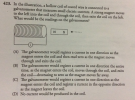 423. In the illustration, a hollow coil of coated wire is connected to a galvanometer that measures small electric currents. A strong magnet moves to the left into the coil and through the coil, then exits the coil on the left. What would be the readings on the galvanometer? N S (A) The galvanometer would register a current in one direction as the (B) The galvanometer would register a current in one direction the entire (C) The galvanometer would register...
A coil of wire is connected to a galvanometer as shown. A magnet is held stationary...
A coil of wire is connected to a galvanometer as shown. A magnet is held stationary above the coil. Under what circumstances will the galvanometer indicate a current?
A galvanometer with a coil resistance of 16.3 is used with a shunt resistor to make...
A galvanometer with a coil resistance of 16.3 is used with a shunt resistor to make a nondigital ammeter that has an equivalent resistance of 0.817 . The current in the shunt resistor is 3.97 mA when the galvanometer reads full scale. Find the full-scale current of the galvanometer.
A galvanometer with a coil resistance of 16.3 is used with a shunt resistor to make...
A galvanometer with a coil resistance of 16.3 is used with a shunt resistor to make a nondigital ammeter that has an equivalent resistance of 0.817 . The current in the shunt resistor is 3.97 mA when the galvanometer reads full scale. Find the full-scale current of the galvanometer.
A galvanometer has a coil resistance of Rgalv = 13.9 ?. It is to be made...
A galvanometer has a coil resistance of Rgalv = 13.9 ?. It is to be made into a voltmeter with a full-scale voltage equal to V = 325.0 V. If the galvanometer deflects full scale for a current of Igalv = 245.5 mA, what size additional resistor should be used?
A galvanometer has a coil resistance of ?galv=27.4 Ω . It is to be made into...
 A galvanometer has a coil resistance of ?galv=27.4 Ω . It is
to be made into a voltmeter with a full‑scale voltage equal to
?=225.0 V. If the galvanometer deflects full scale for a current of
?galv=255.5 mA, what size additional resistor should be used?
additional resistor size:
ople Window Help Jump to... ersity-PHYS 1010/1133-Winter19-MACKAY> Activities and Due Dates> D Assignment Score: s00/1700 Resources Hint Check Answer Question 14 of 17> eter has a coil resistance of R.-274 Ω. It...
A galvanometer has a coil resistance of ?galv=27.4 Ω . It is
to be made into a voltmeter with a full‑scale voltage equal to
?=225.0 V. If the galvanometer deflects full scale for a current of
?galv=255.5 mA, what size additional resistor should be used?
additional resistor size:
ople Window Help Jump to... ersity-PHYS 1010/1133-Winter19-MACKAY> Activities and Due Dates> D Assignment Score: s00/1700 Resources Hint Check Answer Question 14 of 17> eter has a coil resistance of R.-274 Ω. It...
The coil of wire in a galvanometer has a resistance of RC = 75.0 Ω. The...
The coil of wire in a galvanometer has a resistance of RC = 75.0 Ω. The galvanometer exhibits a full-scale deflection when the current through it is 0.200 mA. A resistor is connected in series with this combination so as to produce a voltmeter. The voltmeter is to have a full-scale deflection when it measures a potential difference of 14.0 V. What is the resistance of this resistor?
Moving a magnet in and out of a coil will make the needle on a galvanometer...
Moving a magnet in and out of a coil will make the needle on a galvanometer move to each side. a) explain what is happening in terms of magnetic induction. b) what would it take to induce an emf that stays positive, or that stays negative? is it possible? c) how can you get the largest possible deflection of the needle? explain what you do in terms of the magnetic field of the magnet, and the induced emf.
A galvanometer has a coil resistance of 20 Ω . A current of 200 μA deflects...
A galvanometer has a coil resistance of 20 Ω . A current of 200 μA deflects the needle through ten divisions at full scale. Part A What resistance is needed to convert the galvanometer to a full-scale 11 V voltmeter? the answer needs to be in kΩ
A galvanometer has a coil with a resistance of 24.0 ?, and a current of 180 ?A causes it to deflect full scale. If this...
A galvanometer has a coil with a resistance of 24.0 ?, and a current of 180 ?A causes it to deflect full scale. If this galvanometer is to be used to construct an ammeter that can read up to 10.0 A, what shunt resistor in micro-ohms is required?
 423. In the illustration, a hollow coil of coated wire is connected to a galvanometer that measures small electric currents. A strong magnet moves to the left into the coil and through the coil, then exits the coil on the left. What would be the readings on the galvanometer? N S (A) The galvanometer would register a current in one direction as the (B) The galvanometer would register a current in one direction the entire (C) The galvanometer would register...
 A galvanometer has a coil resistance of ?galv=27.4 Ω . It is
to be made into a voltmeter with a full‑scale voltage equal to
?=225.0 V. If the galvanometer deflects full scale for a current of
?galv=255.5 mA, what size additional resistor should be used?
additional resistor size:
ople Window Help Jump to... ersity-PHYS 1010/1133-Winter19-MACKAY> Activities and Due Dates> D Assignment Score: s00/1700 Resources Hint Check Answer Question 14 of 17> eter has a coil resistance of R.-274 Ω. It...
A galvanometer has a coil resistance of ?galv=27.4 Ω . It is
to be made into a voltmeter with a full‑scale voltage equal to
?=225.0 V. If the galvanometer deflects full scale for a current of
?galv=255.5 mA, what size additional resistor should be used?
additional resistor size:
ople Window Help Jump to... ersity-PHYS 1010/1133-Winter19-MACKAY> Activities and Due Dates> D Assignment Score: s00/1700 Resources Hint Check Answer Question 14 of 17> eter has a coil resistance of R.-274 Ω. It...
Most questions answered within 3 hours.
-
Where is the error in this code sequence?
String s1 = "Hello";
String s2 = "ello";...
asked 10 months ago -
Financial data for Joel de Paris, Inc., for last year
follow:
Joel de Paris, Inc.
Balance...
asked 10 months ago -
Consider this reaction:
Al2(SO4)3 (aq)+ BaCl3
(aq) Al2Cl6 (aq)- +
3BaSO4(s) . What is the...
asked 10 months ago -
Suppose that Savneet is considering increasing her
recent random sample from 20 car rentals to 40...
asked 10 months ago -
Trucks arrive at an unloading terminal at an average rate of 120
per hour.
Trucks arrive...
asked 10 months ago -
Why are methanol and ethanol completely soluble in water while
octanol is not very little soluble....
asked 10 months ago -
A facilities manager at a university reads in a research report
that the mean amount of...
asked 10 months ago -
When the CuSO4 is rehydrated by adding water to the anhydrous
compound, is this an endothermic...
asked 10 months ago -
A ray of sunlight is passing from diamond into crown glass; the
angle of incidence is...
asked 10 months ago -
A block of mass 0.249 kg is placed on top of a light, vertical
spring of...
asked 10 months ago -
how do the kidneys compensate in the presences of acidosis
a) trigger hyperventilate
b) reserve acid...
asked 10 months ago -
Question 501 pts
The rental rate of capital to the firm increases. Which of the
following...
asked 10 months ago