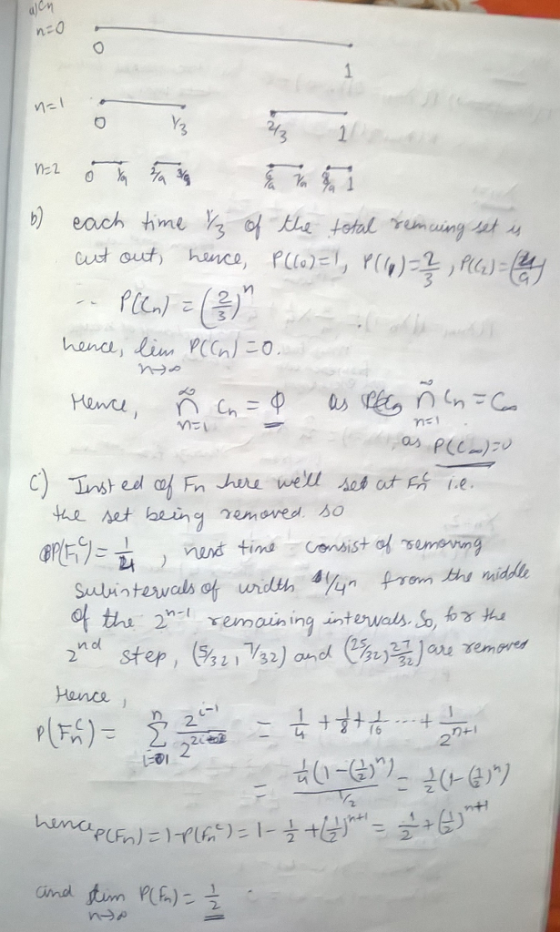
![Consider the sample space Ω-10, 1]. Let P be a probability function such that for any interval [a, b], P([a, b) b- a. In other words, probabilty of any interval is its length. Let us start with Co 10, 1], and at nth step, we define C, by removing an interval of length 1/3° from the middle of each interval in Cn-1. For example, G = [0, 1/3ju [2/3, 11, c2 [0, 1/9] U [2/9, 1/3] U [2/3,7/9] U [8/9, 11 and so on. Here is a different description. Let Fo = 10, 11 and at step n, we define Fn by removing the middle (1/4) from the middle of each interval of FT-1. For example, F-[03/8ju (5/8,1], F2[0, 5/32] U [7/32,3/8 U[5/8, 25/32 U [27/32, 1] a. Plot Cn for n = 0, 1, 2 b. What is P(Cn)? What is limnt P(Cn)? Is n? c. What is P(F)? What is limn P(Fn)? d. no=0Cn is called the Cantor set and no-0F, is called the fat cantor set. Can you explain why the second object is named fat?](http://img.homeworklib.com/questions/30535150-8b36-11eb-8a7e-fd89c23330d8.png?x-oss-process=image/resize,w_560)
Homework Answers
b) here the second set its called fat because the intersection of the set is not 0.
please leave a comment if you find any difficulty with the solution.
Add Answer to:
Consider the sample space Ω-10, 1]. Let P be a probability function such that for any...
5. Consider the sample space Ω = [0, 1]. Let P be a probability function such...
 5. Consider the sample space Ω = [0, 1]. Let P be a probability function such that for any interval fa, b, P(a, b-b-a. In other words, probabilty of any interval is its length Let us start with Co [0, 1, and at nth step, we define Cn by removing an interval of length 1/3 from the middle of each interval in Cn-1 For example, C1-[0, 1/3 u [2/3,1], C2-[0,1/9)U[2/9,1/3 U [2/3,7/9 U[8/9, 1] and so on. Here is a...
Let X = ℝ with the standard topology and I = [0, 1]. Let F1 be...
 Let X = ℝ with the standard topology and I = [0, 1]. Let F1 be
the subset of I formed by removing the open middle third (1/3,
2/3). Then F1 = [0, 1/3]⋃[2/3, 1] Next, let F2 be the subset of F1
formed by removing the open middle thirds (1/9, 2/9) and (7/9, 8/9)
of the two components of F1. Then F2 = [0, 1/9] ⋃[2/9, 1/3] ⋃[2/3,
7/9] ⋃[8/9, 1] Continuing this manner, let Fn+1be the subset of...
Let X = ℝ with the standard topology and I = [0, 1]. Let F1 be
the subset of I formed by removing the open middle third (1/3,
2/3). Then F1 = [0, 1/3]⋃[2/3, 1] Next, let F2 be the subset of F1
formed by removing the open middle thirds (1/9, 2/9) and (7/9, 8/9)
of the two components of F1. Then F2 = [0, 1/9] ⋃[2/9, 1/3] ⋃[2/3,
7/9] ⋃[8/9, 1] Continuing this manner, let Fn+1be the subset of...
Let P be some probability measure on sample space S = [0, 1]. (a) Prove that...
Let P be some probability measure on sample space S = [0, 1]. (a) Prove that we must have limn→∞ P((0, 1/n) = 0. (b) Show by example that we might have limn→∞ P ([0, 1/n)) > 0.
Problem 5 Let U be an n dimensional vector space and T E L(U,U). Let I...
 Problem 5 Let U be an n dimensional vector space and T E L(U,U). Let I denote the identity transformation I(u) = u for each u EU and let 0 denote the zero transformation. Show that there is a natural number N, and constants C1, ..., CN+1 such that C1I + c2T + ... + CN+1TN = 0 (Hint: Given dim(U) = n, what is the dimension of L(U,U)? consider ciI + c2T + ... + Cn+11'" = 0, where...
Consider the construction of the Cantor set C c [0, 1] In the st step we...
 Consider the construction of the Cantor set C c [0, 1] In the st step we remove the open interval (, ) ad are left with two closed intervals [0· and [릎,1]. Let J1 denote one of these two closed intervals. In the 2nd step, we divide J into three intervals and remove the open middle third interval. We are left with two closed intervals inside J. Let J2 denote one of these two intervals. For example, if Ji were...
Please all thank you Exercise 25: Let f 0,R be defined by f(x)-1/n, m, with m,nENand n is the minimal n such that m/n a) Show that L(f, P)0 for all partitions P of [0, 1] b) Let mE N. Show that t...
 Please all thank you
Exercise 25: Let f 0,R be defined by f(x)-1/n, m, with m,nENand n is the minimal n such that m/n a) Show that L(f, P)0 for all partitions P of [0, 1] b) Let mE N. Show that the cardinality of the set A bounded by m(m1)/2. e [0, 1]: f(x) > 1/m) is c) Given m E N construct a partition P such that U(f, Pm)2/m. d) Show that f is integrable and compute Jo...
Please all thank you
Exercise 25: Let f 0,R be defined by f(x)-1/n, m, with m,nENand n is the minimal n such that m/n a) Show that L(f, P)0 for all partitions P of [0, 1] b) Let mE N. Show that the cardinality of the set A bounded by m(m1)/2. e [0, 1]: f(x) > 1/m) is c) Given m E N construct a partition P such that U(f, Pm)2/m. d) Show that f is integrable and compute Jo...
1. (10 marks) (a) Let m events Bi, , Bm form a partition of the sample space Ω and let event A be...
 1. (10 marks) (a) Let m events Bi, , Bm form a partition of the sample space Ω and let event A be any event such that A c S2. Then show that given Bi > 0 for j = 1,.. ., m (b) Considcr a clinical trial where group of paticnts arc trcated for depression. As in many such trials a patient has two possible out- comes, in this study a relapse and no relapse. Refer to a relapse...
8 arbitrary set. K is Cousider E} n=1 nieU and Let (X, K) be a measure space where X is an sigma-algebra of subsets...
 8 arbitrary set. K is Cousider E} n=1 nieU and Let (X, K) be a measure space where X is an sigma-algebra of subsets of X and is a measure sequenc o clemenis of K We delin lim supn(Fn) liminfn(En)- U then prove: (a) lim in(E)) lim inf(u(E,) (b) T J (c) If sum E,)x, then (lim sup(E)) = 0 x X) <oc lor somc nE N, then lim supn (Fn)> lim sup(u(F,n ))
8 arbitrary set. K is Cousider...
8 arbitrary set. K is Cousider E} n=1 nieU and Let (X, K) be a measure space where X is an sigma-algebra of subsets of X and is a measure sequenc o clemenis of K We delin lim supn(Fn) liminfn(En)- U then prove: (a) lim in(E)) lim inf(u(E,) (b) T J (c) If sum E,)x, then (lim sup(E)) = 0 x X) <oc lor somc nE N, then lim supn (Fn)> lim sup(u(F,n ))
8 arbitrary set. K is Cousider...
5. Let Ω = { 1, 2, 3, . j be the countably infinite sample space...
 5. Let Ω = { 1, 2, 3, . j be the countably infinite sample space whose elements (outcomes) are the positive integers. For each positive integer n, define the event An k k is a multiple of n \ (a) Find n and m such that An-Ag n A4 and Am-A6 A9. (b) If P((k]) -fnd the probability of the event As k-1 Note: an exact answer is required here; if you write a program to obtain answers of...
Consider a DTMC X;n 2 0 with state space E 0,1,2,... ,N), and transition probability matrix P = (...
 Consider a DTMC X;n 2 0 with state space E 0,1,2,... ,N), and transition probability matrix P = (pij). Define T = min(n > 0 : Xn-0), and vi(n) = P(T > n|X0 = i). Use the first-step analysis to show that vi (72), t"2(n), . . . , UN(n)) = where B is a submatrix of P obtained by deleting the row and column corresponding to the state 0. Hint: First establish a recursive formula v(n )-ΣΝ1pijuj(n-1).
Consider a...
Consider a DTMC X;n 2 0 with state space E 0,1,2,... ,N), and transition probability matrix P = (pij). Define T = min(n > 0 : Xn-0), and vi(n) = P(T > n|X0 = i). Use the first-step analysis to show that vi (72), t"2(n), . . . , UN(n)) = where B is a submatrix of P obtained by deleting the row and column corresponding to the state 0. Hint: First establish a recursive formula v(n )-ΣΝ1pijuj(n-1).
Consider a...
 5. Consider the sample space Ω = [0, 1]. Let P be a probability function such that for any interval fa, b, P(a, b-b-a. In other words, probabilty of any interval is its length Let us start with Co [0, 1, and at nth step, we define Cn by removing an interval of length 1/3 from the middle of each interval in Cn-1 For example, C1-[0, 1/3 u [2/3,1], C2-[0,1/9)U[2/9,1/3 U [2/3,7/9 U[8/9, 1] and so on. Here is a...
 Let X = ℝ with the standard topology and I = [0, 1]. Let F1 be
the subset of I formed by removing the open middle third (1/3,
2/3). Then F1 = [0, 1/3]⋃[2/3, 1] Next, let F2 be the subset of F1
formed by removing the open middle thirds (1/9, 2/9) and (7/9, 8/9)
of the two components of F1. Then F2 = [0, 1/9] ⋃[2/9, 1/3] ⋃[2/3,
7/9] ⋃[8/9, 1] Continuing this manner, let Fn+1be the subset of...
Let X = ℝ with the standard topology and I = [0, 1]. Let F1 be
the subset of I formed by removing the open middle third (1/3,
2/3). Then F1 = [0, 1/3]⋃[2/3, 1] Next, let F2 be the subset of F1
formed by removing the open middle thirds (1/9, 2/9) and (7/9, 8/9)
of the two components of F1. Then F2 = [0, 1/9] ⋃[2/9, 1/3] ⋃[2/3,
7/9] ⋃[8/9, 1] Continuing this manner, let Fn+1be the subset of...
 Problem 5 Let U be an n dimensional vector space and T E L(U,U). Let I denote the identity transformation I(u) = u for each u EU and let 0 denote the zero transformation. Show that there is a natural number N, and constants C1, ..., CN+1 such that C1I + c2T + ... + CN+1TN = 0 (Hint: Given dim(U) = n, what is the dimension of L(U,U)? consider ciI + c2T + ... + Cn+11'" = 0, where...
 Consider the construction of the Cantor set C c [0, 1] In the st step we remove the open interval (, ) ad are left with two closed intervals [0· and [릎,1]. Let J1 denote one of these two closed intervals. In the 2nd step, we divide J into three intervals and remove the open middle third interval. We are left with two closed intervals inside J. Let J2 denote one of these two intervals. For example, if Ji were...
 Please all thank you
Exercise 25: Let f 0,R be defined by f(x)-1/n, m, with m,nENand n is the minimal n such that m/n a) Show that L(f, P)0 for all partitions P of [0, 1] b) Let mE N. Show that the cardinality of the set A bounded by m(m1)/2. e [0, 1]: f(x) > 1/m) is c) Given m E N construct a partition P such that U(f, Pm)2/m. d) Show that f is integrable and compute Jo...
Please all thank you
Exercise 25: Let f 0,R be defined by f(x)-1/n, m, with m,nENand n is the minimal n such that m/n a) Show that L(f, P)0 for all partitions P of [0, 1] b) Let mE N. Show that the cardinality of the set A bounded by m(m1)/2. e [0, 1]: f(x) > 1/m) is c) Given m E N construct a partition P such that U(f, Pm)2/m. d) Show that f is integrable and compute Jo...
 1. (10 marks) (a) Let m events Bi, , Bm form a partition of the sample space Ω and let event A be any event such that A c S2. Then show that given Bi > 0 for j = 1,.. ., m (b) Considcr a clinical trial where group of paticnts arc trcated for depression. As in many such trials a patient has two possible out- comes, in this study a relapse and no relapse. Refer to a relapse...
 8 arbitrary set. K is Cousider E} n=1 nieU and Let (X, K) be a measure space where X is an sigma-algebra of subsets of X and is a measure sequenc o clemenis of K We delin lim supn(Fn) liminfn(En)- U then prove: (a) lim in(E)) lim inf(u(E,) (b) T J (c) If sum E,)x, then (lim sup(E)) = 0 x X) <oc lor somc nE N, then lim supn (Fn)> lim sup(u(F,n ))
8 arbitrary set. K is Cousider...
8 arbitrary set. K is Cousider E} n=1 nieU and Let (X, K) be a measure space where X is an sigma-algebra of subsets of X and is a measure sequenc o clemenis of K We delin lim supn(Fn) liminfn(En)- U then prove: (a) lim in(E)) lim inf(u(E,) (b) T J (c) If sum E,)x, then (lim sup(E)) = 0 x X) <oc lor somc nE N, then lim supn (Fn)> lim sup(u(F,n ))
8 arbitrary set. K is Cousider...
 5. Let Ω = { 1, 2, 3, . j be the countably infinite sample space whose elements (outcomes) are the positive integers. For each positive integer n, define the event An k k is a multiple of n \ (a) Find n and m such that An-Ag n A4 and Am-A6 A9. (b) If P((k]) -fnd the probability of the event As k-1 Note: an exact answer is required here; if you write a program to obtain answers of...
 Consider a DTMC X;n 2 0 with state space E 0,1,2,... ,N), and transition probability matrix P = (pij). Define T = min(n > 0 : Xn-0), and vi(n) = P(T > n|X0 = i). Use the first-step analysis to show that vi (72), t"2(n), . . . , UN(n)) = where B is a submatrix of P obtained by deleting the row and column corresponding to the state 0. Hint: First establish a recursive formula v(n )-ΣΝ1pijuj(n-1).
Consider a...
Consider a DTMC X;n 2 0 with state space E 0,1,2,... ,N), and transition probability matrix P = (pij). Define T = min(n > 0 : Xn-0), and vi(n) = P(T > n|X0 = i). Use the first-step analysis to show that vi (72), t"2(n), . . . , UN(n)) = where B is a submatrix of P obtained by deleting the row and column corresponding to the state 0. Hint: First establish a recursive formula v(n )-ΣΝ1pijuj(n-1).
Consider a...
Most questions answered within 3 hours.
-
Where is the error in this code sequence?
String s1 = "Hello";
String s2 = "ello";...
asked 10 months ago -
Financial data for Joel de Paris, Inc., for last year
follow:
Joel de Paris, Inc.
Balance...
asked 10 months ago -
Consider this reaction:
Al2(SO4)3 (aq)+ BaCl3
(aq) Al2Cl6 (aq)- +
3BaSO4(s) . What is the...
asked 10 months ago -
Suppose that Savneet is considering increasing her
recent random sample from 20 car rentals to 40...
asked 10 months ago -
Trucks arrive at an unloading terminal at an average rate of 120
per hour.
Trucks arrive...
asked 10 months ago -
Why are methanol and ethanol completely soluble in water while
octanol is not very little soluble....
asked 10 months ago -
A facilities manager at a university reads in a research report
that the mean amount of...
asked 10 months ago -
When the CuSO4 is rehydrated by adding water to the anhydrous
compound, is this an endothermic...
asked 10 months ago -
A ray of sunlight is passing from diamond into crown glass; the
angle of incidence is...
asked 10 months ago -
A block of mass 0.249 kg is placed on top of a light, vertical
spring of...
asked 10 months ago -
how do the kidneys compensate in the presences of acidosis
a) trigger hyperventilate
b) reserve acid...
asked 10 months ago -
Question 501 pts
The rental rate of capital to the firm increases. Which of the
following...
asked 10 months ago